
Executive summary
Software has not simply become more expensive. The unit being sold has changed. A vendor once sold perpetual use of a particular version; today it sells an ongoing relationship that combines access, updates, cloud storage, collaboration, security maintenance, support, and, increasingly, AI credits.1, 16
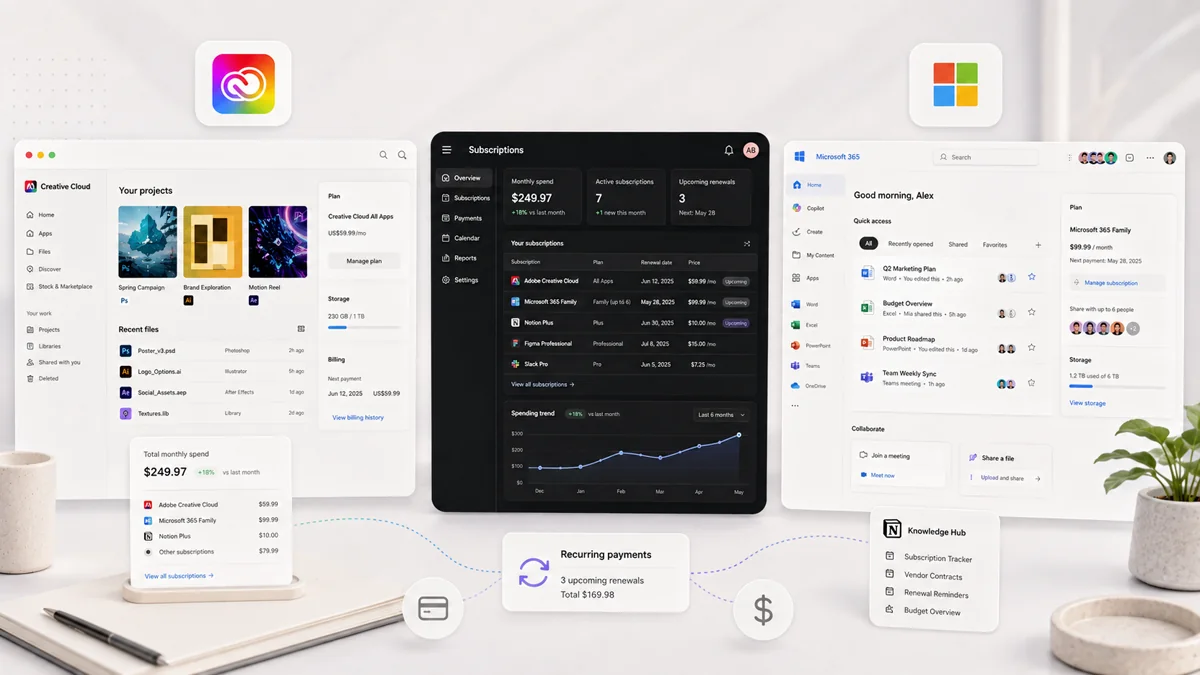
This change lowers the threshold for first-time purchases, but turns the original occasional large expenditures into long-term, automatically renewed, and continuously superimposed small expenditures. For manufacturers, revenue has therefore become predictable; for users, the cost has changed from "should I buy a new version" to "can I stop paying". Adobe clearly admitted in the early stages of its transformation that moving from perpetual licenses to subscriptions will reduce revenue and cash flow in the short term, but it can generate sustainable revenue in the long term; by fiscal 2025, Adobe's subscription revenue has reached $22.904 billion, accounting for about 96% of total revenue.3, 4
The core conclusions of this article can be summarized as follows:1, 16
| Core issues | Conclusion |
|---|---|
| Why does software continue to appear more expensive? | Not only has the unit price increased, but also because the billing dimension has expanded from "version" to the number of users, functional levels, storage capacity, call volume, AI credits and add-on components, the actual total cost of ownership has become increasingly difficult to express by a price. |
| Are subscriptions purely about extracting profits from manufacturers? | no. Cloud infrastructure, security maintenance, support, synchronization and artificial intelligence inference all incur ongoing costs; but subscriptions do enhance the vendor's pricing power, bundling capabilities and customer lock-in capabilities. |
| What does the user get? | Lower first-time threshold, continuous updates, multi-device access, collaboration and cloud services; but it also loses the ability to freeze versions, stop upgrades and continue to use them, and completely control the upgrade rhythm. |
| Why do businesses accept subscriptions? | SaaS outsources infrastructure and software maintenance to the vendor and typically converts the main payment into recurring operating expenses; but "converting from capital expenditures to operating expenses" is only an approximation, and some implementation costs may still be capitalized. |
| What's the next stage? | Instead of returning to permanent licensing, we are moving towards “basic subscription + AI credits + pay-as-you-go + large package bundle”. Software bills will look more like cloud computing bills than traditional commodity prices. |
The prices listed in the article are based on the U.S. public prices available before August 2, 2026, excluding taxes, corporate discounts, promotions, exchange rates and regional pricing differences. Data that are not disclosed by the manufacturer or cannot be reliably compared are marked as "not disclosed" or "not directly comparable."15
From buying software to renting a capability
In the era of traditional desktop software, users usually purchased a perpetual license for a certain version. The so-called "permanent" does not mean that the supplier must maintain it permanently, but that users can in principle run this version as long as the device and operating system are still compatible. To get the next big chunk of revenue, manufacturers must convince users to buy the upgrade. Therefore, a version release is a business event in itself: the new features must be enough to justify the cost of the upgrade.1, 16
Several transitional models emerged: low-priced or one-time purchase mobile apps; Freemium with free basics plus paid premium features; perpetual licenses plus annual maintenance contracts; and subscription models that provide updates on an annual or monthly basis. They change not just the frequency of payments, but also the allocation of risk between vendors and users.1, 16
| Pricing model | Why users pay | Manufacturer revenue characteristics | User control | Main risks |
|---|---|---|---|---|
| perpetual license | Get long-term rights to a specific version | Revenue is focused on release and upgrade cycles | Higher, freezeable version | High initial price; aging versions, reduced security and compatibility |
| One time low price purchase | Get a single app or limited functionality | Single time, low customer unit price | Middle to high | The manufacturer lacks motivation for follow-up maintenance |
| Perpetual license + maintenance | Get a version and purchase updates and support | Licensing revenue plus relatively stable maintenance fees | medium | The contract is complex and the boundaries between upgrades and maintenance are easily blurred. |
| Freemium | Use basic features for free, pay for advanced capabilities | Rely on a small number of paying users for conversion | medium | Free tier may be cut; product designed around conversion rates |
| fixed subscription | Pay for ongoing access, updates and services | Regular, predictable | lower | Cumulative costs are high; stopping payments often means loss of service access |
| Pay as you go | Pay by storage, calls, seats or compute volume | Fluctuate in sync with usage | depends on observability | Uncertainty about bills can easily lead to out-of-control expenses |
| blend mode | Basic subscription plus usage, AI or feature packs | Multi-level income stacking | lower | Complex price structures make it difficult to compare total costs |
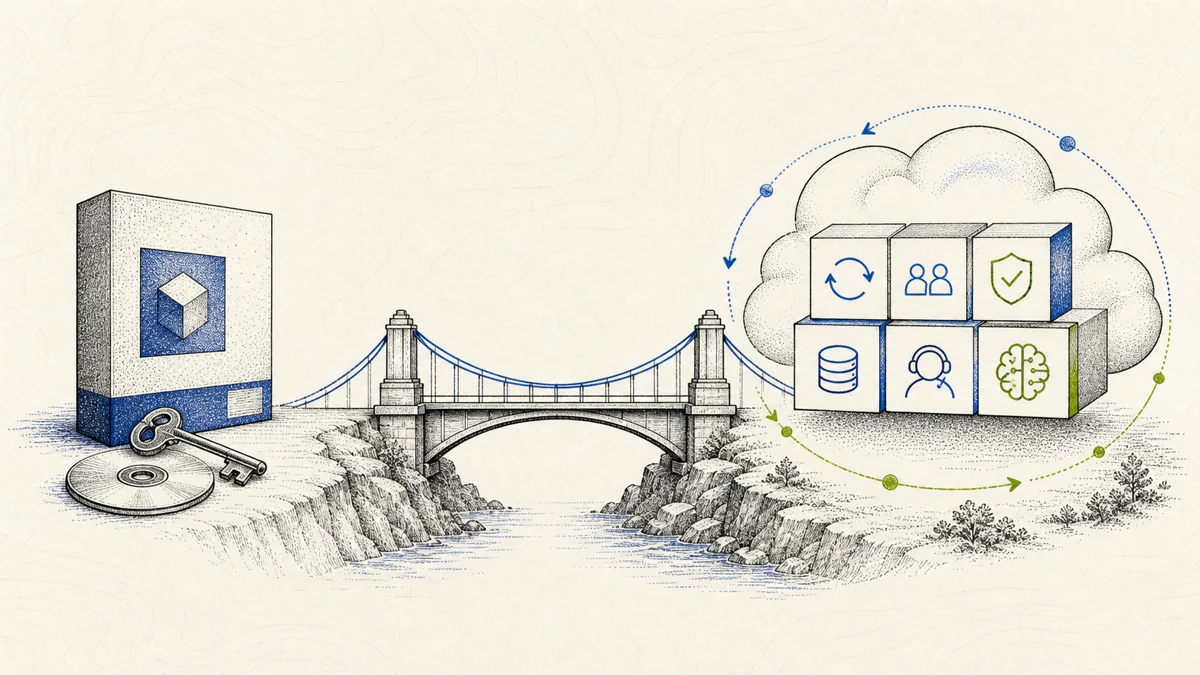
Cloud computing provides the technical foundation for subscription. NIST defines SaaS as applications that users run on cloud infrastructure using a provider over the network; users no longer manage the underlying servers, networks, and operating systems. In other words, the purchase object gradually changes from "a copy of the software" to "the continued ability to run remotely."1
The key nodes in the past fifteen years are as follows:1, 16
| Time | Event | Business significance |
|---|---|---|
| 2011 | Microsoft launches Office 365 globally, providing per-user and monthly office software and cloud service solutions | Traditional office suites began to migrate from version sales to continuous services. |
| 2012 | Adobe launches Creative Cloud and begins migration from Creative Suite perpetual licenses | Professional creative software has become an iconic case of subscription transformation. |
| 2013 | Microsoft launches Office 365 Home Premium for families; Adobe subscription revenue share rises to 28%, up from 15% in 2012 | The subscription model extends beyond the enterprise market to the average consumer. |
| 2016 | Apple allows all App Store app categories to use auto-renewing subscriptions | Mobile app subscriptions have expanded from a handful of content-based services to a universal business model. |
| Around 2020 | Remote work drives video conferencing, collaboration and cloud software into daily work | Freemium SaaS such as Zoom completes large-scale user education; Zoom’s free tier retains a 40-minute meeting limit. |
| 2024 | Atlassian stops supporting Server products; China's "Regulations on the Implementation of the Consumer Rights Protection Law" requires a prominent reminder before automatic renewal | Enterprise software is accelerating its withdrawal from local permanent deployment, and supervision has begun to respond to automatic renewal issues. |
| 2025 | The EU's Data Act becomes applicable; Microsoft includes Copilot credits in some consumer subscriptions; Adobe launches Creative Cloud Pro | Subscription competition has shifted from "cloud functions" to "artificial intelligence functions and call quotas." |
| 2026 and beyond | Atlassian begins phasing out Data Center products; artificial intelligence vendors generally try credit points and usage charges | On-premises deployment continues to shrink, and software pricing gradually moves closer to cloud resource metering. |
- Office 365 launches globally
- Adobe begins the Creative Cloud transition
- Consumer office software enters the subscription era
- App Store subscriptions expand to every category
- Remote work accelerates SaaS adoption
- On-premise products retreat as renewal rules tighten
- Switching rules and AI benefits enter subscriptions
- AI credits and usage billing accelerate
- Affected Data Center products are scheduled to end
This timeline illustrates that subscriptions did not suddenly replace perpetual licenses one year. It is the result of cloud computing, mobile app stores, remote collaboration, investor preferences and product architecture. The real watershed is when software is no longer viewed as a periodically completed product, but as a service that is always being developed, deployed, and operated.1
Why prices keep rising
First, there’s the predictability of revenue. Under the permanent licensing model, manufacturers must wait for the next major version release, and revenue is highly dependent on the upgrade cycle; subscription revenue is usually recognized gradually during the contract period. Salesforce said its cloud service revenue is generally recognized evenly over the life of the contract, with more than 90% of customer bill value coming from subscription and support services, which are typically billed upfront on an annual basis.8, 9
This model has a key financial effect: the cost of acquiring a customer is often incurred initially, while the revenue is recouped in the months or years ahead. Therefore, manufacturers will pay close attention to customer acquisition cost (CAC), customer lifetime value (LTV), renewal rate and churn rate. A simplified SaaS logic is:1, 20
Customer lifetime value ≈ revenue per period × gross profit margin ÷ churn rate20
The formula won't work for all contracts, but it sheds light on why "reducing cancellations" is sometimes more important than "increasing sales." Recurly said based on data from its platform's 67 million subscribers that the customer acquisition rate for subscription business dropped from 4.1% in 2021 to 2.8% in 2024, prompting manufacturers to shift their focus to retaining, suspending subscriptions and recalling old users. This data comes from subscription management service providers and has sample and business stance limitations, but it can still reflect changes in industry business priorities.20
Secondly, the low marginal cost of software does not mean that the marginal cost of SaaS is zero. Copying a local software adds little to production costs, but online software must bear hosting, bandwidth, storage, availability, security, customer service, payment processing and third-party service costs. Atlassian includes third-party hosting, cloud equipment depreciation, payment processing fees and infrastructure support personnel as revenue costs; Salesforce also lists data center capacity, third-party technology and data services, and hosting costs for Slack free users.1, 8, 9, 10, 11
Artificial intelligence further changes the cost structure. After the development of traditional functions is completed, the incremental cost of a large number of user calls may be very low; however, generative artificial intelligence consumes computing resources for each inference. Therefore, Microsoft provides consumers with monthly AI credits, and Salesforce adds Flex Credits and Data Cloud Credits to high-end plans. This means that in the future software will not only charge based on "access", but also "how much intelligence is used."5, 6, 7, 8, 9
Again, subscriptions provide manufacturers with stronger upsell tools. After the user has established an account, imported data, trained employees, and formed a workflow, the focus of sales will shift from "To buy or not to buy" to "Basic version or Professional version", "Whether to add seats" and "Whether to buy artificial intelligence, analysis, security and support modules". Salesforce's current public pricing extends from $25 per user per month for Starter Suite to $175 for Enterprise, $350 for Unlimited, and $550 for Agentforce 1 Sales; some artificial intelligence and analytics capabilities are also available as additional purchases.8, 9
Finally, there is the lock-in effect. The real lock-in does not come from automatic credit card charges, but from data formats, plug-ins, automation scripts, staff skills, approval processes, and third-party integrations. Once the software becomes the organization's working operating system, changing vendors is not just "installing another program" but a business migration. The EU's Data Act considers cloud service switching fees and technical barriers as factors that inhibit customer migration, and specifically establishes switching rules between data processing services, which illustrates that lock-in has been elevated from a business strategy to a competition policy issue.16, 17
- More predictable subscription revenue
- Continuous investment in R&D, cloud, and sales
- More frequent features and broader bundles
- More tiers, add-ons, and AI credits
- Higher ARPU and customer lifetime value
- Larger acquisition and ecosystem budgets
Hosting, security, support, and AI inference shape packaging
Data, workflows, and skills raise switching costs
Annual discounts, pauses, win-back, and bundles reduce churn
That's not to say every product update is designed to be locked down. A more accurate judgment is: Subscription puts "continuous product improvement" and "continuous improvement of customer switching costs" into the same incentive structure. Both can occur simultaneously and are even difficult to separate from each other.16, 17
Five companies, five subscription paths
The big software vendors don't have exactly the same model. Adobe represents complete subscription; Microsoft retains subscriptions and permanent versions; Salesforce is natively built on SaaS; Atlassian promotes customer migration by ending local product support; Zoom relies on free entrance, low-friction purchasing and churn management.1, 3, 4, 5, 6
| Manufacturer | Subscription path | Latest comparable operating evidence | Pricing or bundling signals | Main meaning |
|---|---|---|---|---|
| Adobe | Migrate from Creative Suite perpetual license to Creative Cloud | Subscription revenue in fiscal year 2025 is US$22.904 billion, accounting for approximately 96% of total revenue; in 2013, subscription revenue accounted for only 28% | Creative Cloud Pro in North America is priced at $69.99 per month on an annual basis, adding generative AI and third-party model capabilities. | The typical "version sales" has turned into "continuous access + cloud + AI". |
| Microsoft | Office permanent version coexists with Microsoft 365 | Total revenue in fiscal year 2025 is US$281.7 billion; Microsoft 365 commercial cloud and consumer cloud revenue still maintain growth, but the company did not disclose a unified subscription revenue ratio that can be directly compared with Adobe | The US consumer plan adds Copilot quota and increases the price by US$3 per month; Office Home 2024 is still sold at a one-time price of US$179.99 | The hybrid model retains price-sensitive users while focusing new features on the subscription tier. |
| Salesforce | Native enterprise SaaS, scaling with seats and modules | Subscription and support revenue in fiscal year 2025 is US$35.679 billion, accounting for approximately 94% of total revenue; the annual churn rate excluding Slack self-service customers is approximately 8% | Enterprise is $175/user/month, Agentforce 1 Sales is $550/user/month, and introduces credits and add-ons | The core of enterprise subscription is "expansion after implementation": adding users, cloud modules, data and AI. |
| Atlassian | Migrate from Server to Cloud, and then gradually terminate Data Center | Revenue in fiscal year 2025 is US$5.2 billion, a year-on-year increase of 20%; Cloud ARR customers exceeding US$10,000 increase from 38,726 in 2023 to 51,978 in 2025 | Server ends support in 2024; affected Data Center products are scheduled to be discontinued on March 28, 2029 | The customer choice is not a simple "buy or not" but a matter of migrating to the cloud, finding alternatives, or bearing the cost of product retirement. |
| Zoom | Freemium comes in, charges per user and feature | In fiscal year 2026, online customer revenue accounts for 39.7% of total revenue, and the average monthly online customer churn rate is 2.8%; approximately 74.9% of online monthly recurring revenue comes from customers who have used it continuously for at least 16 months | Free Basic sessions are 40 minutes long; Historical Public Pro starts at $15.99/month, current specific region and billing prices may change | Free entrance is responsible for acquiring customers, while long-term users, upgrades and additional products are responsible for increasing LTV. |
Adobe is the clearest financial sample. In 2013, its subscription revenue accounted for only 28% of total revenue; by fiscal year 2025, this proportion was approximately 96.4%. This is not an ordinary product price increase, but a reconstruction of the entire revenue structure.3, 4
Subscription revenue96.4%
Product and other revenue3.6%
Calculated from Adobe's published FY2025 figuresHowever, you can't just compare the first month's list price. What is really relevant is the cumulative cost that users pay over a number of years and whether the features included in the plans are comparable.1, 16
| Example scenario | Nominal public price | Three years cumulative | Five years cumulative | Ten years cumulative | Compare restrictions |
|---|---|---|---|---|---|
| Adobe Creative Cloud early complete solution | About $49.99/month | $1,799.64 | $2,999.40 | $5,998.80 | Early prices and regional conditions may be different; continuous access to new versions and cloud services cannot be completely equated with fixed versions. |
| Adobe Creative Cloud Pro North America 2025 Price | $69.99/month, annual plan paid monthly | $2,519.64 | $4,199.40 | $8,398.80 | Contains AI capabilities; some markets such as China do not adopt the same update plan. |
| Microsoft 365 Personal | $99.99/year | $299.97 | $499.95 | $999.90 | Includes continuous updates, cloud storage, multiple devices and some AI capabilities; specific benefits vary by region. |
| Office Home 2024 | $179.99 one-time | $179.99 | $179.99 | $179.99 | Limited to one PC or Mac, does not include subscription services, and does not include free upgrade rights to the next major version. |
| Salesforce Enterprise, 100 seats | $175/user/month | $630,000 | USD 1,050,000 | USD 2,100,000 | Enterprise discounts, implementation, integration, support, data and AI add-on charges are not taken into account. |
The above calculations are calculated by the author based on public nominal prices, excluding taxes, discounts, inflation, exchange rates and version upgrade costs. They cannot answer which plan is "definitely more cost-effective," but they can reveal a fact that is often hidden by monthly pricing: Low monthly fees do not equal low long-term costs.1, 16
Microsoft's hybrid strategy provides a useful counterexample. Office Home 2024 can still be purchased as a one-time purchase, but it only includes the fixed desktop version and does not include Microsoft 365 online services. Future major versions will need to be purchased again. Instead of choosing between “$179.99” and “$99.99 per year” for the same item, users choose between fixed tools and ongoing service.5, 6, 7
Salesforce shows that the true price of enterprise software is often not a number on a public price list. The list price for 100 Enterprise seats is already $210,000 per year; but implementation, integration, sandboxing, support, data platform, analytics and AI may constitute the second tier of billing. Salesforce disclosed that revenue growth in fiscal 2025 will mainly come from new business, upgrades and existing customers increasing subscriptions, while price itself is not an important driver of revenue growth that year. This shows that SaaS growth depends not only on price increases, but also on expanding the scope of use within customers.1, 8, 9
Atlassian reveals another type of pricing power: product lifecycle rights. When Server stops supporting and Data Center announces its retirement, original customers must include migration engineering, process reconstruction, and personnel training into their software costs. Even without a dramatic increase in unit prices for new cloud subscriptions, customers' actual switching spend is still likely to be high.10, 11
Zoom explained that reducing churn rates may be more valuable than directly increasing prices. Its average monthly online customer churn rate fell from 3.1% in fiscal 2024 to 2.8% in fiscal 2026, while nearly three-quarters of its online monthly recurring revenue comes from customers who have been using it for at least 16 months. For such services, user retention time itself is a business asset.12, 20
Who pays: consumer and enterprise pain points
For the average consumer, the biggest problem with subscriptions isn't that any single service is unaffordable, but that there are multiple, seemingly small, automatic payments at once. Design software, office software, cloud storage, password management, notes, music, videos, fitness and artificial intelligence tools each cost only a few dozen yuan or more than a dozen dollars, but together they form a fixed expense that is difficult to detect.1, 16
Subscription fatigue isn’t just about “too expensive” either. A 2025 study on multi-platform subscriptions found that subscription fees, search costs and learning costs increase users’ psychological burden of constantly comparing costs and benefits and increase cancellation intentions. The research subjects are mainly Korean streaming media users and cannot directly represent all software subscribers. However, its "continuous mental accounting" mechanism is also applicable to tool software: users will repeatedly ask themselves how many times they have used it in the last month.1, 16
Deloitte's 2025 U.S. Digital Media Survey also found that respondents are not consistently increasing their subscription spending, and many are tired of managing multiple subscriptions and rising prices. While media subscriptions and productivity software are not exactly the same, both share the burden of automatic renewal, content or feature fragmentation, and multi-platform management.15, 19
Subscriptions also change how users control the software:1, 16
| Control dimension | Perpetual license | SaaS subscription |
|---|---|---|
| Whether to upgrade | Users can often stay on older versions for longer periods of time | Server-side functions, interfaces and models may be uniformly updated by the vendor |
| Do you want to continue using it? | You can usually still use the old version after you stop buying upgrades | You typically lose service or access to premium features when you stop paying |
| data location | Can be completely saved locally | May rely on cloud storage, accounts and provider data structures |
| Functional stability | The fixed version is relatively stable | Package content, quota and functional boundaries can be changed during renewal |
| Migration ability | Mainly depends on the file format | Also depends on API, export tool, data volume, plugins and workflow |
| privacy relationship | Can run in offline environment | Identity authentication, online synchronization and AI services extend data relationships |
This does not mean that cloud software necessarily violates privacy. Microsoft, for example, said it will not use prompts, answers or document content from consumers using Copilot in Microsoft 365 apps to train its underlying model. Subscriptions and cloud capabilities do, however, change the privacy question from "what permissions are granted on a single installation" to "what data is collected, processed and retained by the provider over the long term".5, 6, 7
For businesses, the appeal of subscriptions is more practical. It reduces the need to purchase servers, deploy software, manage patches and build disaster recovery systems on your own; the cost is also easier to scale with the number of employees and business size. The China Academy of Information and Communications Technology pointed out that SaaS has become an important choice for many small and medium-sized enterprises to migrate to the cloud due to its lightweight, rapid deployment and low adoption threshold; its 2025 Blue Book further pointed out that the "small, fast, light and accurate" characteristics of enterprise-level SaaS are helping small and medium-sized enterprises deploy artificial intelligence capabilities.1, 18, 21
However, the “CapEx to OpEx” argument commonly used by companies oversimplifies the accounting reality. Under the FASB's ASU 2018-15, if a cloud hosting arrangement is a service contract in nature, hosting fees are generally recognized as an expense over the period in which the services are provided; however, eligible implementation costs may be capitalized and amortized over the term of the hosting contract.13, 15
Under IFRS, if the customer only obtains access to the supplier's software, software assets are usually not recognized; configuration and customization often do not form intangible assets controlled by the customer, so the related costs may be expensed when obtaining the service. However, the conclusion may be different if the customization results in independent code or resources that the customer can control.14
Therefore, the real change in corporate procurement is not a simple migration of accounting accounts, but a migration of risk structure:1, 16
| Traditional software risks | Corresponding risks in a SaaS environment |
|---|---|
| One-time purchases are too large and assets are idle | Continue to purchase unused seats |
| Upgrade project costs are high | Suppliers frequently adjust versions, packages and interfaces |
| Difficulties in maintaining self-built infrastructure | Dependence on supplier availability, security and business continuity |
| Older versions are not compatible | Data, plug-ins and automated processes are difficult to migrate |
| Purchasing over budget | Annual renewals, add-ons and usage gradually expand |
| Local system fragmentation | “SaaS creep”: Departments each buy large amounts of duplicate tools |
Subscriptions don't eliminate IT asset management, they just change management from servers and license keys to seats, contracts, usage, APIs, data exports and renewal dates. Companies that only look at “per user per month” numbers can easily mistake a long-term commitment for an ongoing expense that can be adjusted at any time.1, 16
United States, Europe, and China: three regulatory models
The three major markets face the same problem: how to retain the convenience brought by the subscription model while preventing automatic renewals, cancellation barriers, price opacity and technology lock-in from eroding competition. The difference is in the focus of governance.18
| Area | Main governance focus | Current or Recent Rules | What does software subscription mean? |
|---|---|---|---|
| USA | Anti-Fraud, Informed Consent and Cancellation Mechanisms | The FTC issued a "Click-to-Cancel" rule in 2024, but the rule was later revoked by the court; in March 2026, the FTC re-solicited opinions on negative selection and automatic renewal rules | The federal level is still in the process of restructuring the rules, and enforcement focuses on misleading disclosures, deductions without consent, and artificially increasing the difficulty of cancellation. |
| European Union | Consumer rights, data portability, interoperability and market contestability | Consumer Rights Directive provides information and withdrawal rights for remote contracts; Data Bill applies from 12 September 2025 and establishes rules for cloud service switching | It not only regulates "how to cancel", but also attempts to lower the barriers to data and technology migration between cloud services. |
| China | Prominent notification, automatic renewal, options, price and tying behavior | The "Regulations on the Implementation of the Consumer Rights Protection Law" will come into effect on July 1, 2024, requiring prominent reminders before users accept services and before the automatic renewal date, and prohibiting the use of technical means to force or disguised forced purchases. | Make direct requests for renewal reminders, package sales and price disclosures for members, apps and digital services. |
The regulatory dilemma in the United States is that automatic renewal may reduce transaction costs or become a "negative selection" trap. The FTC acknowledged in its new round of rule solicitation in 2026 that continuous service can bring convenience to consumers, but also pointed out that the agency has received more than 100,000 complaints related to negative selection and related practices in the past five years. Issues include insufficient disclosure, deductions without valid consent, and cancellation difficulties.15, 18
The EU's thinking is closer to competitive infrastructure construction. The "Data Act" does not directly stipulate how much Adobe or Microsoft should charge, but requires data processing services to reduce switching barriers. The implication is that if customers can export data, migrate workloads, and switch vendors at an acceptable cost, the original vendor's ability to raise prices will naturally be constrained. EU rules plan to further eliminate specific data processing service switching charges from January 12, 2027, so as of August 2026, this phased arrangement has not yet been fully put in place.3, 4, 5, 6, 7
China's system is currently more focused on the transaction link. The "Regulations on the Implementation of the Consumer Rights Protection Law" require operators to prominently remind users before accepting automatic renewal services and before the renewal date; the same regulations also prohibit setting different prices for the same transaction conditions without consumers' knowledge, and require prominent reminders for combination or bundling services.18
China's enterprise SaaS market also has another characteristic: enterprise digital needs often require standardization, industry adaptation and local implementation at the same time. China Academy of Information and Communications Technology’s enterprise-level SaaS research takes vertical industry applications, model access and enterprise scenarios as important directions; this means that cost disputes in the Chinese market may not only be reflected in public subscription prices, but may also be reflected in customization, implementation, privatized deployment, interfaces and service fees.1, 18, 21
A more effective policy would not simply cap subscription prices. Price caps could force vendors to reduce free tiers, reduce service quality, raise additional fees, or prevent smaller providers from covering true cloud operating costs. More deserving of priority are the following principles:1, 16
First, require prices to be disclosed in comparable form. In addition to the monthly price, consumers and businesses should be able to see the total annual price, renewal price, three-year typical costs, minimum number of seats, usage caps, AI credits, and overage fees.1, 16
Second, establish "registration and cancellation symmetry." Services that complete subscriptions online should allow users to cancel online through similar steps and should not require phone calls, manual retention, or multi-level page jumps.1, 16
Third, strengthen data export rights. Supplier shall provide machine-readable format, complete export instructions, reasonable export speed, API access, proof of deletion and transition period after contract termination.1, 16
Fourth, additional artificial intelligence functions are required to be optional. When adding AI capabilities to existing packages and raising prices simultaneously, clear non-AI solutions should be provided, especially when the AI capabilities require additional processing of enterprise data or introduce uncertain usage. Microsoft's practice of providing Classic solutions in some markets shows that this option is not technically impossible.5, 6, 7
Fifth, corporate procurement should include “exit testing” in bidding. Buyers should not only ask about go-live time, but also ask vendors to demonstrate data export, identity system replacement, API replacement, plug-in migration, and contract termination processes.1, 16
Counterarguments, alternatives, and the next decade
The subscription model has its critics, but perpetual licensing isn't a cost-free paradise either. Fixed versions may not receive security updates for a long time, manufacturers may release features artificially to create demand for upgrades, and small software companies may not be able to continue maintenance due to insufficient one-time revenue. SaaS allows suppliers to continuously patch vulnerabilities, build collaboration functions and assume responsibility for service availability; Salesforce invested approximately US$5.493 billion in R&D in fiscal year 2025, and Zoom spent approximately US$845 million in R&D in fiscal year 2026. These investments cannot simply be regarded as zero-cost profits from copying software.1, 8, 9, 12
The question isn't "whether subscriptions are evil," but whether subscription revenue matches ongoing value. Charging a software monthly does not automatically prove that it creates new value every month; similarly, a one-time purchase does not mean that users actually own the operating system, cloud interface, plug-in ecosystem and online services they rely on.1, 16
In reality, there won’t be just one alternative.1, 16
Open source and self-hosted can increase control and portability, but the user or enterprise must bear the cost of deployment, updates, backups, security, and personnel. Free licenses eliminate vendor licensing fees, not the total cost of ownership.1, 16
perpetual license plus paid upgrade is suitable for software with stable functionality, offline use and predictable long-term compatibility. Microsoft continues to offer Office Home 2024, indicating that even large vendors acknowledge that there is still a market for fixed versions.5, 6, 7
Subscription plus pause mechanism Software suitable for seasonal use. Recurly's 2025 sample showed that among merchants that offered the option to pause, some users who might have canceled chose to pause; its 2026 report also stated that about a quarter of new registrations came from returning users. The results come from platform data and cannot be considered an unbiased statistic for the entire market, but illustrate that "cancellation does not have to equal permanent churn."20
Pay-as-you-go may be more suitable for low-frequency users: when you occasionally generate images, run models, or process videos, you don't have to pay for a high-end subscription all year round. But it can also turn “subscription fatigue” into “bill anxiety.” If users cannot see the quota, unit price, and budget cap in real time, pay-as-you-go charging may be more opaque than fixed subscriptions.1, 16
Basic subscription plus usage package is likely to become the mainstream in the next stage. It combines the stable base revenue that manufacturers like and the usage recovery required for AI services. Microsoft's AI credits, Salesforce's Flex Credits and Adobe's different levels of generative AI rights have already shown this direction.3, 4, 5, 6, 7
Software prices will show three trends in the next ten years.1, 16
First, the price tag will increasingly lose its explanatory power. The same product may be available monthly, annually, per user, per organization, per call, per agent, per GB of data, per workflow, and per add-on module. What an enterprise really needs to manage is a set of price functions, not a price list.1, 16
Second, binding will make a comeback. Subscription fatigue has prompted vendors to repackage office, storage, security, conferencing, communications, analytics and AI into one big package. Bundling can reduce users’ burden of managing multiple subscriptions, but it also makes users pay for unnecessary features and strengthens ecological lock-in. Deloitte observed that the media industry is responding to stagnant spending and service fragmentation through aggregation and bundling; similar logic is emerging in the software industry.19
Third, price competition will gradually shift to competition for exit rights. When core functions converge, the most trustworthy provider may not be the one with the lowest monthly price, but may be the one that allows users to export data in a standard format, freeze versions, lower packages, suspend services, and leave smoothly. The EU's data switching rules have written this concept into the institutional framework.16, 17, 20
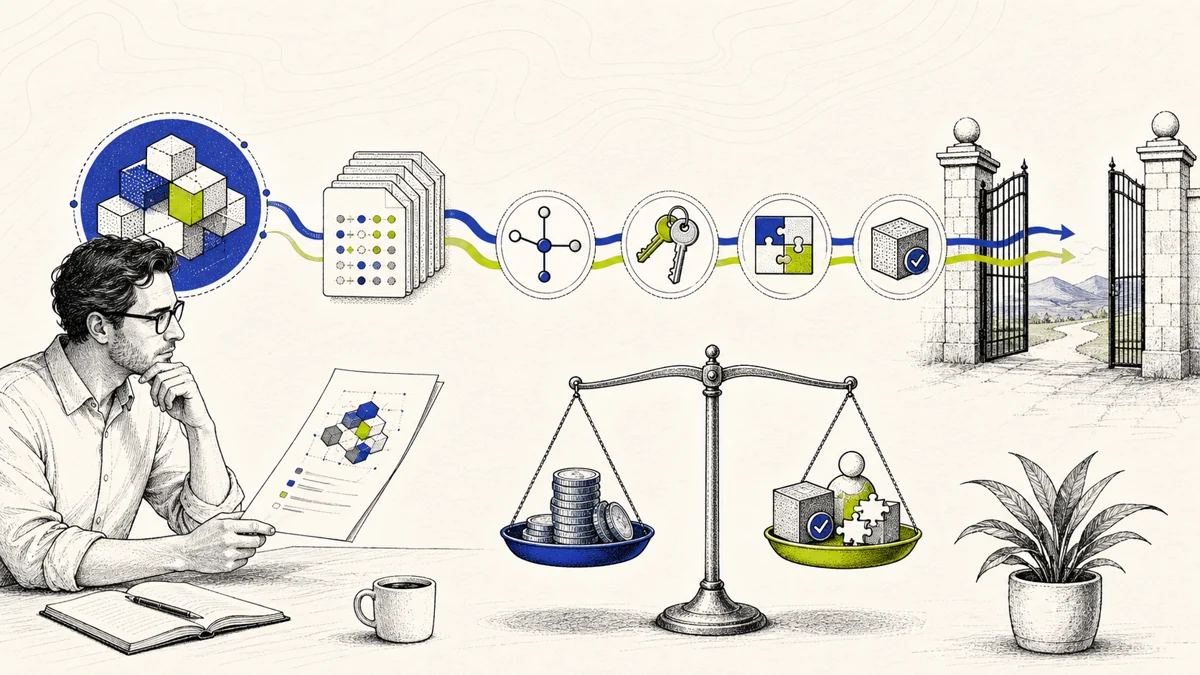
Therefore, to determine whether a subscription is reasonable, ask not just "how much does it cost per month" but five more specific questions:1, 16
| Judgment Dimension | Questions to ask |
|---|---|
| Cumulative cost | What is the actual payment over three and five years? Is the renewal price likely to change? |
| Intensity of use | How many times a month is it really used? Are there low frequency or pause scenarios? |
| Substitution ability | Can I export the complete data? Can other software read it after exporting? |
| functional autonomy | Can I say no to AI features, bundled services, or automatic upgrades? |
| switching cost | How many steps are required to cancel? How long is data retained after deactivation? How much manpower does the migration require? |
The most revealing picture is not another vendor price increase. It is the transfer of risk: under perpetual licensing, the vendor carried the risk that customers would skip an upgrade; under subscriptions, customers carry the risk that maintaining the status quo requires continuous payment.1, 16
Software feels more expensive for reasons that go beyond a larger price tag. We no longer buy a version that can sit unchanged on a hard drive. We rent a digital environment that keeps evolving, accumulating data, adding capabilities, and redrawing the boundary of what the price includes.1, 16