
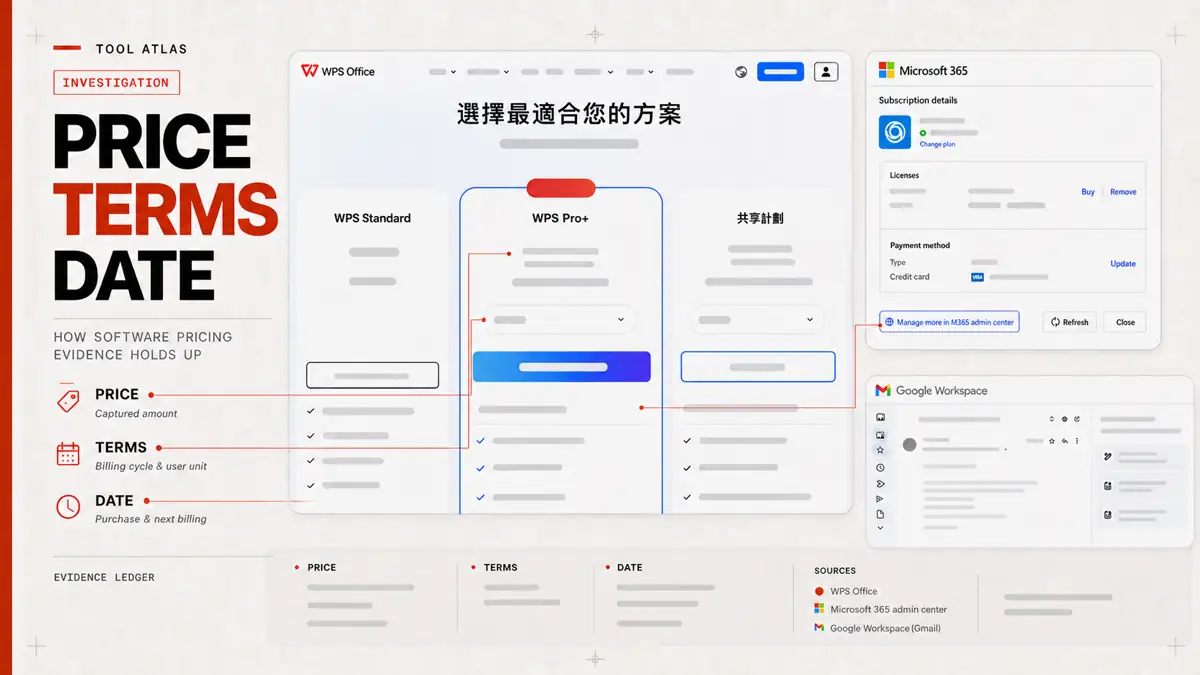
Three green pages, three different pricing problems
On August 1, Tool Atlas reopened the official pricing routes for WPS Office, Microsoft 365 Business, and Google Workspace. All three routes returned content. That was the easy part. The pages expressed price in different units, mixed promotions with standard offers, and attached different products to the amount a crawler could see.1, 2, 3, 9
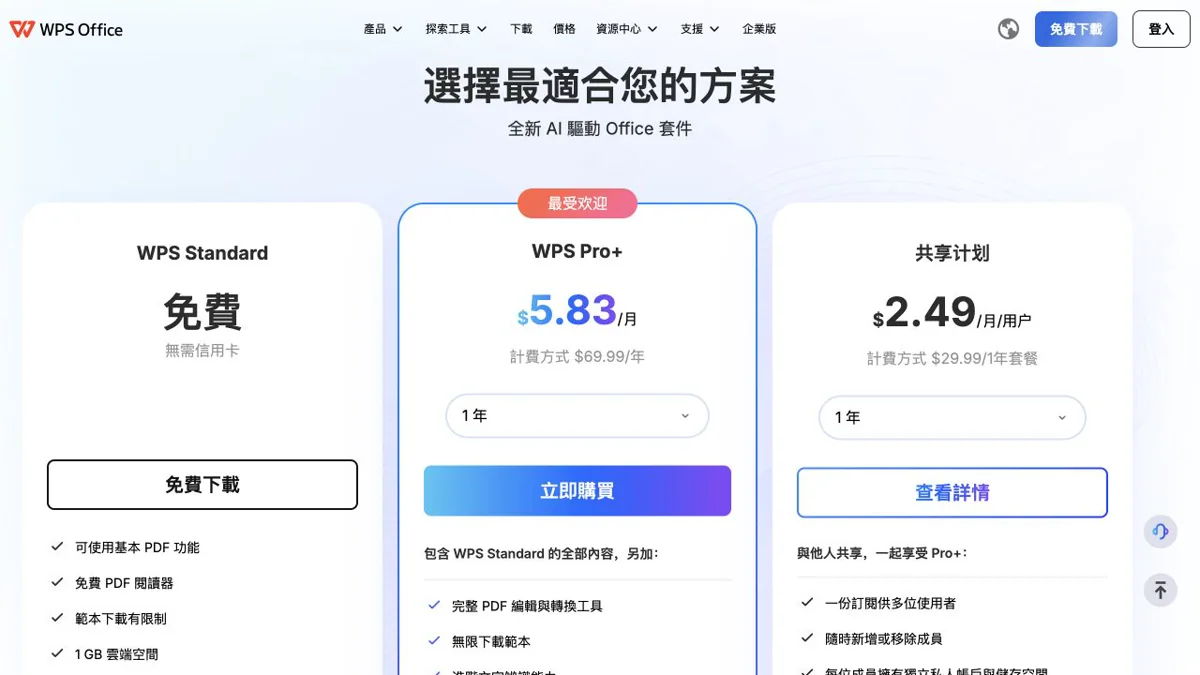
WPS showed the cleanest public comparison. The reviewed page listed WPS Standard as free, WPS Pro+ at $5.83 per month billed as $69.99 per year, and a Sharing Plan at $2.49 per user per month billed as $29.99 per year per user. It also said the displayed prices applied to PC and Android. A catalog entry that keeps only “$5.83” loses the annual commitment, product name, and platform note that make the number useful.1
Microsoft's business page combined stand-alone plans, versions with Teams, and bundles that add Copilot. The reviewed US route showed Business Basic at $7 per user per month with annual payment, while higher cards paired Business Standard or Premium with Copilot at other prices. A text extractor can capture every dollar token and still attach the wrong one to the wrong plan.2
Google's page made the promotion problem visible. It displayed a limited offer beside standard prices and described an annual commitment with monthly billing. On the reviewed US page, the Starter row presented a discounted $3.50 beside $7, Standard showed $7 beside $14, and Plus showed $11 beside $22. The footnote limited the introductory price by customer status, user count, and duration. Publishing the smallest visible number as “the price” would mislead most returning buyers.3
| Source route | What the page showed | What the catalog must preserve | Review result |
|---|---|---|---|
| WPS Office | Free, Pro+, and Sharing offers with annual totals | Plan name, per-account or per-user unit, annual billing, platform note | Public amount readable; retain commercial context |
| Microsoft 365 Business | Base plans, Teams variants, and Copilot bundles | Exact SKU, included services, per-user unit, annual commitment | Multiple valid amounts; map each to its own plan |
| Google Workspace | Introductory and standard prices in the same plan row | Promotion eligibility, standard price, commitment, currency, user limits | Manual interpretation required; lowest token is not the default price |
The review did not turn a successful page load into an automatic catalog update. It produced a dated observation for a person to compare with the approved plan record. That separation kept a promotion, bundle, or stray dollar value from overwriting a different commercial offer.1, 2, 3, 9
The editorial rulings behind the three rows
For WPS, we accepted the public amount as readable but refused to shorten it to “from $5.83.” The annual total and device note stay in the sentence because they change what a buyer is agreeing to. The Sharing Plan remains a separate offer because its per-user unit is not interchangeable with an individual Pro+ account.1
For Microsoft, we declined to choose the smallest dollar token as the product's headline price. The page describes several valid products: base business subscriptions, variants with different collaboration packaging, and offers bundled with Copilot. The catalog should match an amount to the full SKU, then let the reader compare the services inside that SKU. Collapsing the page into one number would create false simplicity.2
For Google, we treated the crossed or adjacent standard amount as necessary context, not clutter. The promotional amount has eligibility and duration. A first-time buyer who qualifies may pay it; an existing customer planning a renewal may not. The responsible catalog entry can show both, but it must label which one is temporary and which one anchors the ongoing comparison.3
These are editorial decisions because no field name resolves them alone. “Price” can mean the cash charged each month, a monthly equivalent of an annual contract, a first-period promotion, a standard reference amount, or a bundle with another product. The reviewer's job is to preserve the commercial difference rather than force every page into the same attractive card.1, 2, 3
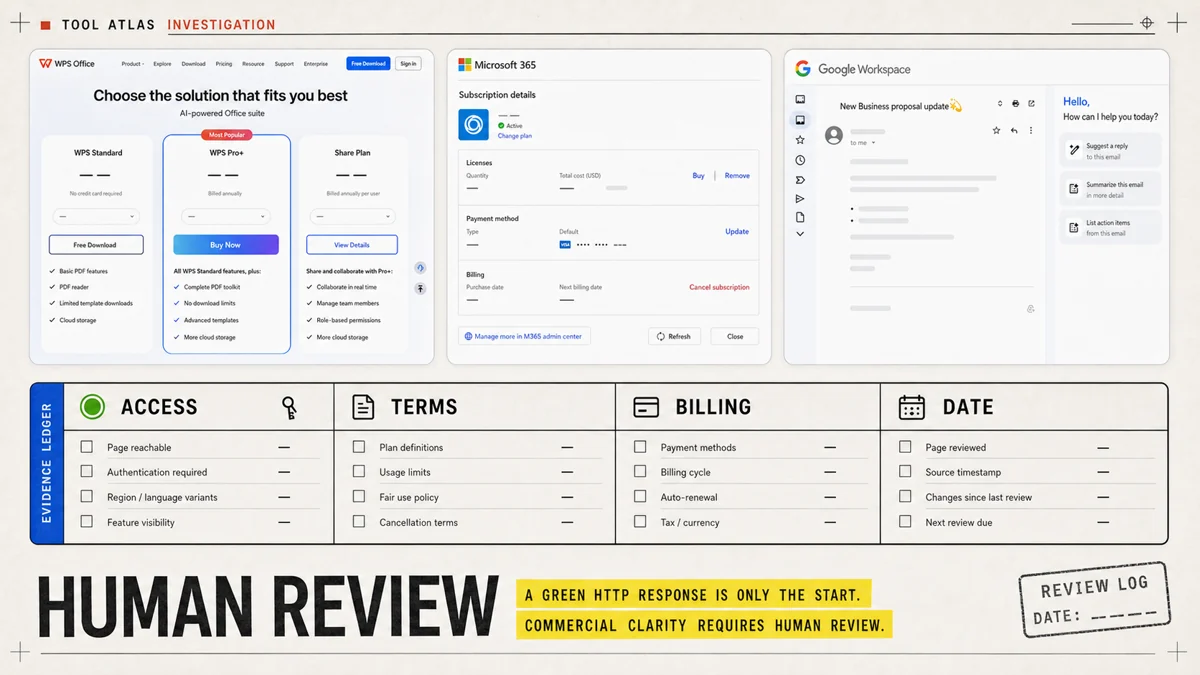
HTTP success proves access, not commercial meaning
HTTP semantics tell a client whether the server fulfilled a request. A 200 response says nothing about whether the returned page belongs to the expected market, whether the price arrived through client-side code, or whether the amount represents a monthly plan, an annual equivalent, an add-on, or a temporary discount. A redirected or blocked page can also leave an old price untouched while removing the monitor's ability to verify it.9
Tool Atlas therefore records the requested URL, final URL, response state, content fingerprint, visible price evidence, market, currency, and review date as separate fields. The machine is good at finding access failures and changed text. A reviewer decides whether those changes alter a product, plan, billing unit, or qualification.9, 1, 2, 3
The Google page gives a concrete reason for that boundary. A simple text pass can produce $3.50 $7 from one row. It cannot know from proximity alone that one value is an introductory offer and the other is the standard reference price. The WPS page is easier to parse, yet its “per month” number still depends on annual billing. Microsoft requires the reviewer to separate a base plan from a plan bundled with Copilot.3, 1, 2
Normalize the offer before comparing it
A buyer needs the commercial sentence, not an isolated number: “WPS Pro+ is displayed at $5.83 per month, billed $69.99 per year, on the reviewed US-facing page.” That sentence can be checked. It also signals that currency, taxes, market availability, renewal, and checkout terms may change the final charge.1
For seat products, record whether the amount applies per user, per account, or to a bundle. Keep the billed total beside a monthly equivalent. Record the commitment and renewal pattern. Separate a limited promotion from the standard offer. If the page says “contact sales,” store that state instead of inventing a price from a nearby plan.1, 2, 3
| Field | WPS Pro+ example | Microsoft Business Basic example | Google Starter example |
|---|---|---|---|
| Product and plan | WPS Pro+ | Microsoft 365 Business Basic | Google Workspace Business Starter |
| Visible amount | $5.83 per month | $7 per user per month | $3.50 beside $7 |
| Commitment or qualifier | Billed $69.99 per year | Annual payment | Introductory conditions and annual commitment shown on the page |
| Unit to preserve | Account or plan as described by the page | Per user | Per user, with promotion and standard amount separated |
| Editorial status | Readable with annual and platform context | Valid only when tied to the exact SKU | Manual interpretation required before headline use |
The ledger keeps the raw observation and the published interpretation separate. If the page changes, the next editor can see whether the source amount moved or only the wording around it. If a reader challenges a value, the team can reconstruct what was visible without pretending the old screenshot governs today's checkout.1, 2, 3
Tax and cancellation belong outside the headline amount but inside the buying record. Adobe's subscription terms illustrate why: cancellation consequences depend on plan and timing. A catalog can help a reader compare offers, yet the checkout and contract remain the final commercial documents.6, 10
A changed page is a question, not an answer
Pricing pages change for reasons that do not affect a plan: copy edits, tracking code, a new testimonial, reordered sections, regional detection, or a promotion banner. A content fingerprint should open a review, not publish a change. The reviewer compares fields and records which one moved.1, 2, 3
The useful change record names the product, plan, field, previous approved value, observed value, source, market, date, reviewer, and decision. “Page changed” tells the next reviewer where to look. “Business Basic remains $7 per user per month with annual payment on the reviewed US page” tells a buyer what the review concluded.2
Silence also needs precision. If a page blocks automated access, the review result is “current evidence unavailable through this route.” It is not “the plan disappeared.” If a public page removes a price, the catalog can mark the amount for review without assuming that every existing customer contract changed.9, 2, 3
Four states are better than a stale number
The public catalog needs more than “verified” and “broken.” A value can be current and clear; current but conditional; changed and awaiting interpretation; or unavailable through the reviewed route. Those states tell the reader what can be concluded. A stale price shown with confidence is worse than a visible uncertainty state because it closes the very question the evidence leaves open.9, 1, 2, 3
This distinction also changes monitoring priorities. A clear annual amount that has not changed may need no editorial action. A new promotion can be urgent because it alters the first number readers see. A blocked page needs a different source route or manual check. A renamed SKU needs product research even if the dollar amount stays the same.9, 1, 2, 3
The reviewer should write one sentence explaining the decision, especially when no number changes. “Promotion added; standard amount unchanged; catalog copy updated to separate eligibility” is useful history. A green check without that sentence cannot tell the next person what was actually reviewed.3, 9
Why the catalog keeps a verification date
Software prices are observations with a shelf life. Promotions expire. Vendors rename plans, change bundles, and show different markets. Tool Atlas keeps the date beside the value so readers can judge freshness and return to the official source before purchase.1, 2, 3, 4, 5
The date also helps editors avoid laundering an old fact into the present tense. A price verified in July can support a dated article about July. It cannot support “costs” forever. A new article run should reopen the source or label the older observation.1, 2, 3
The reader-facing result
This August review produced a modest but useful outcome. WPS offered the easiest public plan sentence. Microsoft required SKU-level separation between base plans and Copilot bundles. Google required a human to distinguish introductory and standard prices. None of those findings can be represented by one “starting at” field without losing information.1, 2, 3
The more important finding is that extraction quality and catalog quality are different things. A crawler can perfectly capture every visible amount and still produce the wrong buying advice. The hard part begins after extraction: identifying the offer, reading the qualifier, comparing it with the existing record, and deciding what a person can responsibly publish.1, 2, 3, 9
When you compare these tools, open the source and read the amount with its unit and footnote. Check the market and whether the page is showing a promotion. Confirm the product name at checkout. For a team, multiply by the seats that need the plan and include the annual commitment. Those steps prevent more bad decisions than a catalog with a faster crawler and weaker context.1, 2, 3
Tool Atlas will show dated evidence and explain uncertainty when the page cannot support a clean claim. A missing current value is less convenient than a confident wrong one. It gives the buyer an honest place to continue the comparison.9, 1, 2, 3