Follow the story, not the apps
A two-person marketing team wants to publish one useful article, turn it into three social posts, and make a simple visual. The work can scatter within an hour: the idea sits in Notion, research links live in browser tabs, ChatGPT holds three drafts, Canva contains old copy, and Buffer has a scheduled caption nobody remembers approving. Each tool did its job. The story lost its owner.1, 2, 10
The fix starts with one content record. Give every story a stable page or database item that holds the audience, reader question, angle, evidence, owner, status, due date, approved copy, asset links, channel versions, and published URLs. Notion fits this role because each database item is also a page and can carry properties, comments, files, and linked views. Another structured system can work, but the team needs one place that answers “what is approved now?”1, 2
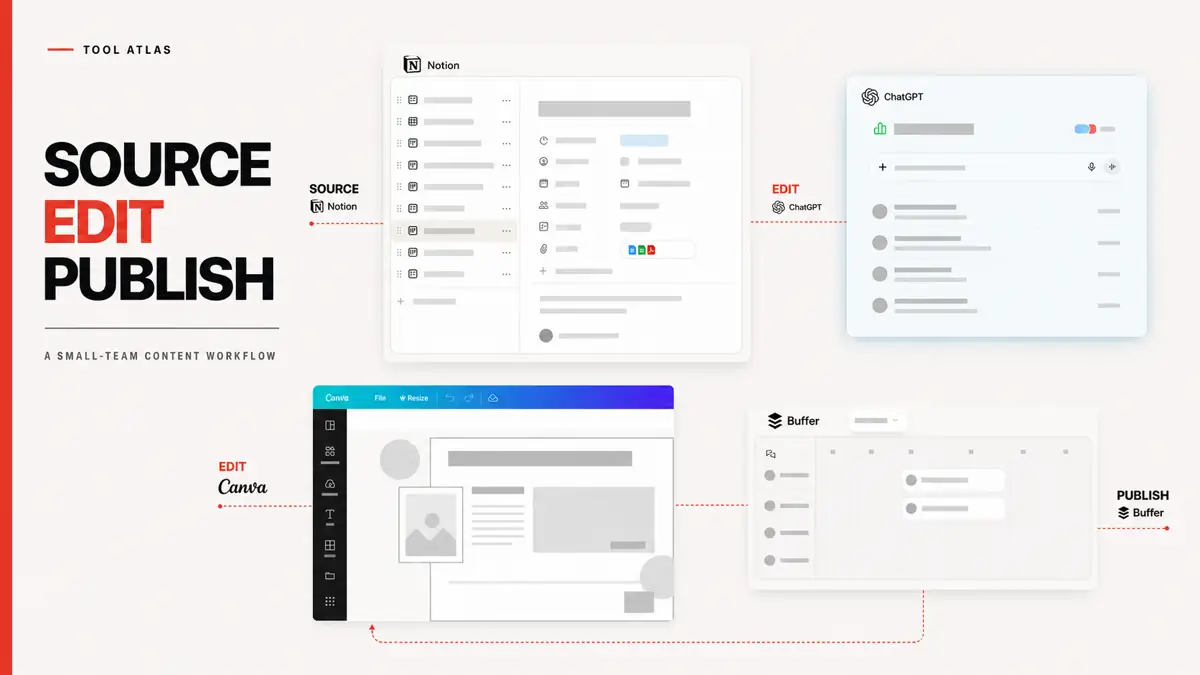
ChatGPT, Canva, and Buffer then become workstations around that record. ChatGPT helps research and shape language. Canva turns approved meaning into a visual system. Buffer adapts and schedules channel-ready packages. None of them should become a second editorial database.5, 8, 10
The story we will carry through the stack
Use a specific assignment: help a freelance photographer decide which two of four overlapping AI subscriptions to keep before renewal. The team has 60 days of invoices and project notes, current vendor plan pages, and permission to describe the workflow without naming the photographer. It does not have a controlled productivity study or evidence that one product is universally better. That boundary is part of the story, not a disclaimer to add at the end.1, 2, 5
The Notion record opens with the decision the reader should be able to make. Under it sit a small evidence table, the anonymization rule, an outline, the current approved copy, a Canva project link, three channel packages, and the final URLs. The owner is visible at the top. A colleague arriving on Thursday can understand the state without searching four applications or asking which draft is real.1, 2
This example exposes the discipline behind the tool choices. The article is not “about four apps.” It is about a reader's renewal decision. If ChatGPT produces a sharper comparison, it has helped. If Canva makes the evidence easier to understand, it has helped. If Buffer publishes an obsolete number beautifully on time, the workflow has failed.5, 8, 10

Build a brief that gives the writer something to decide
A topic such as “AI productivity tips” gives a model room to produce fluent filler. A useful brief names a reader, a problem, a promised decision, and the evidence available. For example: “A freelance photographer paying for four overlapping AI tools needs to decide which two to keep before annual renewal. Compare the work each product performs, not feature lists. Use our last 60 days of projects and current official plan pages.”1, 5
The brief should also record what the piece will not claim. If the team has no customer interviews, it cannot say customers prefer an option. If a price comes from one region and annual billing, label it. If a product screenshot carries the argument, record its source and date. These boundaries make the draft sharper because the writer knows where judgment ends and speculation begins.11, 12, 2
A lightweight Notion database needs fewer properties than most templates suggest. Use status, owner, format, audience, publish date, and final URL. Put the brief, source notes, working copy, approval note, and asset links inside the page. Add a property only when the team filters, assigns, or reports on it. Twenty empty fields make a content system feel serious while hiding the work.1, 2
| Part of the record | What belongs there | Owner |
|---|---|---|
| Brief | Reader, question, angle, desired action, exclusions | Editor or strategist |
| Evidence | Source link, date, claim supported, caveat | Researcher or writer |
| Canonical copy | Current approved long-form text | Editor |
| Visual package | Canva link, source assets, rights note, alt text, exports | Designer |
| Channel package | Platform copy, crop, link, disclosure, schedule | Channel owner |
| Release record | Approver, published URLs, correction note, result | Publisher |
Give ChatGPT a source packet and an editorial job
The strongest use of ChatGPT begins after the team has framed the question. Give it the brief, selected sources, product facts, quotes you are allowed to use, and the house style. Ask it to identify gaps before drafting. A good research pass returns disputed claims, missing evidence, dated facts, and questions for a human. That output helps the editor decide whether the story is ready to write.5, 6
Draft in layers. Start with the central claim and a section outline. Then write the full article. Use a separate pass to challenge the reasoning, find unsupported sentences, and propose stronger examples. The editor chooses what survives. Asking for title, article, LinkedIn post, Instagram caption, email, and image prompt in one generation tends to spread the same weak idea across six formats.5, 6
Keep evidence attached at the claim level. A folder of twenty links does not show which sentence each source supports. In the content record, note the source beside the price, policy, study, or product capability. When a fact changes, the editor can find the affected sentence instead of rereading the entire research archive.1, 2
Account and data choices belong in the workflow. OpenAI's consumer Data Controls let signed-in users turn off use of conversations for model improvement, and Temporary Chats follow a separate retention pattern. Business products have additional controls. Those settings do not grant permission to paste client secrets, unpublished financial results, or licensed source material into a model. The team still needs an input rule based on its contracts and data.5, 6
The editor should read the draft without the prompt beside it. Cut generic openings, repeated conclusions, false certainty, and product claims that outrun the sources. Add lived detail, counterexamples, and a recommendation the team can defend. AI can multiply options. Editorial quality comes from selecting one line of thought and accepting responsibility for it.5, 6
What the AI draft gets wrong in the working example
The first generated outline may group the four subscriptions by their marketing categories. That sounds orderly and misses the photographer's problem: two products overlap only during image selection, while another becomes essential for client review. The editor reorganizes the piece around the actual work stages and invoices. The model did not fail to write; it answered an easier question than the brief required.5, 1
The draft may also say that canceling two tools will “cut costs in half.” The invoices do not support that claim because one plan is annual, one is monthly, and renewal falls on different dates. The team replaces the slogan with a dated cost table and a cancellation sequence. This is the difference between fact checking a sentence and repairing the reasoning that produced it.1, 5
Use ChatGPT again after the repair, this time as an adversarial reader. Ask which conclusion depends on one anecdote, where a vendor page is being treated as user evidence, and what would make the recommendation change. The editor can reject weak suggestions, but the questions force the article to show its boundary. Deep research is useful only when the final piece reveals the decisions the research changed.5, 6, 2
Let Canva design the approved idea
Move copy into Canva after the headline, claim, numbers, and call to action have an approved version. The design file should link back to the content record and carry the version date in its name or page. If a sentence changes in the article, update the visual or record why the channel version differs.8, 2
Start with a small visual system: one type hierarchy, brand colors, image treatment, safe areas, and two or three reusable layouts. That gives a small team speed without making every post look like a template demonstration. Canva's business and plan pages describe brand and collaboration features, but the team still decides which elements carry identity and which can flex for the story.8, 7
Every asset needs a source and permitted use. Generated images still need review for misleading details, recognizable people, trademarks, or imitation of protected work. Product screenshots need the right version and crop. Paid partnerships or endorsements need clear disclosure where readers will notice it; the FTC's guidance says disclosure should appear with the endorsement message rather than behind a profile page or a “more” control.11, 8
Write alternative text according to the image's purpose. The W3C tutorial distinguishes informative images from decorative ones and recommends that linked images describe the destination or function. “Colorful graphic” wastes the field. “Bar chart showing trial conversion rose from 8% to 13% after onboarding changes” gives the reader the information the chart carries.12
For the subscription story, the visual should not be four vendor logos arranged around arrows. The argument is the overlap between stages of work and the risk of canceling before files are exported. A useful figure maps capture, generation, selection, client review, delivery, and archive against the four subscriptions, then marks where source files or approvals would be lost. The image now does analytical work that prose alone makes slow to scan.8, 12, 1
The Canva source contains the editable stage labels and a note linking every number to the evidence table. The exported social crop simplifies the figure and leads to the full article; it does not shrink a dense chart until nobody can read it. Alternative text summarizes the overlap and the cancellation risk rather than listing colors or shapes.8, 12, 2

Buffer should receive a release package
Scheduling is the last reversible moment before publication. Give Buffer a complete package: approved channel copy, final asset, destination URL, tracking parameters if used, disclosure, alternative text where the channel supports it, publish time, and owner. The person scheduling should not have to reopen ChatGPT or guess which Canva page is current.10, 11, 12
Buffer supports separate user accounts and channel-level access. Its documented Needs Approval role can create drafts and submit them to someone with publishing authority, while Full Access can publish. That separation helps a small team avoid shared passwords and keeps a freelancer's draft from entering the queue as an approved post. It requires the relevant team plan, so include approval needs in the subscription decision.10, 9
Review the post in the channel's real shape. Check the first visible lines, crop, link destination, account, time zone, tags, and disclosure. Read the caption beside the image. A sentence that works in the article can become misleading after the platform truncates the explanation that follows it.10, 11, 12
Automation can move an approved package from Notion toward Buffer, but it should stop before an ambiguous state. A checkbox named Approved can become stale after someone edits the copy. Use a release version or approval timestamp, and require a new approval when the package changes. The goal is fewer hand-copying errors, not unattended publishing.1, 10
In the working example, the editor changes one annual total after the social post has entered Buffer. That edit invalidates the article table, the figure annotation, and two captions. The Notion record moves from Approved back to Correction; the Buffer drafts are paused; the Canva project receives a new export. No tool can infer all three consequences reliably from a changed number. The workflow succeeds because the release owner knows which artifacts carry the claim.1, 8, 10
Do a cold review before rescheduling. Open the public destination in a signed-out browser, inspect the actual image crop, and compare the first visible caption lines with the approved claim. A correct package in Buffer can still point to an unpublished route or lose a necessary qualifier after truncation. Approval belongs to what the reader will receive.10, 11, 12
Run a weekly rhythm the team can sustain
On Monday, choose one reader problem and assemble the source packet. On Tuesday, use ChatGPT to test angles and create the first draft. Wednesday belongs to human editing and fact checks. Thursday locks the copy and produces the Canva assets. Friday packages and approves the channel versions in Buffer. The days can change; the sequence protects decisions from being remade inside each app.1, 5, 8, 10
Batch the expensive thinking, not every output. One researched article can support a short post and a visual, provided each version preserves the meaning and fits its channel. Publishing five shallow derivatives from a weak draft creates more review work than value. A small team gains leverage by reusing evidence and judgment.1, 10
Track cycle time, review time, correction count, missed deadlines, and the share of published pieces that answer the brief. Channel metrics belong beside those operating measures. High reach does not excuse a false claim, while a perfect workflow that produces nothing useful needs simplification.1, 10
The handoffs deserve their own review
At the end of the week, ask where meaning changed unintentionally. Did the AI outline replace the reader question? Did the Canva headline remove a condition? Did the social caption turn a dated observation into a general rule? Did the scheduler receive an old URL? These are not separate app mistakes. They are handoff failures, and the content record should show which one recurs.1, 5, 8, 10
Then remove friction selectively. A repeated filename mistake may deserve automation. A repeated weak brief needs editorial training. A repeated approval delay may mean too many reviewers. Buying another orchestration tool before identifying the failure adds one more place for state to diverge.1, 10
Keep the record after the post goes live
Paste each public URL into the source record and save the final channel package. If a correction is needed, update the canonical copy, note the reason, and change every live version that carries the error. Deleting a draft or editing one caption does not repair the same claim in an image, newsletter, and article.1, 2, 10
After the campaign, record what the team learned: which reader question drew qualified attention, where reviewers found repeated problems, which asset took too long, and which derivative format deserved the effort. Feed those observations into the next brief and template. Keep the evidence packet so a future update can distinguish a fresh fact from inherited copy.1, 10
This stack works when each product has one clear role. Notion owns the content record. ChatGPT expands the research and language under human direction. Canva owns the visual source. Buffer owns the approved distribution queue. The editor owns the story from question to correction.1, 5, 8, 10