A $0 download hides part of the bill
Open a search engine, message a friend, watch a short video, stream an album, or ask an AI assistant a question. The service may ask for no money. Someone still pays for engineers, computing, licenses, moderation, support, fraud losses, and regulatory work. A zero price tells you which charge is absent. It does not tell you who funds the product or what the provider needs from you.1, 2
That missing explanation creates two common mistakes. One person assumes the provider sells a file containing their name. Another treats the service as a public utility with no commercial pressure. Most large platforms operate between those extremes. They keep raw data inside their systems, use activity to rank content or infer interests, then sell advertising access, transactions, subscriptions, devices, cloud services, or business infrastructure.2, 3, 4, 5
The OECD treats zero-price markets as markets where buyers still judge quality through privacy, security, advertising load, switching difficulty, and access to related services. That frame is more useful than the slogan “you are the product.” You may be a user, a source of attention, a contributor to network value, and a future subscriber at the same time. Each role creates a different incentive for the company.1
This article uses “free software” for software and digital services offered at zero or heavily subsidized monetary price. It does not mean free and open-source software. An open-source project may charge for hosting and support while giving users strong control. A proprietary app can charge nothing while making export, refusal, and exit expensive.1
Find the payer before reading the privacy policy
The privacy policy explains legal categories and processing purposes. The revenue statement shows which outcome pays the bills. Read both. If advertising supplies almost all revenue, engagement, targeting signals, measurement, and ad inventory will shape product decisions. If subscriptions dominate, the free tier must attract users while preserving reasons to upgrade. If transactions dominate, the platform benefits when more economic activity passes through its rules and payment rails.3, 4, 6, 5
| Revenue route | What the provider needs from free users | What users receive | What to inspect |
|---|---|---|---|
| Advertising | Attention, ad inventory, targeting or contextual signals, and measurable responses | Broad access without a subscription | Ad load, sensitive targeting, tracking scope, paid placement, and recommendation incentives |
| Freemium | A large acquisition pool and a minority willing to upgrade | A usable entry tier and a way to test the product | Feature gates, trial renewal, export rights, collaboration limits, and whether the free tier deteriorates |
| Marketplace and commissions | Buyers, sellers, creators, developers, or merchants who transact inside the platform | Discovery, distribution, identity, payments, or audience | Commission, ranking, self-preferencing, dispute rules, and off-platform alternatives |
| Cross-subsidy | Adoption that increases demand for cloud, enterprise support, commerce, finance, or another product | A low-cost tool or open entry point | Which profitable product sets the roadmap and what happens if the subsidy ends |
| Hardware and bundle | Software use that improves device sales, accessories, storage, warranties, or default-service revenue | Integrated software with little visible incremental charge | Compatibility, default settings, accessory dependence, storage pricing, and device exit cost |
| Data-derived optimization | Activity that improves ranking, fraud detection, personalization, pricing, advertising, or model performance | More relevant results, safer transactions, or adapted interfaces | Data sensitivity, retention, cross-service combination, partner flows, training use, and opt-out |
These routes overlap. WeChat connects free messaging to games, subscriptions, advertising, payments, merchant services, and business infrastructure. Google combines advertising with subscriptions, app distribution, devices, and cloud. Spotify uses advertising and restrictions to fund a free service, while describing that service as a source of new Premium subscribers. A single “ad-supported” label misses most of the system.3, 5, 6
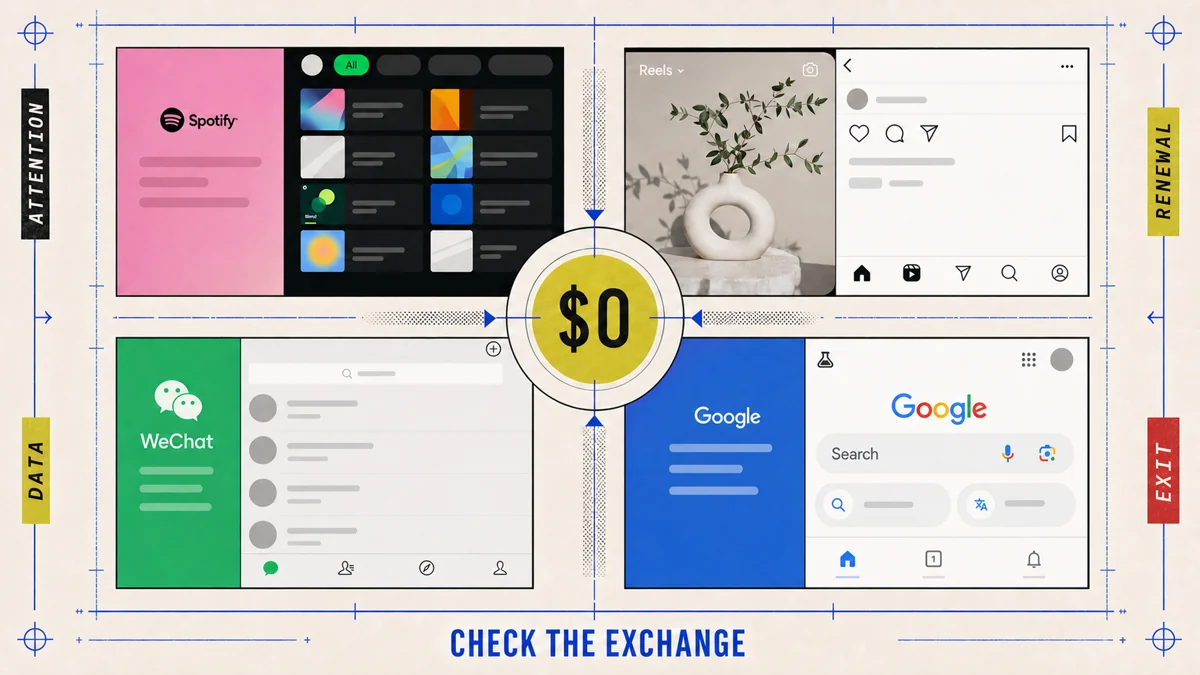
The diagram should be read from the payer inward. A merchant commission can finance a free buyer interface. An enterprise contract can subsidize a consumer tool. Device revenue can finance an operating system. The arrangement can give users exceptional value. Trouble starts when the interface shows the benefit but hides the input, the payer, or the route out.1, 5, 3
Four free products make four different bargains
Company reports reveal more than product slogans because they name revenue, user measures, and management priorities. The figures below describe the 2025 fiscal year. They do not turn revenue per user into a price for personal data. Revenue includes technology, sales, infrastructure, market power, content, and the combined activity of large populations.3, 4, 5, 6
| Company and free surface | 2025 evidence | What the free surface does for the business | Decision boundary for a user |
|---|---|---|---|
| Alphabet: Search, YouTube, Gmail, Maps, Android services | Alphabet reported $294.691 billion in Google advertising revenue and $402.836 billion in total revenue; more than 70% of revenue came from online advertising | Captures frequent intent and attention, improves ad matching and measurement, and distributes subscriptions, platforms, devices, and cloud services | Separate the utility you need from optional activity history, ad personalization, default-service dependence, and account-wide data combination |
| Meta: Facebook and Instagram | Meta reported $196.175 billion in advertising revenue and $200.966 billion in total revenue; family daily active people averaged 3.58 billion in December | Turns reach, engagement, ad impressions, targeting, and measurement into the main revenue engine | Review recommendation control, advertising preferences, cross-product data, public audience, and the cost of moving a social graph |
| Tencent: Weixin and WeChat | Combined monthly active users reached 1.418 billion; Tencent reported RMB369.281 billion in value-added services, RMB144.973 billion in marketing services, and RMB229.435 billion in fintech and business services | Uses messaging as an entrance to content, games, subscriptions, advertising, payments, merchants, finance, and cloud | Convenience and lock-in rise together; review payments, mini-program permissions, stored content, account recovery, and practical alternatives for key relationships |
| Spotify: ad-supported listening | Spotify reported 476 million ad-supported MAUs, 290 million Premium subscribers, €1.836 billion in ad-supported revenue, and €15.350 billion in Premium revenue | Finances free listening with ads and uses the free service as a major acquisition route for subscriptions | Compare the annual subscription with ad time, playback restrictions, recommendation history, playlist portability, and household use |
The four rows also show why one ratio can mislead. Meta reports daily active people across a family of apps. Tencent reports combined monthly active accounts for Weixin and WeChat. Spotify reports service MAUs and subscribers. Alphabet does not publish one comparable active-user denominator for its whole advertising system. Dividing annual revenue by any of these point-in-time counts can illustrate platform yield, but it cannot produce a clean per-person bill.3, 4, 5, 6
The more useful comparison asks what behavior improves the revenue line. Meta benefits when ads gain impressions and performance. Spotify benefits when the free service attracts listeners and some convert. Tencent benefits when more communication, entertainment, transactions, and business services run through its ecosystem. Alphabet benefits when products place its advertising and commercial services near intent. Product incentives become easier to read once the payer is visible.3, 4, 5, 6
Write down the costs the interface omits
A household or small team can audit a free product without pretending to price privacy in dollars. Use separate lines for money, time, exposure, dependence, and risk. Mixing them into one dramatic number creates false precision. Keeping them separate makes tradeoffs visible.1, 2
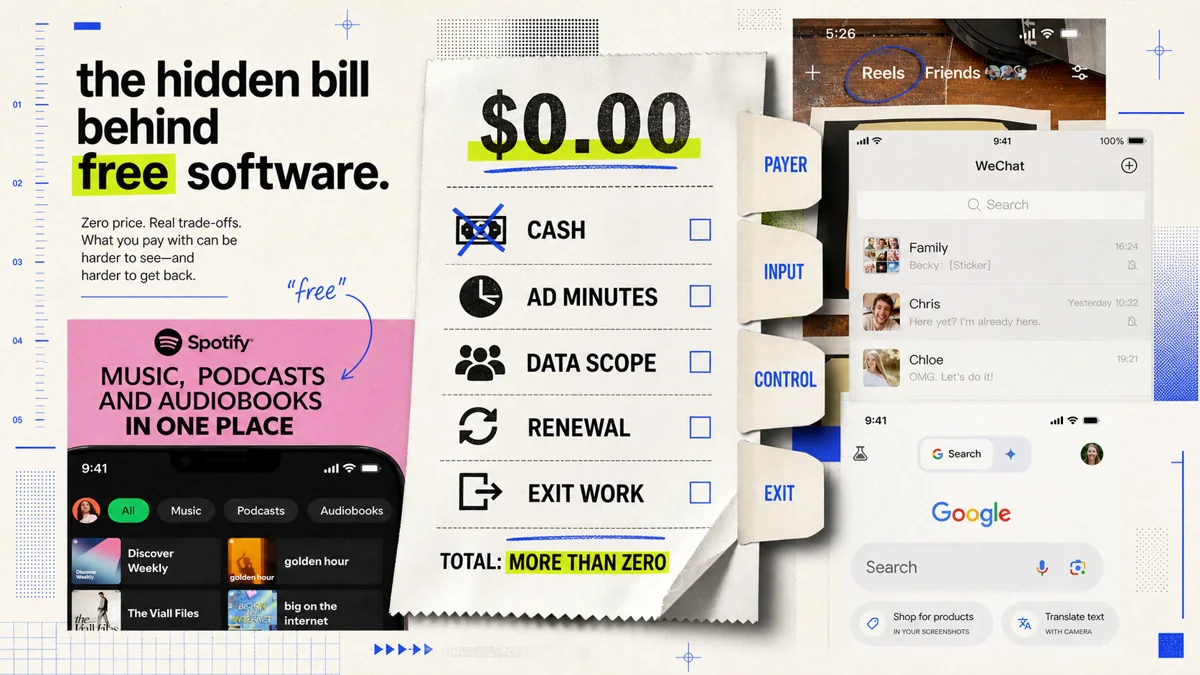
The audit illustration treats the interface like a receipt. The visible line is $0.00. The other lines record ad minutes, data scope, renewal, and exit work. Those entries are not interchangeable. Ten minutes of ads has a measurable time cost. A retained location history has a context-dependent risk. A social graph that cannot move creates dependence rather than an invoice.1, 2
A short privacy screen can use six factors scored from zero to three: data sensitivity, collection breadth, retention, external sharing, user control, and consequence if the data is wrong or exposed. A high total should trigger review, not an automatic verdict. The score helps a family notice that a weather widget asking for precise continuous location deserves a different decision from a photo editor reading one selected image.2, 8
Export deserves a live test. Download a playlist, document archive, photo library, or message history. Open it. Check dates, attachments, metadata, and relationships. A ceremonial download full of opaque files does not preserve a usable exit. The work only counts as portable when another tool or a person can reconstruct what matters.8, 10, 1
Consent adds interaction cost
The FTC found that major social-media and video services collected extensive information from users and, in some cases, non-users, while incentives favored broad collection and monetization. The report called for stronger minimization, concrete retention limits, reduced sharing, and deletion when data is no longer needed. A privacy policy can disclose categories without making those limits easy to understand or use.2
Interface design determines whether refusal is practical. A bright acceptance button, a muted secondary choice, repeated prompts, a long cancellation route, or a permission request shown after a user has invested time can steer behavior without changing the formal wording. The FTC describes dark patterns as interfaces that trick or manipulate people into choices they might not otherwise make.7
Personalization also covers several different exchanges. A music service may use listening history to improve recommendations. A search product may connect activity to ad relevance and measurement. A platform may combine data across services. An AI assistant may receive work files or intimate questions that carry more consequence than a song skip. “Personalized” says nothing about scope, retention, recipient, or whether refusal preserves the core service.2, 3, 6
| Question | Minimum useful answer | Reason to pause |
|---|---|---|
| What data enters? | Named categories tied to the requested feature | Broad labels such as “activity” hide messages, location, contacts, or files |
| Who receives or uses it? | Provider functions, named processor classes, advertising use, training use, and cross-service combination | The policy leaves major flows open-ended |
| How long does it remain? | A period or event that starts deletion | “As long as necessary” has no operational boundary |
| What changes if I refuse? | The exact feature lost and a less-personalized route where feasible | Refusal disables unrelated core functions |
| How do I leave? | Export, deletion, account closure, subscription cancellation, and remaining copies | The controls exist only through support or produce an unusable archive |
The fair bargain depends on consequence. Contextual ads on a public recipe page require less knowledge about a person than behavioral targeting across services. A map needs location for navigation, but it may not need an indefinite history for the route to work. A free editor can process one selected file without receiving the entire photo library. Product teams make these boundaries; users should be able to see and change them.2, 8, 11
Regulation is turning hidden prices into product rules
Regulators use different legal systems, but several product requirements now repeat across regions: collect less, explain the purpose, separate optional monetization from necessary processing, make refusal possible, expose advertising or ranking logic, support access and deletion, and reduce the cost of leaving.8, 9, 10, 11, 12, 2
| Route | Product requirement | What a user should be able to observe |
|---|---|---|
| European Union: GDPR | Access, correction, erasure, objection, portability, and limits on processing | A usable rights request, a copy of data, a deletion route, and an explanation of the legal basis |
| European Union: DSA and DMA | Advertising transparency, limits on sensitive or minor targeting, restrictions on dark patterns, and controls on gatekeeper data combination and interoperability | Why an ad appeared, whether a choice is paid placement, a route that does not force unrelated tracking, and practical movement between services |
| China: PIPL and Network Data Security Management Regulations | Informed consent where consent applies, withdrawal, limits on refusing service over unnecessary data, clear processing and retention rules, and channels for access, correction, deletion, copying, and account termination | Separate choices for optional processing, reachable account controls, stated retention, and a service route that survives refusal of unnecessary collection |
| United States: FTC and sector or state rules | Enforcement against unfair or deceptive practices, dark-pattern scrutiny, and specific protections in areas such as children's data | Claims that match actual data practice, cancellation that does not obstruct exit, and consequences when a provider misleads users |
Rights on paper still need product work. A download button does not create interoperability. A consent toggle does not help if refusal breaks unrelated features. A deletion request does not erase copies that another recipient independently controls. Buyers should judge the control by the completed route and the resulting artifact, not by the presence of a menu label.8, 10, 12
The same standard belongs in procurement. A school, employer, or small company can ask a free service for its payer, retention, training use, administrator visibility, export format, cancellation route, and breach process. Zero price removes one approval line. It does not remove security, continuity, or data-governance work.2, 8, 12
Keep free access without giving up the right to leave
Free products widened access to communication, navigation, publishing, music, education, and business tools. Paying money is not automatically safer or fairer. A subscription provider can still over-collect data, design a difficult cancellation route, or trap work in a proprietary format. The useful distinction is whether the exchange stays visible, proportionate, and reversible.1, 2, 8
| Step | Action | Evidence to keep |
|---|---|---|
| Identify the payer | Name the main revenue route: user, advertiser, merchant, developer, enterprise buyer, hardware buyer, or a mix | Annual report or pricing page and the date reviewed |
| Bound the data | Allow the smallest permissions that complete the feature; separate high-consequence work and personal accounts where useful | Permission screenshot, data-control settings, and the reason for each sensitive grant |
| Price the alternatives | Compare annual subscription cost with observed ad time, upgrade friction, add-ons, and review work | One-week attention sample and annualized cash total |
| Rehearse exit | Export representative data, open it, and test a plausible replacement before the archive is large | Export format, missing fields, recovery steps, and time spent |
| Recheck the bargain | Review after a new business model, AI training policy, advertising format, ownership change, or major product redesign | Previous settings, new terms, and the decision to continue, narrow, pay, or leave |
For a low-consequence utility, the audit can end in minutes. Check permissions, disable unnecessary tracking, and keep an alternative. For family photos, private messages, client files, precise location, financial records, or children's accounts, test the full path from collection to deletion before the product becomes the only copy or the default meeting place.2, 8, 11
The zero on the price tag can represent a generous subsidy, an efficient multi-sided market, an acquisition offer, or an exchange a user would reject if it were written as a bill. You do not need one verdict for every free service. You need enough evidence to identify the payer, measure your own costs, limit high-consequence data, and leave without abandoning years of accumulated value.1, 2, 8