Executive Summary
For most of the AI coding boom, developers treated Claude and Codex as competitors: choose one coding agent, give it a repository, and let it work.6, 7, 8, 9, 10, 11, 12
That framing is becoming outdated.1, 2, 3, 4, 6, 7, 8, 9, 10, 11, 12
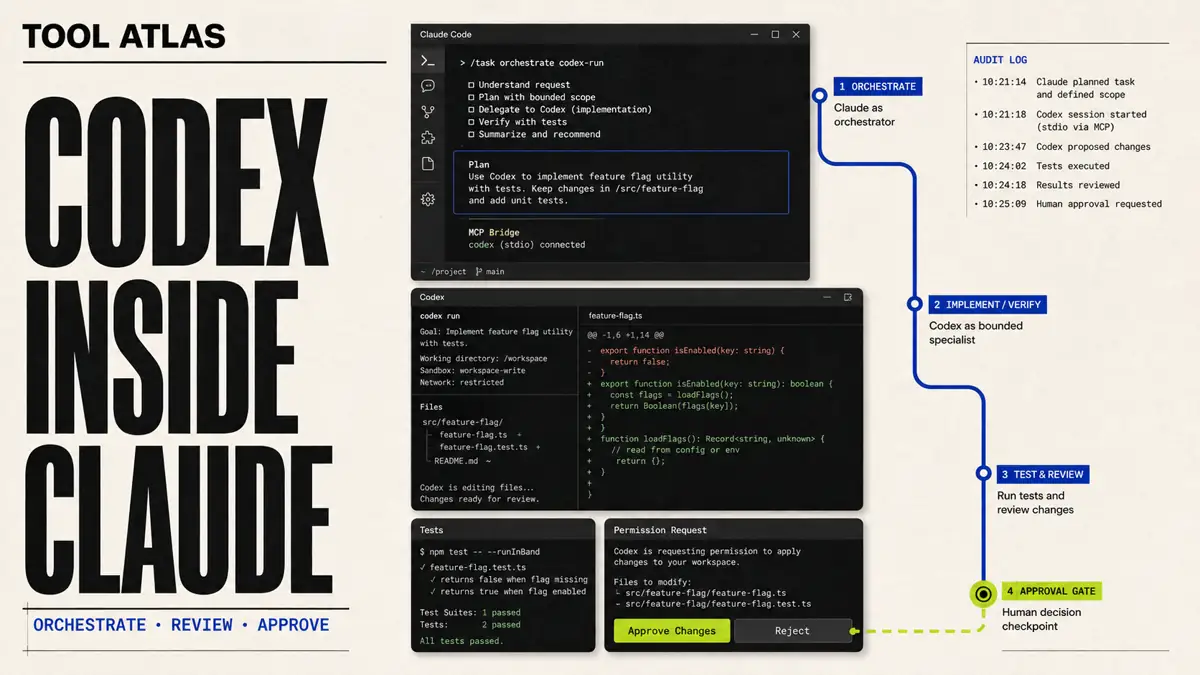
Claude Code has evolved into an extensible agent environment with plugins, subagents, hooks, sandboxing, and Model Context Protocol support, while OpenAI has turned Codex into a programmable coding agent that can be controlled through its CLI, SDK, app server, non-interactive execution mode, and MCP server.1, 2, 3, 4, 6, 7, 8, 9, 10, 11, 12
More importantly, there is now a remarkably direct integration path: OpenAI maintains an official Codex plugin for Claude Code. The plugin lets Claude users invoke Codex for code reviews, adversarial reviews, debugging and implementation tasks, background jobs, and session handoffs without leaving their Claude Code workflow. Under the hood, the plugin wraps the local Codex app server and uses the same Codex CLI installation, authentication state, repository checkout, and configuration already present on the machine.1, 2, 3, 4, 6, 7, 8, 9, 10, 11, 12
That changes the architectural question from:1, 2, 3, 4, 6, 7, 8, 9, 10, 11, 12
to:1, 2, 3, 4, 6, 7, 8, 9, 10, 11, 12
My conclusion is straightforward: Claude-plus-Codex is already practical for developer workstations, code review, CI-adjacent workflows, debugging, and bounded agent delegation. It is not yet something I would give unrestricted production privileges.6, 7, 8, 9, 10, 11, 12
The highest-value pattern is not to let two agents endlessly talk to each other. It is to make one agent the orchestrator and the other a specialist, exchange compact structured artifacts rather than entire transcripts, put both behind filesystem and network boundaries, and measure cost per accepted engineering outcome.1, 2, 3, 4, 6, 7, 8, 9, 10, 11, 12
For most teams, I would start with:1, 2, 3, 4, 6, 7, 8, 9, 10, 11, 12
Claude → implementation/reasoning → Codex read-only review → human approval6, 7, 8, 9, 10, 11, 12
rather than:1, 2, 3, 4, 6, 7, 8, 9, 10, 11, 12
Claude ↔ Codex ↔ Claude ↔ Codex until somebody runs out of tokens.6, 7, 8, 9, 10, 11, 12
That distinction determines whether multi-agent coding becomes leverage or simply an expensive automated argument.1, 2, 3, 4, 6, 7, 8, 9, 10, 11, 12
Why Claude and Codex Are More Complementary Than They Look
Background and motivation. Claude and Codex increasingly overlap, but they do not have to play identical roles.6, 7, 8, 9, 10, 11, 12
Anthropic describes Claude as a general AI platform capable of language, analysis, reasoning, and coding, while Claude Code adds repository-aware tools, file operations, command execution, extensibility, subagents, hooks, and MCP integrations. OpenAI positions Codex specifically around coding-agent workloads; its SDK is designed for programmatic coding threads, CI/CD, internal engineering tools, and applications in which Codex becomes a specialist inside a larger workflow.1, 2, 3, 4, 6, 7, 8, 9, 10, 11, 12
The useful abstraction is therefore not “model A versus model B,” but planner/orchestrator versus execution or verification specialist.1, 2, 3, 4, 6, 7, 8, 9, 10, 11, 12
A Claude-led workflow might ask Claude to understand a product requirement, inspect architecture, decide what needs to change, and coordinate the task. Codex can then independently inspect the resulting diff, challenge assumptions, investigate failing tests, or implement a tightly scoped subtask.6, 7, 8, 9, 10, 11, 12
OpenAI's official Claude Code plugin already encodes several of these patterns. /codex:review performs read-only review, /codex:adversarial-review challenges design choices and failure modes, /codex:rescue delegates debugging or implementation work, and background commands allow long-running Codex jobs to continue while Claude works on something else.1, 2, 3, 4, 6, 7, 8, 9, 10, 11, 12
The most natural use cases are therefore:1, 2, 3, 4, 6, 7, 8, 9, 10, 11, 12
Code generation and implementation. Claude decomposes a feature; Codex receives one bounded engineering unit.6, 7, 8, 9, 10, 11, 12
Independent code review. Claude creates the change; Codex acts as a second-model reviewer rather than asking the same model to critique its own work.6, 7, 8, 9, 10, 11, 12
Automation scripts and CI investigations. Codex supports codex exec specifically for pipelines, scheduled tasks, pre-merge workflows, and machine-readable JSONL output.6, 7, 8, 9, 10, 11, 12
Agent orchestration. Claude determines when a specialist is worth invoking; Codex executes the coding-specific subtask and returns results.6, 7, 8, 9, 10, 11, 12
There is an important conceptual rule here: do not make hidden chain-of-thought the protocol between agents. Production orchestration should exchange explicit task specifications, tool calls, test outcomes, diffs, structured findings, and concise explanations. Codex's app server exposes streamed agent events, approvals, authentication and conversation state; MCP provides structured tool interfaces. Those are much more reliable integration boundaries than trying to transport one model's private reasoning into another.6, 7, 8, 9, 10, 11, 12
The Architecture: Three Ways to Put Codex Behind Claude
Technical feasibility. There are now three realistic integration levels.1, 2, 3, 4, 6, 7, 8, 9, 10, 11, 12
The first—and the one I would recommend for individual developers—is the official OpenAI Codex plugin for Claude Code. Installation is unusually simple:1, 2, 3, 4, 6, 7, 8, 9, 10, 11, 12
/plugin marketplace add openai/codex-plugin-cc
/plugin install codex@openai-codex
/reload-plugins
/codex:setup
The plugin requires Node.js 18.18 or later and either Codex authentication through a ChatGPT account or an OpenAI API key. If Codex is not already authenticated, codex login is required. In other words: requires credentials/privileged access to the relevant OpenAI account or API project.6, 7, 8, 9, 10, 11, 12
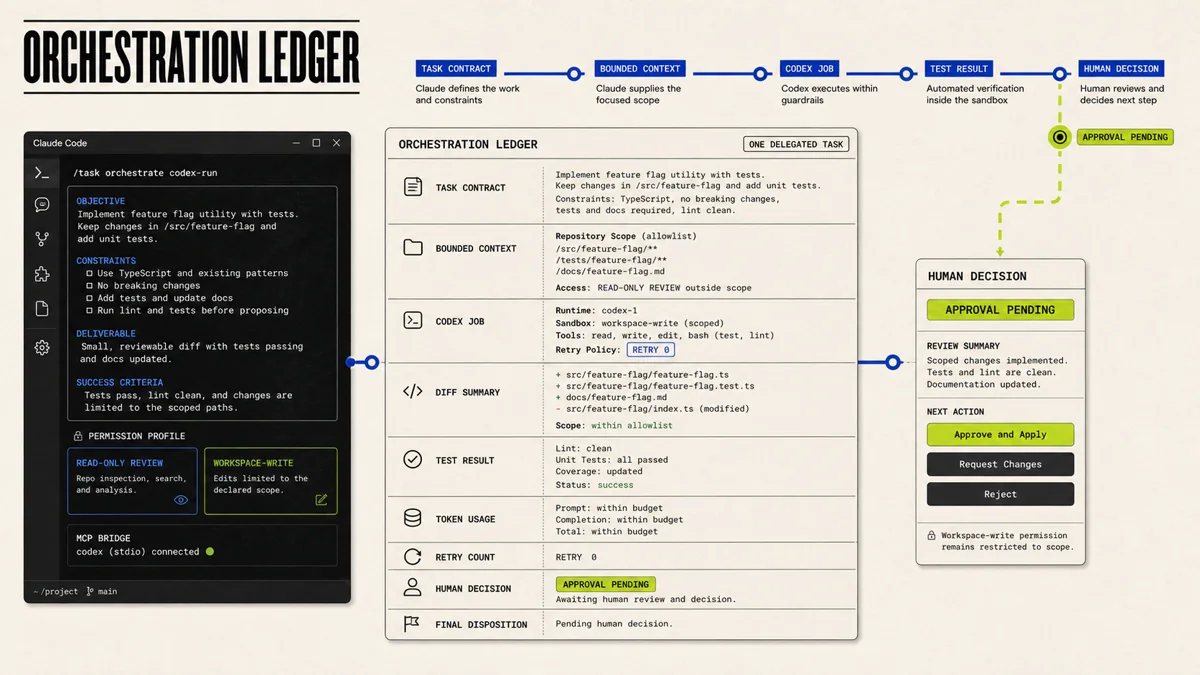
The resulting architecture looks approximately like this:1, 2, 3, 4, 6, 7, 8, 9, 10, 11, 12
OpenAI states that its Claude Code plugin wraps the Codex app server, invokes the globally installed Codex binary, and shares Codex's local authentication, configuration, checkout, and machine environment.1, 2, 3, 4, 6, 7, 8, 9, 10, 11, 12
The second path is MCP.1, 2, 3, 4, 6, 7, 8, 9, 10, 11, 12
Claude Code supports local stdio MCP servers using the pattern claude mcp add ... -- <command>, while Codex can itself run as an MCP server. OpenAI documents codex mcp-server specifically as a way for another agent to consume Codex, exposing Codex as a long-running specialist.1, 2, 3, 4, 6, 7, 8, 9, 10, 11, 12
That makes the following standards-based setup possible:1, 2, 3, 4, 6, 7, 8, 9, 10, 11, 12
# Requires an installed and authenticated Codex CLI.
claude mcp add --transport stdio codex -- codex mcp-server
This exact pairing is an architectural inference from the two vendors' documented MCP interfaces, whereas OpenAI's Claude Code plugin is the more explicit first-party integration. Claude Code's MCP documentation also warns that servers processing external content create prompt-injection risk, so MCP should be treated as a security boundary rather than just a convenience layer.1, 2, 3, 4
The third path is the application/API architecture. A SaaS product can make Claude the user-facing orchestration model while a server-side worker invokes Codex through the Codex SDK, app server, CLI, or a controlled MCP bridge. OpenAI explicitly recommends its SDK when Codex needs to be embedded in applications and its MCP-server pattern when Codex is a specialist in a broader agent workflow.6, 7, 8, 9, 10, 11, 12
That is the architecture I would choose for a product rather than a developer workstation.1, 2, 3, 4, 6, 7, 8, 9, 10, 11, 12
A Practical Implementation Guide
Implementation steps. Do not begin by building sophisticated agent-to-agent conversations. Begin by making delegation boring.1, 2, 3, 4, 6, 7, 8, 9, 10, 11, 12
| Step | What to implement | Expected time | Complexity | Risk |
|---|---|---|---|---|
| Environment | Install Claude Code, Codex CLI/plugin, verify versions | 30–60 min | Low | Low |
| Credentials | Authenticate Claude and Codex; keep secrets outside repository | 30–90 min | Medium | High |
| Permissions | Configure read/write/network boundaries | 1–3 hrs | Medium | High |
| Routing | Define which tasks Claude may delegate to Codex | 2–4 hrs | Medium | Medium |
| Prompt contract | Define input/output schema and acceptance criteria | 2–6 hrs | Medium | Medium |
| Retry/control | Add timeout, queue, concurrency and retry policies | 4–8 hrs | Medium | Medium |
| Observability | Log task ID, model, status, token usage and outcome | 1–2 days | Medium | Medium |
| Production hardening | CI tests, evals, audit controls, rollback | 1–3 weeks | High | High |
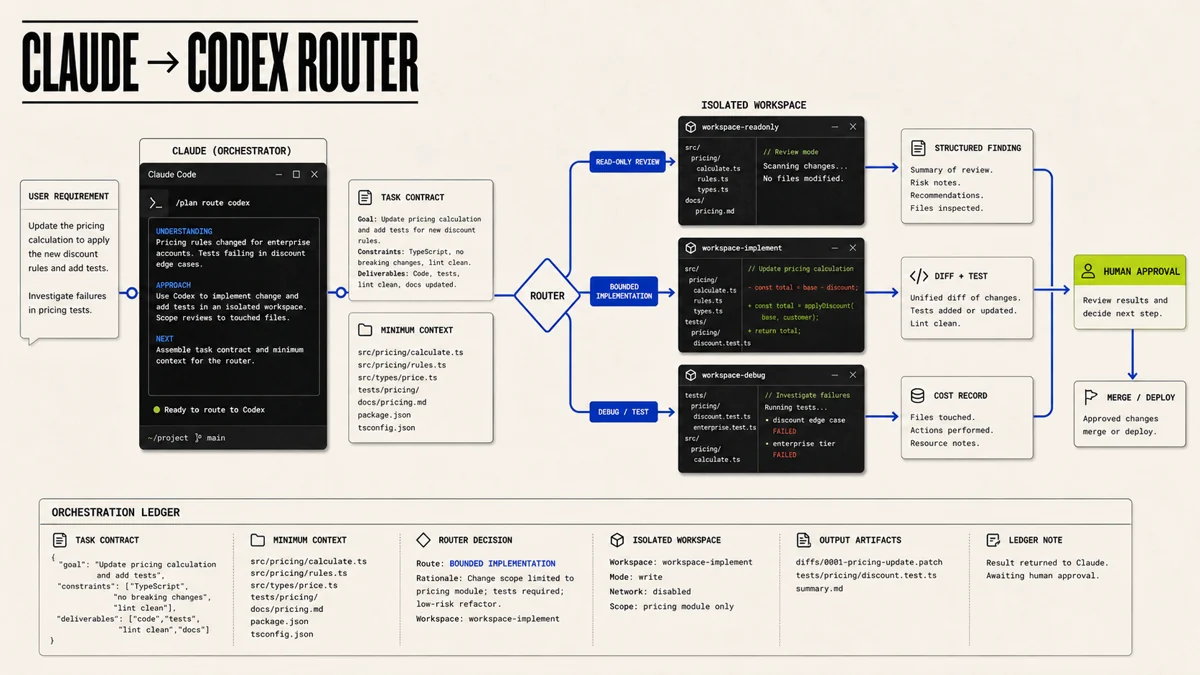
The crucial architectural choice is request routing.1, 2, 3, 4, 6, 7, 8, 9, 10, 11, 12
Instead of telling Claude, “Ask Codex whenever you think it might help,” define policy:6, 7, 8, 9, 10, 11, 12
Delegate to Codex when:
- an independent review is requested;
- a failing build needs isolated investigation;
- a coding task can be described with explicit acceptance tests;
- the expected value of independent verification exceeds the token budget.

Do not delegate when:
- the request contains production secrets;
- the task requires unrestricted infrastructure access;
- a deterministic tool can answer the question;
- the same task has already failed twice without new information.
The router should transmit the minimum sufficient context.1, 2, 3, 4, 6, 7, 8, 9, 10, 11, 12
A practical pseudocode implementation might look like this:1, 2, 3, 4, 6, 7, 8, 9, 10, 11, 12
import asyncio
import json
import os
from dataclasses import dataclass

@dataclass
class AgentTask:
    task_id: str
    objective: str
    repo_path: str
    acceptance_tests: list[str]
    max_attempts: int = 2

async def run_codex(task: AgentTask) -> dict:
    """
    Requires credentials/privileged access:
    Codex CLI must already be authenticated.
    """

    prompt = f"""
Objective:
{task.objective}

Acceptance criteria:
{chr(10).join(f"- {x}" for x in task.acceptance_tests)}

Rules:
- Work only inside the current repository.
- Do not expose credentials.
- Prefer the smallest safe change.
- Run relevant tests.
- Return: summary, files changed, tests, unresolved risks.
"""

    cmd = [
        "codex", "exec",
        "--json",
        "--sandbox", "workspace-write",
        prompt,
    ]

    for attempt in range(task.max_attempts):
        proc = await asyncio.create_subprocess_exec(
            *cmd,
            cwd=task.repo_path,
            stdout=asyncio.subprocess.PIPE,
            stderr=asyncio.subprocess.PIPE,
        )

        stdout, stderr = await proc.communicate()

        if proc.returncode == 0:
            events = [
                json.loads(line)
                for line in stdout.decode().splitlines()
                if line.strip()
            ]
            return {
                "task_id": task.task_id,
                "status": "completed",
                "events": events,
            }

        # Simplified exponential backoff.
        # Production code should classify retryable vs permanent failures.
        await asyncio.sleep(2 ** attempt)

    return {
        "task_id": task.task_id,
        "status": "failed",
        "error": stderr.decode()[-2000:],
    }
Codex officially supports codex exec for scripted and CI workloads and JSONL event output for machine consumption. Both OpenAI and Anthropic recommend bounded exponential-backoff behavior for transient failures; their SDKs already retry several eligible transient errors, so adding an application retry loop without understanding SDK behavior can accidentally multiply requests.6, 7, 8, 9, 10, 11, 12
Concurrency deserves similar discipline. Both Claude and Codex support parallel agent patterns, but both vendors warn that parallel agents increase token consumption because each agent performs its own model and tool work.6, 7, 8, 9, 10, 11, 12
My default would therefore be:1, 2, 3, 4, 6, 7, 8, 9, 10, 11, 12
interactive coding: concurrency 1–2
code review queue: concurrency 2–4
large repository scan: bounded worker pool
production-changing operations: concurrency 1 + human approval
These are operational recommendations, not vendor limits.1, 2, 3, 4, 6, 7, 8, 9, 10, 11, 12
Token Economics, Cost Optimization, and Business Value
Cost and token optimization. Multi-agent systems have an uncomfortable economic property: adding an agent often increases both capability and duplicated context.1, 2, 3, 4, 6, 7, 8, 9, 10, 11, 12
A naive system sends a 50,000-token repository summary to Claude, forwards the same 50,000 tokens to Codex, receives a long report, sends that report back into Claude, then repeats the process.6, 7, 8, 9, 10, 11, 12
That is not orchestration. It is token amplification.1, 2, 3, 4, 6, 7, 8, 9, 10, 11, 12
A better cost formula is:1, 2, 3, 4, 6, 7, 8, 9, 10, 11, 12
Total Cost =
(Claude input tokens × Claude input price)
+ (Claude output tokens × Claude output price)
+ (Codex input tokens × Codex input price)
+ (Codex output tokens × Codex output price)
+ tool / infrastructure charges
For prices per million tokens:1, 2, 3, 4, 6, 7, 8, 9, 10, 11, 12
Cost =
(Tc_in / 1,000,000 × Pc_in)
+ (Tc_out / 1,000,000 × Pc_out)
+ (Tx_in / 1,000,000 × Px_in)
+ (Tx_out / 1,000,000 × Px_out)
Because the requested deployment does not specify exact Claude/Codex models, plan type, region, service tier, or subscription-versus-API billing, the dollar estimates below are deliberately unspecified.6, 7, 8, 9, 10, 11, 12
| Calling pattern | Claude input/output | Codex input/output | Relative token load | Estimated dollar cost |
|---|---|---|---|---|
| Claude only | 12k / 2k | — | Baseline | unspecified |
| Claude + one Codex review | 12k / 1.5k | 18k / 3k | ~2–3× | unspecified |
| Claude + scoped Codex specialist | 8k / 1k | 10k / 2k | ~1.5–2× | unspecified |
| Three-round Claude↔Codex loop | 30k / 5k | 54k / 9k | Very high | unspecified |
| Hierarchical routing + cached context | 8k / 1k | 8k / 1.5k | Controlled | unspecified |
The winning strategies are surprisingly mundane.1, 2, 3, 4, 6, 7, 8, 9, 10, 11, 12
Prompt engineering: send a task contract, relevant file paths, failing tests and acceptance criteria—not the whole conversation.1, 2, 3, 4, 6, 7, 8, 9, 10, 11, 12
Hierarchical model selection: use stronger models where ambiguity is high and cheaper/faster models for narrow investigations. Anthropic explicitly recommends routing focused subagent work to cheaper models to control cost, and OpenAI's Claude plugin allows model and reasoning-effort configuration for delegated Codex jobs.6, 7, 8, 9, 10, 11, 12
Caching: keep stable instructions, architecture guidance, tool definitions and repository conventions at the beginning of prompts. Both Anthropic and OpenAI support prompt caching for repeated prompt prefixes; Anthropic also documents substantial price reductions for cache reads relative to fresh input.1, 2, 3, 4, 6, 7, 8, 9, 10, 11, 12
Context isolation: let specialist agents search large logs or code areas in their own context and return only conclusions. Claude's subagent design explicitly uses isolated contexts to prevent exploratory material from flooding the main conversation.1, 2, 3, 4
Streaming: use it for perceived latency and early processing, not as a magical token discount. Streaming allows applications to process responses incrementally; it only reduces total spend when your architecture can stop unnecessary generation or avoid subsequent calls.1, 2, 3, 4, 6, 7, 8, 9, 10, 11, 12
Benefits and commercial value. For product and engineering leaders, I would not justify the architecture with “more AI.” I would justify it using measurable outcomes.1, 2, 3, 4, 6, 7, 8, 9, 10, 11, 12
Recommended KPIs include:1, 2, 3, 4, 6, 7, 8, 9, 10, 11, 12
| Business objective | KPI |
|---|---|
| Developer productivity | Median human minutes per accepted change |
| Faster delivery | Issue-to-PR and PR-to-merge lead time |
| QA automation | Percentage of PRs receiving independent agent review |
| Quality | Escaped defects per release / accepted agent finding rate |
| Reliability | Successful delegated jobs / total delegated jobs |
| Economics | AI cost per merged PR or resolved issue |
| Automation | Percentage of agent tasks requiring no manual rework |
| Product differentiation | Time from user specification to validated prototype |
The key KPI is cost per accepted outcome, not tokens per session.1, 2, 3, 4, 6, 7, 8, 9, 10, 11, 12
A system that spends twice as many tokens but cuts debugging from four engineer-hours to twenty minutes may be economically excellent. A system that generates millions of cheap tokens while producing noisy reviews is not.1, 2, 3, 4, 6, 7, 8, 9, 10, 11, 12
Security, Compliance, and Production Operations
Risk and compliance. Connecting two coding agents compounds capabilities—and therefore compounds risk.1, 2, 3, 4, 6, 7, 8, 9, 10, 11, 12
Both Claude Code and Codex provide sandbox and permission mechanisms. Claude Code normally restricts write operations and supports filesystem/network sandboxing; Codex likewise separates approval policies from sandbox boundaries and defaults to constrained workspace access rather than unrestricted machine access.1, 2, 3, 4, 6, 7, 8, 9, 10, 11, 12
The production priority list should look like this:1, 2, 3, 4, 6, 7, 8, 9, 10, 11, 12
| Priority | Risk | Mitigation |
|---|---|---|
| Critical | Secret leakage | Vault-managed credentials; no keys in prompts/repos; redact logs |
| Critical | Destructive commands | Workspace sandbox; deny unrestricted shell/network; human approval |
| Critical | Prompt injection | Treat repo/docs/MCP content as untrusted; tool allowlists |
| High | Runaway agent loops | Hard turn limits, timeouts, cost ceilings, cancellation |
| High | Data sovereignty | Provider/region review, DPA, retention and residency assessment |
| High | Supply-chain exposure | Pin/approve plugins, CLI versions and MCP servers |
| Medium | Model drift | Regression evals and canary deployments |
| Medium | Service failure | Retry budgets, fallback modes and manual workflow |
| Medium | Abuse | Authentication, per-user quotas and audit logging |
The official OpenAI Claude plugin itself warns that its optional review gate can create long Claude/Codex loops and rapidly consume usage limits. That is exactly why autonomous “model debates” should not be your default architecture.6, 7, 8, 9, 10, 11, 12
GDPR and data sovereignty also become more complicated when two vendors participate in the same task. OpenAI offers DPAs and data-residency options for eligible business/API customers, while Anthropic incorporates a DPA with Standard Contractual Clauses into its commercial terms and documents GDPR-oriented privacy practices. Availability, retention, residency and zero-retention behavior depend on product, account and configuration, so a compliant Claude-only architecture does not automatically imply that forwarding the same data into Codex preserves your compliance posture.5, 13
That legal distinction matters.1, 2, 3, 4, 6, 7, 8, 9, 10, 11, 12
Operations and monitoring. Production systems need an orchestration ledger. For every delegated task, record:1, 2, 3, 4, 6, 7, 8, 9, 10, 11, 12
task_id
parent_session_id
repository / environment
orchestrator model
specialist model
prompt/context version
permission profile
start/end timestamps
retry count
token usage
estimated cost
files changed
test result
human approval
final disposition
Claude Code can export usage, cost and tool-activity telemetry through OpenTelemetry, while its analytics tooling can track organizational usage. OpenAI likewise provides Codex-oriented enterprise analytics/governance capabilities.14, 6, 7, 8, 9, 10, 11, 12
I would set internal SLOs such as:1, 2, 3, 4, 6, 7, 8, 9, 10, 11, 12
99.5% orchestration-layer availability, 95% of delegated jobs reaching a terminal state before their configured timeout, 100% of production-impacting operations passing an explicit policy gate, and 100% of agent jobs generating an auditable task record.1, 2, 3, 4, 6, 7, 8, 9, 10, 11, 12
Those are suggested engineering targets, not Claude or OpenAI guarantees.1, 2, 3, 4
Rollback should be equally boring: agents work on Git branches or worktrees, commits remain reversible, deployment credentials stay outside the agent sandbox, and failed agent changes are discarded rather than “fixed forward” automatically. Codex itself supports worktree-based parallelism specifically to isolate simultaneous work.6, 7, 8, 9, 10, 11, 12
Where This Architecture Actually Makes Sense
Case studies and scenarios. Consider two realistic deployments.1, 2, 3, 4, 6, 7, 8, 9, 10, 11, 12
| Scenario | Primary benefit | Relative AI cost | Implementation time | Main difficulty |
|---|---|---|---|---|
| Automated code-review agent | Independent verification, faster review queue | Medium | 1–3 weeks | False positives and context quality |
| Low-code backend generator | Faster prototype-to-code cycle | High | 4–8 weeks | Security, sandboxing, validation |
Scenario A: the independent code-review agent.1, 2, 3, 4, 6, 7, 8, 9, 10, 11, 12
A SaaS company lets Claude Code implement issues. Before a pull request is submitted, Codex runs a read-only review or adversarial review against the diff. Claude receives structured findings and either fixes them or explains why they are not applicable. A human still owns merge approval.1, 2, 3, 4, 6, 7, 8, 9, 10, 11, 12
This is arguably the best first deployment because the second model is not being given production authority. OpenAI's plugin already exposes read-only review modes specifically for this workflow.1, 2, 3, 4, 6, 7, 8, 9, 10, 11, 12
The economic question becomes measurable:1, 2, 3, 4, 6, 7, 8, 9, 10, 11, 12
Incremental AI cost
vs.
reviewer minutes saved
+ defects caught before merge
+ reduced rework
The difficult part is not connecting the APIs. It is tuning what qualifies as a useful finding.1, 2, 3, 4, 6, 7, 8, 9, 10, 11, 12
Scenario B: a low-code platform that generates backend services.1, 2, 3, 4, 6, 7, 8, 9, 10, 11, 12
A customer describes a data model and workflow. Claude acts as product interpreter and architect, translates ambiguous requirements into a technical plan, and sends bounded coding tasks to Codex. Codex generates handlers, migrations and tests in an isolated workspace. Claude validates the output against the original product requirement before the platform presents a preview.6, 7, 8, 9, 10, 11, 12
This architecture could materially reduce prototype time, but its production risk is much higher because generated code may touch databases, authentication and infrastructure.1, 2, 3, 4, 6, 7, 8, 9, 10, 11, 12
The correct sequence is therefore:1, 2, 3, 4, 6, 7, 8, 9, 10, 11, 12
Conclusion and recommendations.1, 2, 3, 4, 6, 7, 8, 9, 10, 11, 12
My view is that running Codex inside Claude is no longer an experimental hack. OpenAI's official Claude Code plugin, Codex app server, SDK, MCP server and non-interactive tooling—combined with Claude Code's plugins, MCP, hooks, subagents and sandboxing—make the integration technically legitimate today.1, 2, 3, 4, 6, 7, 8, 9, 10, 11, 12
But the architecture only becomes economically interesting when the agents have different jobs.1, 2, 3, 4, 6, 7, 8, 9, 10, 11, 12
Using Claude and Codex to redundantly solve every problem doubles context and increases latency. Using Claude to interpret and orchestrate while Codex independently reviews or executes bounded engineering work creates something more valuable: model specialization plus independent verification.6, 7, 8, 9, 10, 11, 12
My three recommendations are therefore:1, 2, 3, 4, 6, 7, 8, 9, 10, 11, 12
Short term — use Codex as Claude's reviewer, not its co-pilot for everything. Install the official plugin, begin with /codex:review and /codex:adversarial-review, keep operations read-only, and measure accepted findings per dollar and human minute saved.6, 7, 8, 9, 10, 11, 12
Medium term — build a routing and observability layer. Delegate only tasks with explicit acceptance criteria; cap concurrency, retries, context size and budget; enable telemetry; keep credentials outside prompts; and require human gates for destructive or production actions. Claude and Codex both provide the permission and sandbox primitives needed to support this architecture.14, 6, 7, 8, 9, 10, 11, 12
Long term — treat models as replaceable workers, not the architecture itself. Build around task contracts, MCP/tool interfaces, test results, diffs, audit trails and policy boundaries. Claude may be the best orchestrator for one workload and Codex the best specialist for another today; those model choices will change. The durable competitive advantage is the orchestration system that knows when to delegate, how much context to send, what authority to grant, how to verify the answer, and when to stop.6, 7, 8, 9, 10, 11, 12
That is the deeper shift behind “Codex inside Claude.”6, 7, 8, 9, 10, 11, 12
The interesting future is not one AI assistant that does everything.1, 2, 3, 4, 6, 7, 8, 9, 10, 11, 12
It is a software-development environment in which multiple specialized agents work under an explicit operating system of permissions, budgets, tests and accountability—and humans decide what is allowed to ship.1, 2, 3, 4, 6, 7, 8, 9, 10, 11, 12