
A researcher is only one line in the budget
The cost of UX research has no useful single-number answer. A full-time salary, a freelancer's hourly rate, a fixed project fee, and a complete study budget describe different purchases. In August 2026, Indeed reported an average US User Experience Researcher salary of about $147,012 a year, while Built In reported $107,332 in average base salary and $119,444 in average total compensation. Upwork's marketplace benchmark for freelance UX researchers was $40–$80 an hour, with a median near $60. None of those figures includes every participant, recruiting fee, tool, or hour of internal coordination.1, 2, 3
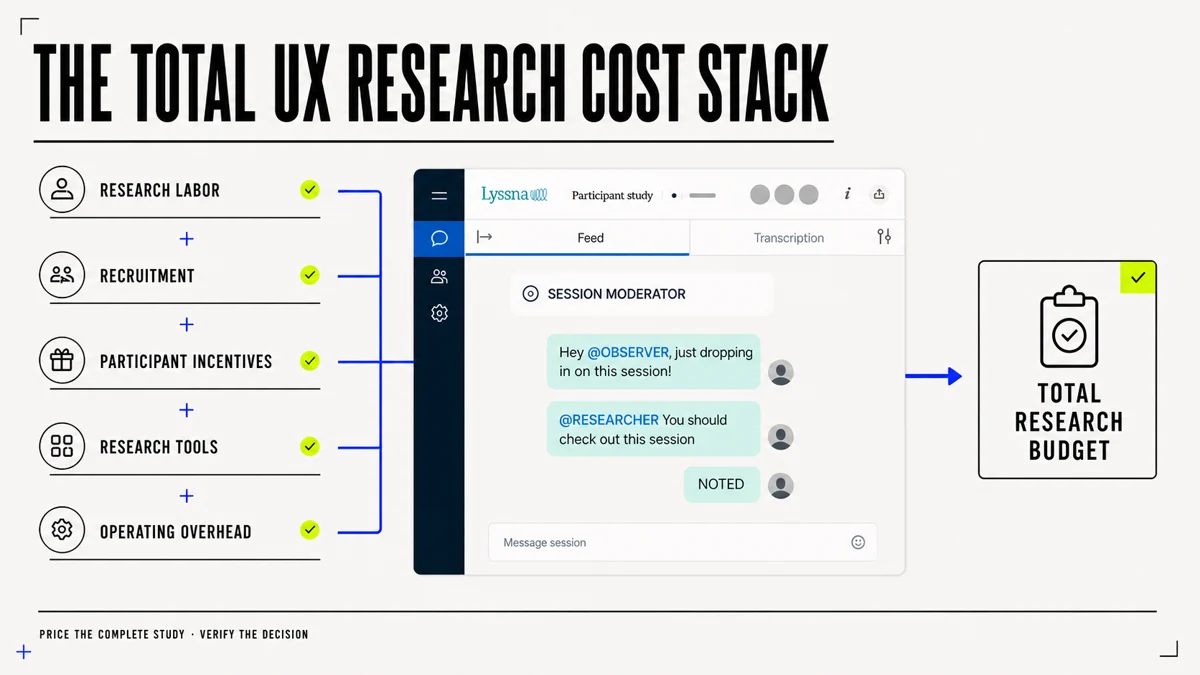
The planning equation is more useful: research labor + recruitment + participant incentives + research tools + operational overhead = total UX research cost. The mix changes with the decision, method, audience, geography, seniority, and amount of context the researcher must acquire. Five existing customers reviewing a checkout flow do not cost the same as five enterprise security leaders who meet a narrow screener, even though both study plans say “five interviews.”4, 5
2026 salary, freelance, project, and participant benchmarks
The public benchmarks form a wide range because they measure different things. Salary datasets reflect different samples, job titles, locations, seniority mixes, and compensation fields. Marketplace rates describe work purchased through one platform. Recruiting and incentive figures price access to participants rather than research design or analysis. Read each number with its unit and boundary attached.1, 2, 3, 4, 5
| Cost model | 2026 reference point | What the number includes | What still sits outside it |
|---|---|---|---|
| Full-time US UX researcher | About $107K–$147K average salary across Built In and Indeed | Employee base salary in each dataset | Benefits, recruiting, equipment, tools, management, and other overhead |
| Freelance UX researcher | About $40–$80/hour on Upwork; median near $60 | Marketplace research labor | Recruitment, incentives, software, travel, tax, and internal staff time |
| Usability testing project | About $600–$1,500 on Upwork | A bounded researcher project fee | Any excluded participant, recruiting, tooling, or operational cost |
| Interviews and persona project | About $1,500–$3,500 on Upwork | Interview research and persona work at the stated marketplace scope | Scope changes, specialist participants, and excluded expenses |
| End-to-end UX audit | About $3,500–$7,000+ on Upwork | A larger research and audit engagement | Additional recruiting, incentives, travel, implementation, or follow-up |
| Participant incentive | Often about $60–$100/participant-hour | Payment for participant time | Recruiting platform fee and research labor |
| Consumer recruiting | About $40/completed session on Respondent PAYG | Recruiting a completed consumer session | Participant incentive |
| B2B recruiting | About $80/completed session on Respondent PAYG | Recruiting a completed B2B session | Participant incentive |
Indeed's figure came from its User Experience Researcher salary page and should not be averaged blindly with Built In's. The gap is a warning against false precision, not proof that one dataset is wrong. A budget should name its geography, seniority, employment model, compensation definition, and date before using either figure.1, 2
The five cost layers inside a study
Research labor
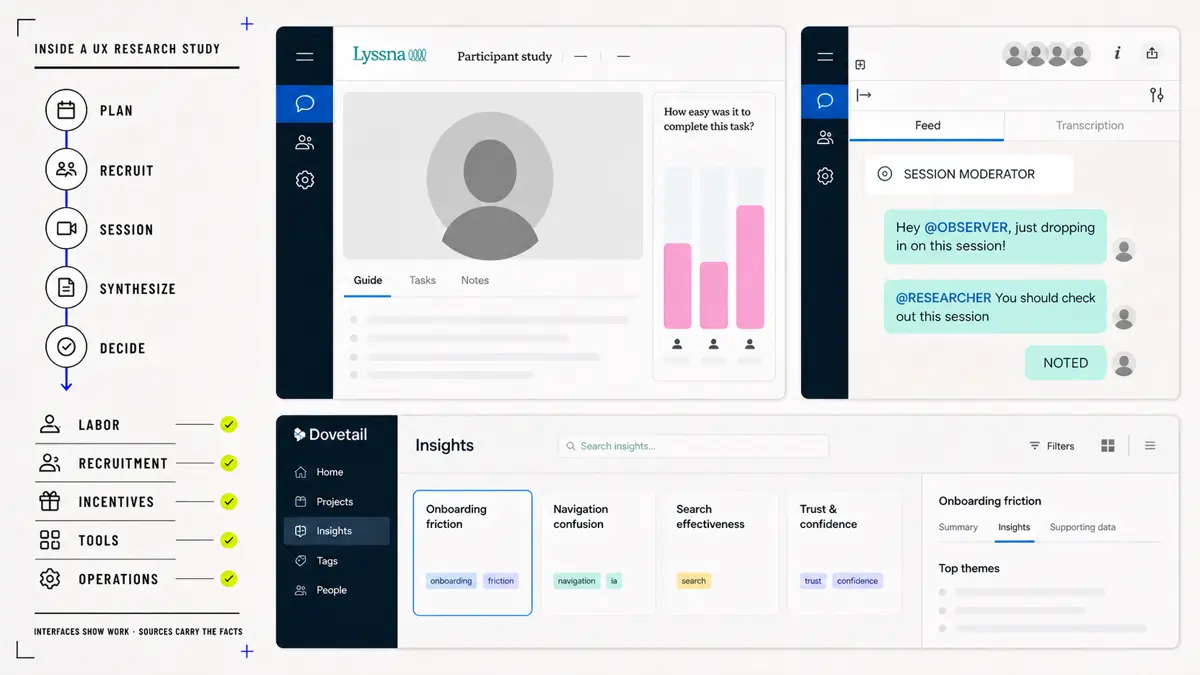
The recorded session is the most visible part of research and often the smallest part of the researcher's job. A serious study can include stakeholder alignment, research-question framing, method selection, participant criteria, screener design, recruitment management, pilot sessions, moderation, transcription review, coding, synthesis, recommendations, presentation, and follow-up. Upwork's own difference between a contained usability study and a larger interview or audit engagement makes this scope visible.3
Participant incentives
Participants are being asked to exchange time, attention, experience, and sometimes sensitive professional context for compensation. User Interviews' incentive guidance places many studies around $60–$100 per participant-hour, with a baseline near $80 for remote moderated general-consumer work and higher expectations for professionals or scarce audiences. Ten one-hour consumer interviews can therefore add about $800 in incentives before the first recruiting fee.5
Participant recruitment
Recruitment is a separate service when the required people are not already reachable through a customer list or community. Respondent's pay-as-you-go reference points were about $40 per completed consumer session and $80 per completed B2B session, excluding incentives. User Interviews also separates recruiting from incentive value and changes pricing by audience and commitment. Existing-customer recruiting can reduce cash cost, but only when existing customers are the population the decision requires.4, 6
Research software
Software becomes material when research recurs. Lookback listed a $299/year freelance plan, $1,782/year team plan, and $4,122/year Insights Hub at the checked date. Optimal Workshop listed Starter at $199/month billed annually, with five studies a year, unlimited seats, and unlimited participant responses per study; Enterprise remained custom. These products can reduce scheduling, recording, observation, repository, and analysis work, but their plan limits and recruiting charges still belong in the budget.7, 8
Operational overhead
Internal time does not disappear when an external researcher runs the study. A product manager may define the decision, legal or security may review handling of participant data, designers and engineers may observe sessions, and a decision owner must accept or reject the recommendations. Localization, accessibility accommodations, travel, taxes, procurement, and data retention can add further work. Track these items even when they do not appear on a vendor invoice.6, 7, 8
Two realistic planning models
Component pricing becomes useful when it is assembled into a study. The following examples preserve the research report's arithmetic but remain illustrative planning models, not market-wide quotes. They exclude software, taxes, travel, localization, accessibility accommodations, internal staff time, and unusual recruiting requirements.3, 4, 5
| Expense | Five remote consumers | Eight B2B professionals |
|---|---|---|
| Researcher fee | $600–$1,500 usability-study range | $1,500–$3,500 interview-and-persona range |
| Participant incentives | 5 × $80 = $400 | 8 × $100 = $800 |
| Recruiting | 5 × $40 = $200 | 8 × $80 = $640 |
| Illustrative total | $1,200–$2,100 | $2,940–$4,940 |
Changing only the audience increases the second model by $1,740–$2,840. A rare audience can move it further. A study seeking security executives at large companies, specialist clinicians using a particular device, or administrators of a niche enterprise system can require more screening, more recruiting work, and a higher incentive because the participant's time is harder to replace.4, 5
Employee, freelancer, or research partner
These purchasing models solve different operating problems. The right comparison is the complete capability and workload the organization receives, not salary divided by 2,080 hours versus a freelancer's rate.2, 3, 9
| Model | Best fit | Cost boundary to inspect | Main advantage | Main risk |
|---|---|---|---|---|
| Full-time researcher | Research is continuous and product context compounds | Salary, benefits, recruiting, tools, management, and other employer overhead | Accumulated product, customer, and organizational knowledge | Fixed annual commitment and possible gaps in specialist methods |
| Freelancer | Demand is uneven or the question is bounded | Labor scope, non-billable coordination, recruiting, incentives, and tools | Variable capacity and targeted specialization | Context acquisition and scope drift between projects |
| Agency or consultancy | The company needs an outcome with fieldwork and operations included | Exact deliverables, participant sourcing, specialist labor, workshops, localization, and implementation boundary | One party can coordinate the complete engagement | Custom scope makes headline-price comparison unreliable |
| Research platform | The team can design and own the study but needs infrastructure or participants | Plan limits, sessions, seats, panel fees, incentives, storage, and data handling | Repeatable scheduling, capture, observation, and analysis workflow | Software can scale weak study design as easily as sound research |
Salary also understates employer cost. In March 2026, the US Bureau of Labor Statistics reported that wages and salaries represented 69.9% of private-industry employer compensation, while benefits represented 30.1%. Used only as a broad planning ratio, Built In's $107,332 salary corresponds to roughly $154,000 in total compensation, and Indeed's $147,012 corresponds to roughly $210,000. Those calculations are not UX-specific employer quotes and still omit items such as recruiting, hardware, software, office space, and management.2, 1, 9
The employee's strongest economic advantage is accumulated context. The freelancer's is flexible capacity. The agency's is coordinated delivery. The platform's is repeatable infrastructure. Buy the advantage your current research program actually needs.3, 6, 7
AI reduces repeatable work, not the need for judgment
Maze's 2026 Future of User Research report surveyed nearly 500 researchers, designers, and product professionals. It reported that 69% used AI in at least some research projects, while respondents associated AI with faster turnaround, team efficiency, and workflow optimization. The same report placed nuance, emotion, ethics, research framing, strategic recommendations, and stakeholder influence among the areas where human judgment remains important.10
Transcription, first-pass coding, summarization, question generation, repository search, highlight extraction, and some unmoderated or AI-moderated work can become faster. The savings are real only when the output still survives evidence review. A quick synthesis cannot repair a leading question, an unrepresentative sample, a weak screener, or a conclusion stronger than the study supports.10, 8, 4
Set the budget from decision risk
A small product team can fund a useful targeted study for a few thousand dollars. A team running research every month may justify dedicated software and a regular freelancer or internal researcher. An organization making repeated high-stakes decisions may benefit from permanent research leadership and specialist partners. Company size alone does not determine the answer; research frequency, participant access, decision stakes, and internal capability do.3, 7, 8, 10
Start by writing the decision, the evidence required, the target participants, the cost of a wrong decision, and the person who will act on the result. Then price labor, recruitment, incentives, tools, and overhead separately. Keep an uncertainty range for difficult recruiting and scope changes. This worksheet makes a $3,000 study legible as risk reduction before a team spends months building, migrating, or launching the wrong thing.3, 4, 5
How much does a UX researcher cost per hour?
Upwork's current marketplace range is about $40–$80 per hour, with a median near $60. Treat it as a marketplace benchmark, not a ceiling for senior specialists or direct consulting relationships, and add any excluded recruitment, incentives, tools, and internal coordination.3
What is the average UX researcher salary in 2026?
Indeed reported about $147,012 for US User Experience Researchers in August 2026. Built In reported $107,332 average base salary and $119,444 average total compensation. Use the dataset that matches the role and compensation field you are planning, and retain the date and geography.1, 2
How much does a UX research project cost?
Upwork listed about $600–$1,500 for usability testing, $1,500–$3,500 for interviews and persona work, and $3,500–$7,000+ for an end-to-end UX audit. Those are researcher project ranges on one marketplace. A complete study may also need recruiting, incentives, software, internal staff time, and specialist accommodations.3
How much should participants and recruitment cost?
User Interviews' planning guidance places many incentives around $60–$100 per participant-hour, with about $80 for remote moderated consumers and higher baselines for professionals. Respondent's checked pay-as-you-go recruiting references were about $40 for a completed consumer session and $80 for B2B, before the incentive.5, 4
Can AI reduce UX research cost?
It can reduce repeatable labor in transcription, first-pass synthesis, reporting, and some research execution. Maze's 2026 report found widespread AI use and reported efficiency benefits, while also preserving a clear need for human judgment in nuance, ethics, framing, and recommendations. Budget the review and decision work instead of assuming automated output is reliable by default.10
The useful 2026 benchmark is a range: freelance labor may start around $40–$80 an hour; focused studies can land in the low thousands before added expenses; specialized B2B work can cost much more; and a full-time US researcher creates a six-figure annual compensation commitment. Optimize the budget for the lowest cost of learning something reliable before an expensive decision, not the lowest visible hourly rate.1, 2, 3, 4, 5