
Decision summary
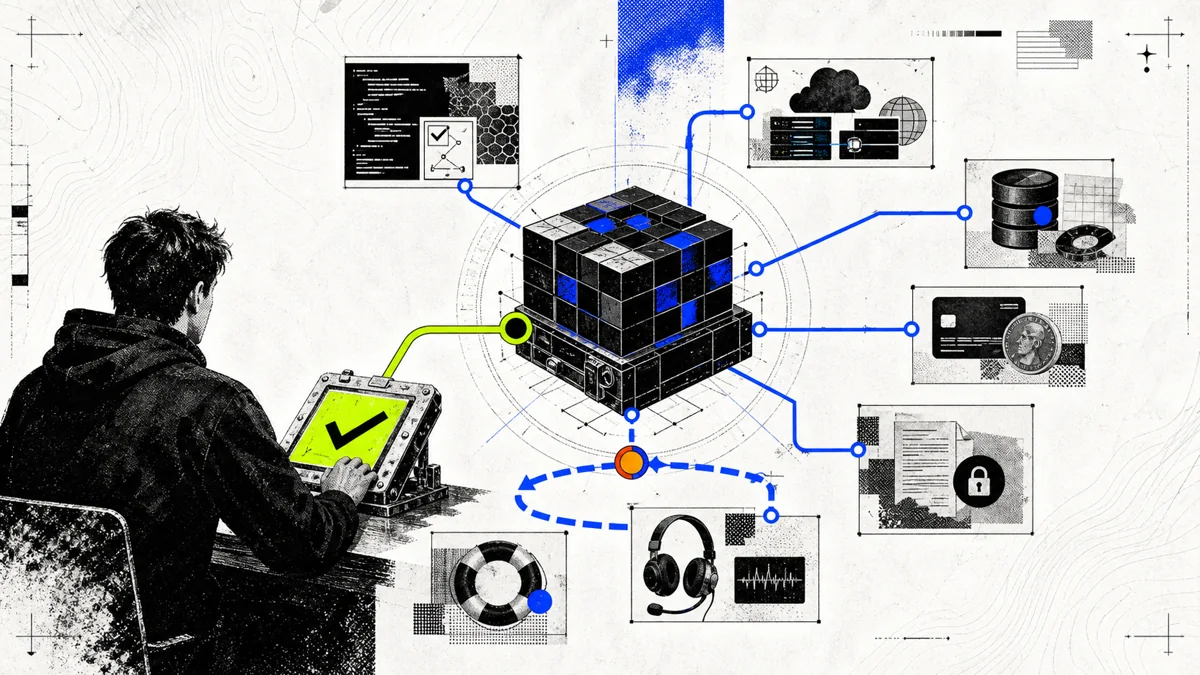
Vibe Coding is easy to mistake for a new programming language or a complete stack. It is a way of building and organizing work: people define the product boundary, acceptance criteria, and risk limits; AI retrieves context, drafts implementations, runs commands, edits code, and helps test the result. Andrej Karpathy popularized the term in early 2025. GitHub, Microsoft, OpenAI, Anthropic, and other vendors have since added multi-file editing, terminal execution, code review, and agent collaboration to production tools. GitHub’s own guidance still puts testing, security review, and human supervision between generated code and a production system.6, 10, 11, 12
A solo founder benefits from low fixed costs, a support load they can manage, decisions they can audit, and vendors they can replace. AI can draft a back-office system quickly; the founder still has to decide:1, 11
- Who owns the intellectual property rights in customer data and code;
- In which jurisdiction the data should be stored;
- Whether the main branch allows AI to commit directly;
- Whether the database backup can be restored;
- Whether the payment platform supports the company’s registration location;
- Whether software dependencies, logs and prompts leak customer information;
- Who bears the responsibility when the company encounters debt, tax or tort problems.
Use these rules when you choose the stack:1, 11
First, start with a managed modular monolith. For most solo companies, TypeScript, Node.js, PostgreSQL, Docker, managed hosting, and managed authentication form a legible, portable baseline. Split high-concurrency services into Go when measurements justify it. Reserve Rust for performance, security, local clients, and system components where its guarantees pay for the extra review cost. Technical novelty is not a reason to make Rust the default language for an uncertain SaaS MVP.2, 3, 4, 5
Second, spend first on controls that reduce irreversible risk. Authentication, database recovery, logs, error tracking, contracts, bookkeeping, and dependency security usually matter more than a second AI editor or a larger token allowance.8, 11, 12
Third, do not buy overlapping collaboration systems. Notion, Feishu, Linear, Jira, Slack, and Teams each cover part of project work. A solo company wastes more money and attention by scattering the same record across four products than by choosing a slightly more expensive primary tool.1, 11
Fourth, keep AI permissions inside the rollback boundary. An agent may create a branch, open a pull request, run tests, and deploy a preview. It should not receive production database write access, domain control, refund authority, or production secrets by default.7, 8, 9, 11
Fifth, choose the legal entity and payment route together. Jurisdiction, company type, budget, and team size are not interchangeable details. In mainland China, a sole proprietorship and a one-person limited liability company carry different liability and governance duties. Current company law also requires shareholders in a limited liability company to pay subscribed capital within the applicable five-year period. A payment tutorial cannot choose that structure for you.9, 13, 14
Excluding wages, taxes, payment fees and large model API usage, this article estimates:9
| Stage | Typical team | Fixed software vs. basic cloud costs | Core goals |
|---|---|---|---|
| Low cost verification | one person | About ¥300–¥1,200/month | Verify willingness to pay and try to use the free tier |
| Stable operation | one to three people | About ¥1,500–¥6,000/month | Establish monitoring, backup, contracts and support systems |
| Expansion and Compliance | three to eight people | About ¥8,000–¥40,000/month | Separation of permissions, multiple environments, auditing and service assurance |
The RMB conversion uses the internal planning assumption 1 USD≈7.2 RMB, which is not a real-time exchange rate; the price snapshot is as of August 2, 2026**, and the actual bill will also be affected by usage, region, taxes, annual payments and vendor price changes.1, 11
Problem and comparison
For a solo company, Vibe Coding can reduce the minimum team needed to ship software. One person can switch between product, design, engineering, testing, and operations, but that person still owns the final decision and the risk.1, 11
Traditional development spends most on people and coordination. With Vibe Coding, watch these constraints instead:1, 11
| Constraint | Performance in traditional teams | Vibe Coding Performance in Personal Company |
|---|---|---|
| demand quality | Product managers communicate repeatedly with R&D | Fuzzy requirements will be quickly amplified by AI into incorrect implementations |
| context management | Knowledge exists in the heads of team members | Warehouse rules, documentation and acceptance tests must be written |
| code review | Cross-review by multiple engineers | The founder is both a generator and a reviewer, prone to confirmation bias |
| operations responsibilities | Have dedicated DevOps or SRE | Outages, chargebacks, complaints and security incidents all go back to the founder |
| delivery speed | Subject to scheduling and personnel restrictions | Prototyping is faster, but technical debt and vendor dependencies also accumulate faster |
| organizational risk | Turnover and departmental barriers | Founder single point of failure and account single point of failure |
This guide compares tools by these dimensions:1, 11
Total cost of ownership. Include subscription price, configuration, upgrades, exports, training, compliance, and troubleshooting time.1, 11
Reversibility. Can you export code, databases, logs, clients, and documents; can you change vendors; can you rely on private runtimes.8
AI understandability. Is there stable documentation, type definitions, CLI, API, declarative configuration and common community paradigms. The clearer the structure, the less likely agents are to make mistakes in hidden conventions.1, 11
Operating burden. Whether one person can maintain it; whether automatic backups, rollbacks, managed upgrades and security patches are provided.8, 11, 12
Regional and compliance adaptation. Whether company country, customer region, invoicing, data processing agreement and cross-border data requirements are supported.13, 14
Fee predictability. Is it a fixed seat fee, per request, per host, per log, per monthly active user, or based on transaction volume?1, 11
Integration difficulty. “Low”, “medium”, and “high” describe the work from an out-of-the-box connection to a custom sync service. They do not rate product quality.1, 11
Vibe Coding is a development method. Node.js, Deno, Go, and Rust are runtimes or languages. Compare them as the foundation for AI-assisted development, not as competing products..2, 3, 4, 5
Technology stack, applicable scenarios and organizational structure
Vibe Coding fits best when you can describe the requirements, verify the result automatically, host the infrastructure, and contain the impact of errors, such as internal tools, vertical SaaS, content processing tools, data dashboards, marketing websites, lightweight APIs, browser extensions, desktop assistance tools, and automation products for niche workflows.1, 11
Keep experienced professionals responsible for fund clearing, medical diagnostics, security control systems, core cryptography, complex embedded systems, and legacy systems without testing standards. These areas carry high error costs and hidden constraints; the people who understand the domain must design and verify the system. GitHub’s official description of Vibe Coding also lists testing, security, and human supervision as necessary for production use.6, 10, 11, 12
Technology stack comparison
| Plan | Vibe Coding Adaptability | Main advantages | Main friction | Recommendation stage |
|---|---|---|---|---|
| Node.js + Express/TypeScript | very high | The front-end and back-end languages are unified; asynchronous I/O is suitable for network services; Express routing and middleware are simple; AI training corpus and examples are abundant | The number of dependencies can easily bloat; the event loop can be blocked by CPU-intensive tasks; types and middleware quality are inconsistent | Default MVP, Web SaaS, API, Automation Platform |
| Deno + TypeScript | high | File, network and environment variable access are prohibited by default; built-in formatting, Lint, testing and TypeScript support; more unified toolchain | Compatibility verification with some Node packages and deployment platforms is still required; team familiarity is usually lower than Node | AI agent execution code, edge functions, and tools that focus on permission isolation |
| Go | Middle to high | Goroutines and channels are suitable for concurrent services; deployables are usually simple; explicit typing and error handling facilitate code review | Front-end components cannot be shared easily; the product-prototype layer has fewer ready-made components than JavaScript; generative UI offers limited advantage | High concurrency API, task processor, webhook, infrastructure components |
| Rust | in | Ownership and type systems prevent large memory and concurrency errors at compile time; Cargo provides unified build and dependency management | High barriers to learning and review; AI may bypass design issues through extensive duplication or unnecessary abstractions; longer compilation feedback loops | Performance hotspots, local clients, system components, edge runtimes, security-sensitive modules |
| hybrid architecture | very high | Use TypeScript to quickly build products, and use Go/Rust to handle clear hot spots | Requires interface contracts, tracing and multi-language CI | After product market fit |
Node.js is officially defined as an asynchronous, event-driven JavaScript runtime and states that the event loop supports non-blocking I/O; Express is positioned as a minimal, flexible web framework. Deno adopts an explicit permission model by default. Programs cannot access the network, file system or environment variables without authorization. It also has built-in TypeScript, formatting, Lint and testing capabilities. Go's official documentation refers to goroutines and channels as its concurrency foundation. Rust's ownership mechanism enables it to provide memory safety guarantees without the need for a garbage collector, and Cargo is responsible for dependencies, construction, and release.2, 3, 4, 5
The practical test in this guide is simple: For most first-time entrepreneurs, choose technology you can sell, maintain, and hand over. If the founder already knows Go or Rust well, continuing with a familiar language makes sense. Writing the core product in Rust only because AI can generate Rust uses compiler strictness to hide uncertainty about the product.4, 5
Organizational structure suitable for solo companies
A solo company can outsource low-frequency specialist work while keeping decision rights and final accountability in-house.1, 11
| Function | One person stage | Three to five people stage | Parts that should not be left entirely to AI |
|---|---|---|---|
| Products and sales | Direct interview, quotation and acceptance by the founder | Founder or Product Owner | Customer commitment, pricing, demand prioritization |
| Technology and Architecture | The founder is responsible and the AI agent executes it. | A technical leader plus product engineer | Permission model, data model, disaster recovery strategy |
| Design and content | Templates, AI and part-time designers | Product design or brand outsourcing | Trademark, brand promise, sensitive content review |
| Finance and Taxation | Outsourced accounting or tax consultant | External finance plus internal approver | Tax filing, fund authorization, income confirmation |
| Law and Contracts | Standard template plus regular review by lawyers | Outside attorney or legal advisor | Equity, intellectual property, privacy, major customer contracts |
| customer support | Founder plus knowledge base | A client succeeds or rotates | Refund Exceptions, Security Incidents, Major Complaints |
| Security and operations | Managed services plus quarterly external inspections | Internal Responsible Person plus External Penetration Testing | Production access, incident rating, disclosure and notification |
Treat “AI is my team” as a planning metaphor, not an operating fact. AI has no legal liability, no SLA, and no way to take over bank accounts, domains, or tax accounts if the founder becomes unavailable. At least one emergency contact should be configured, and documentation for account recovery, key escrow, code attribution, and business continuity should be established.13, 14, 11, 12
Legal, Finance and Tax Pathways
Legal jurisdiction, company type, budget and team size are "unspecified" and the following is not case-by-case legal or tax advice.13, 14
| Path | Responsibility and governance | Suitable for the situation | Key action |
|---|---|---|---|
| China's sole proprietorship or self-employment form | A sole proprietorship does not have independent legal personality, and investors usually bear unlimited liability for corporate debts with their personal property. | Low risk, low debt, business verification, consulting or light services | Verify local registration conditions, business scope, domicile, invoices and tax types; avoid undertaking high compensation liability |
| Chinese one-person or small limited liability company | In principle, shareholders bear liability to the extent of their subscribed capital contribution; corporate governance, accounting, reporting and property separation are required | SaaS, employees, long-term contracts, intellectual property and financing needs | Set up the registered capital reasonably; plan the actual payment according to the five-year period; open a company account; establish articles of association, seal and approval system |
| International remote team | Depends on country of incorporation, founder’s tax residency, location of employees and location of customers | Overseas customers, cross-border payment collection, remote collaboration | First confirm tax residence, permanent establishment, employment, sales tax/VAT, data cross-border and bank availability before selecting the place of registration |
| Overseas companies add operations in China | Domestic and overseas reporting, related party transactions, foreign exchange and data compliance obligations may arise simultaneously | Have real overseas business and operational needs | It should not be set up just to open a payment account; funds, contracts and intellectual property relationships need to be designed by cross-border accountants and lawyers |
The Chinese government has publicly stated that a one-person limited company has the status of a legal person, and shareholders are in principle liable to the extent of their subscribed capital contributions; a sole proprietorship is an unincorporated organization, and investors bear unlimited liability for debts. The current Company Law will come into effect on July 1, 2024, and stipulates that capital contributions subscribed by shareholders of a limited liability company should generally be paid in full within five years from the company's incorporation date. The registration of market entities also involves matters such as name, domicile, business scope, legal representative, and beneficial owner.13, 14
China's tax incentives for small and low-profit enterprises and value-added tax incentives for small-scale taxpayers have applicable conditions and time limits. For example, official policies provide preferential corporate income tax to small and low-profit enterprises that meet the conditions of taxable income, number of employees, and total assets; some taxable transactions of small-scale taxpayers that are subject to the 3% tax rate from 2026 to 2027 can be taxed at a reduced rate of 1%. The specifics still need to be judged based on the business, invoicing, and tax period.13, 14
The international part cannot be summed up in one sentence: "Chinese company plus Stripe" or "U.S. LLC". Taking the United States as an example, the SBA clarifies that a sole proprietorship is simple to set up, but the operator is generally personally liable; the liability, tax and registration requirements for entities such as LLCs depend on state law. An EIN can be applied for free directly from the IRS, but obtaining an EIN does not automatically solve bank account opening, state tax, sales tax, personal tax residency or overseas filing issues.9, 13, 14
Whatever form it takes, it should be established from day one:1, 11
- Separation of company income, personal income and collection;
- Retain invoices, contracts, subscription bills and payment vouchers for all expenditures;
- Clarify the ownership of codes, domain names, trademarks, design drafts and training data;
- Sign confidentiality, results attribution and data processing terms with outsourced personnel;
- Complete monthly bank, payment platform, invoice and accounting book reconciliation;
- Set aside cash for annual subscriptions, refunds, cloud resources, and taxes rather than treating account balances as distributable profits.
Software options and how to choose
The prices below are public starting prices or representative packages as of August 2, 2026. Free tiers typically have limits on seats, history, build minutes, storage, traffic, monthly active users, or commercial use.7
Code editors and IDEs
| Candidate | Price | Advantages | Disadvantages | Applicable scenarios | Integration difficulty |
|---|---|---|---|---|---|
| Cursor | The personal version is about $20/month; the team standard version is about $32/person/month. | Multi-file proxies, repository context, and centralized editing experience; ideal for rapid iteration | Usage and model policies may change; team knowledge may be trapped in private rules | TypeScript, Web SaaS, prototype-intensive teams | low |
| VS Code + GitHub Copilot | VS Code is free; Copilot Pro is about $10/month | The editor is open and expandable; it integrates naturally with GitHub, PR, and Actions | Need to combine extensions, rules and agent processes yourself | Want to reduce lock-in and have an existing GitHub workflow | low |
| JetBrains IDE+AI | AI Pro is about $10/month, AI Ultimate is about $30/month, plus some IDE licenses | Strong deep indexing, reconstruction and type analysis; suitable for large back-end projects | Memory and subscription costs are higher; lightweight front-end prototypes are not necessarily necessary | Java, Go, Rust, complex backends and multi-module projects | in |
Cursor, GitHub Copilot, and JetBrains AI all offer individual or team AI programming options, but their billing, model credits, and team governance will change and should be rechecked before purchasing. VS Code itself is free and open source, and supports multi-file tasks through chat and agent extensions.6, 10
Version control and code hosting
| Candidate | Price | Advantages | Disadvantages | Applicable scenarios | Integration difficulty |
|---|---|---|---|---|---|
| GitHub | Free; Team starts from about $4/person/month | Broad integrations, Actions, Copilot, security scanning, and third-party connections | Advanced security and enterprise governance are additional; Actions overage charges | Most solo companies choose by default | low |
| GitLab | Free; Premium about $29/person/month | Integrated warehouse, CI/CD, security and project management; can be self-hosted | Paid seats cost more; self-hosting will increase operations | Requires integrated DevSecOps or private deployment | in |
| Bitbucket | Free tier available for up to five people | Tightly integrated with Jira and Confluence; suitable for Atlassian system | There are fewer community templates and AI tools than on GitHub | Small teams already using Jira/Confluence | low |
GitHub, GitLab, and Bitbucket all offer free starter plans; GitLab's free tier includes a set number of compute minutes, and Bitbucket's free tier is open to up to five users.6, 10
Instant collaboration and office work
| Candidate | Price | Advantages | Disadvantages | Applicable scenarios | Integration difficulty |
|---|---|---|---|---|---|
| Feishu | The basic version is free; the advanced version is priced by region and package | Messages, documents, forms, meetings and approvals are centralized; suitable for Chinese teams | Overseas members, data areas and third-party plug-ins need to be verified first | Mainland China solo company, remote collaboration and approval | low |
| Slack | Free; Pro annual payment is about $7.25/person/month | Developer integrations and channel connections are mature; webhooks and automation are widely available | The history and functions of the free tier are limited; documentation capabilities need to be configured separately | International remote development team | low |
| Microsoft Teams | Essentials is about $4/person/month; Microsoft 365 Business Basic is about $7/person/month | Complete combination of conference, office, mailbox and identity system | Management console and permissions model are relatively complex | More B2B clients, Office documents, and corporate meetings | in |
Feishu provides free basic tier and enterprise plans; both Slack Pro and Teams Essentials are charged per seat, and the Microsoft 365 package can also include business email and Office services.1, 11
A solo company usually needs one daily workspace. Chinese teams can choose Feishu, international development teams Slack, and teams already deep in Office Teams. Keep chat, tasks, and formal documents in a clear primary home instead of splitting them across three platforms.13, 14
Project management
| Candidate | Price | Advantages | Disadvantages | Applicable scenarios | Integration difficulty |
|---|---|---|---|---|---|
| Linear | Free; Basic is about $10/person/month; Business is about $16 | Fast, simple structure, suitable for product development rhythm | Complex financial approvals and traditional project portfolio management are weak | Software product team of one to ten people | low |
| Jira | Free tier is available for up to ten people; Standard is about $7.91/person/month | Workflow, permissions, reporting and ecological strength | Configurations tend to be overly complex; maintenance costs are higher than tool prices | Client projects, compliance processes, multi-team collaboration | Middle to high |
| Notion | Free; Plus about $10/person/month; Business about $20 | Documentation, database, roadmap and knowledge base integration | Strict state machine, project statistics and large number of Issue management are weak | solo company, mixed content and product management | low |
The free tiers of Linear, Jira, and Notion are enough to cover most early-stage teams; paying primarily buys access, automation, history, and advanced analytics.11, 12
A solo company does not need to simulate a large enterprise. It is recommended to keep only four categories of status: Inbox → Planned → In Progress → Done. Issues that have not been scheduled for more than two weeks are either removed or returned to customer evidence rather than continuing to pile up.1, 11
Continuous integration and continuous delivery
| Candidate | Price | Advantages | Disadvantages | Applicable scenarios | Integration difficulty |
|---|---|---|---|---|---|
| GitHub Actions | Public warehouses are free; private warehouses include package minutes, and excess billing is required. | Unified with PR, branch protection, releases, and security features | Complex YAML is prone to copying out of control; third-party Actions pose supply chain risks | Default selection for GitHub hosted projects | low |
| GitLabCI/CD | Free includes about 400 computing minutes/month, extra for oversubscription or premium packages | Integrated with GitLab repository, Runner, and security scanning | Shared Runner quota is limited; self-built Runner needs maintenance | GitLab users, controlled build environment | in |
| CircleCI | Free includes certain points; Performance starts at about $15/month | Caching, parallelism, and multi-platform builds mature | Points billing needs to be understood; one more external control surface | Complex to build, requires specialized CI platform | in |
GitHub Actions is free for public repositories and offers private repository minutes for different plans; the GitLab free tier includes certain computing quotas; the CircleCI free tier provides limited users and build credits.6, 10
For solo companies, the primary goal of CI is not to “automatically deploy everything” but to ensure that AI-generated code cannot be bypassed:7
Format → Static Checking → Type Checking → Unit Testing → Integration Testing → Build → Security Scanning → Preview Deployment7, 11, 12
Containerization and deployment platform
Docker is better suited as a portable build boundary than a standalone deployment platform. Docker Personal is free to use; Docker Desktop is generally free for small businesses that meet employee and revenue requirements, but commercial organizations that exceed licensing requirements require a subscription.7
| Candidate | Price | Advantages | Disadvantages | Applicable scenarios | Integration difficulty |
|---|---|---|---|---|---|
| Vercel | Hobby $0; Pro about $20/month and includes some usage credit | Good front-end preview, Next.js, domain name and edge deployment experience | Hobby is more of a personal project; high traffic and advanced features can quickly add to your bill | Next.js, marketing website, full stack web products | low |
| Cloudflare Workers | Paid plans start at approximately $5/month, billed per request and resource | Global edge, CDN, security and workers unified; low starting cost | Runtime limitations are different from traditional servers; database connections need to be designed | API gateway, edge functions, static sites and global users | in |
| Railway | Hobby starts at about $5/month; Pro starts at about $20/month, plus actual usage | Docker and database deployment are intuitive; ideal for small backends | Usage-based bills require setting a budget; platform capabilities are not equal to complete cloud vendors | Node, Go, background tasks, prototypes and internal tools | low |
Vercel Pro, Cloudflare Workers, and Railway all combine a base subscription with usage or resource fees. Treat a free tier as a test budget, not as a permanent production cost.7
Monitoring, error tracking and logging
| Candidate | Price | Advantages | Disadvantages | Applicable scenarios | Integration difficulty |
|---|---|---|---|---|---|
| Sentry | Developer is free; Team representatives start at about $26/month | Front-end and back-end exceptions, performance, version and user context are unified | Sampling is required when event volume is high; not complete infrastructure monitoring | All user-facing web and mobile products | low |
| Grafana Cloud | Free tier; Pro platform fee is about $19/month plus usage | Metrics, logs, tracking, and visualization are open; migration to open-source tools is straightforward | Requires understanding of observability models and query languages | Have multiple services, require long-term portability | in |
| Datadog | Infrastructure Pro starts at about $15/host/month, other modules are additional | Mature integration, wide integration, and strong alarm capabilities | Costs are higher after modules are stacked; log fees may be unpredictable | Have budget and need enterprise-level unified observation | low to medium |
Sentry, Grafana Cloud, and Datadog all offer free or entry plans, but billing may be for events, logs, metrics, hosts, and functional modules respectively.1, 11
In production, logs must answer four questions: which version failed, who is affected, when the failure started, and how to roll back.1, 11
Databases and ORMs
| Candidate combination | Price | Advantages | Disadvantages | Applicable scenarios | Integration difficulty |
|---|---|---|---|---|---|
| Supabase PostgreSQL + Prisma | Supabase Pro is about $25/month; Prisma has free and about $10/$49 packages | Database, storage, real-time and authentication are composable; Prisma type and migration experience mature | Easy to gradually rely on Supabase proprietary functions; connection pooling and migration need to be standardized | Default SaaS, backend system, structured business data | low |
| Neon PostgreSQL + Drizzle | Neon free tier, typical starting usage is about $15/month; Drizzle is open source and free | Serverless Postgres, branch database; Drizzle is close to SQL and lightweight | Branching and automatic hibernation behavior need to be understood; some advanced functions are billed based on usage | Preview Environment, Edge Apps, TypeScript Team | in |
| Hosted PostgreSQL + Prisma/Drizzle | Depends on cloud vendor; ORM is free and open source | Data layer standardization and supplier replaceability are the highest | Authentication, storage, and real-time functions need to be combined by yourself | Focus on migration, existing cloud platform, or B2B compliance needs | Middle to high |
The public starting price of Supabase Pro is about $25/month; Neon provides free tiers and billing based on computing resources; Prisma provides free and paid data services, and Drizzle ORM is an open source tool.8
No matter which one you choose, the database should maintain three boundaries: the business schema uses standard SQL; the migration files enter the code warehouse; backup and export do not rely on a single console button.8
Authentication and security
| Candidate | Price | Advantages | Disadvantages | Applicable scenarios | Integration difficulty |
|---|---|---|---|---|---|
| Clerk | The free tier covers early monthly activity; Pro starts at about $20/month | Quick integration of UI components, organizations, multi-tenancy and modern login experience | The user model, interface and billing are strongly coupled with the platform | B2B SaaS, team spaces and rapid onboarding | low |
| Auth0 | Free can cover a certain monthly living expenses; Essentials is about $35/month, and the professional package is higher | Protocols, enterprise identities, rules and connectors mature | The price of enterprise functions has increased significantly; the configuration range is large | Enterprise SSO, Complex Identity Sources, International B2B | in |
| Supabase Auth | Free/with Supabase package; Pro includes higher monthly living limit | Natural integration with Postgres, row-level security and application databases | Advanced corporate identities and complex organizational models require additional design | Small and medium-sized products that already use Supabase | low |
Clerk, Auth0, and Supabase Auth all offer free starting quotas, with payment typically centered around monthly active users, enterprise login, MFA, and advanced organizational features.8
Authentication does not start with password hashes and email verification on your own. Even with managed authentication, authorization is still responsible: who the user is and what the user has access to are two different questions.1, 11
Payment and Subscription Billing
| Candidate | Price | Advantages | Disadvantages | Applicable scenarios | Integration difficulty |
|---|---|---|---|---|---|
| Stripe | Payment rates vary by country; representative bank card rates in the United States are approximately 2.9% + $0.30; Billing charges approximately 0.7% of the billing amount. | API, subscription, webhook, invoice and ecological maturity | Merchant registration location is limited by supported countries; tax and merchant responsibilities are usually still borne by the merchant | Stripe supports regions for global SaaS | in |
| Paddle | Usually about 5%+$0.50/transaction | Merchant of Record model handles some sales tax, billing and compliance responsibilities | The commission is higher than that of a pure payment gateway; products and industries need to be reviewed | International digital products, hoping to reduce global sales tax burden | low to medium |
| Lemon Squeezy | Usually about 5%+$0.50/transaction | Quick activation of digital products and subscriptions; includes partial tax treatment | Platform policies, settlement and functional depth need to be verified | Individual Developer, Small International Micro SaaS | low |
Stripe Billing, Paddle, and Lemon Squeezy all post transaction or billing commissions. Stripe's merchant availability is determined by country and region; as of the date of this article, its global list of supported merchant regions should not be misinterpreted as indicating that businesses in mainland China can directly open a full Stripe merchant account.9, 13, 14
For the mainland China market, it should be designed in conjunction with banks, licensed payment service providers, WeChat Pay or Alipay merchant plans, and invoice requirements. Don’t let AI create false registration, address or tax information for a company based on an overseas tutorial.9, 13, 14
Customer support
| Candidate | Price | Advantages | Disadvantages | Applicable scenarios | Integration difficulty |
|---|---|---|---|---|---|
| Crisp | Free; Mini is about $45/workspace/month; Essentials is about $95 | Plans by workspace rather than per seat are suitable for small teams; chat and shared inboxes are simple | Limited enterprise-level ticketing, auditing, and complex SLA capabilities | SaaS for one to ten people | low |
| Intercom | Essential starts at about $19/seat/month; AI results are extra | Chat, product news, help center and AI customer service are tightly integrated | Fees rise as seats, contacts and AI results are stacked | Product drives growth, requires in-app support | low |
| Zendesk | Support Team is about $19/agent/month; Suite package is higher | Tickets, queues, SLAs, reporting and multi-channel maturity | May be overweight for solo company; higher configuration and maintenance costs | Many customers, clear support process and contractual SLA | in |
Crisp, Intercom and Zendesk all provide different levels of customer service solutions. Intercom's AI customer service may be billed based on successful results, while Zendesk prefers traditional work orders and multi-channel support.1, 11
Early stage founders shouldn’t fully automate customer conversations too soon. Customer service is the cheapest channel for product research. AI can be used to categorize, summarize, and draft responses, but refunds, privacy, security, and contract issues require human confirmation.11, 12
Documentation and knowledge base
| Candidate | Price | Advantages | Disadvantages | Applicable scenarios | Integration difficulty |
|---|---|---|---|---|---|
| Docusaurus | Open source and free, hosting is included | Documentation as code, Git review, versioning and portability | The editing threshold for non-technical members is high; search and analysis require configuration | API, SDK, developer documentation | in |
| Notion | Free; Plus about $10/person/month | Internal knowledge, databases and collaboration flexibility | Weak public development documentation, releases, and code reviews at scale | Internal SOPs, sales materials, product planning | low |
| GitBook | Free; Premium about $65/site/month, additional users are charged separately | Complete documentation, site publishing, search and permissions for developers | Small companies have a higher starting point for payment; content hosting depends on the platform | External product documentation, API documentation and customer portal | low |
Docusaurus is an open source static document generator; Notion provides documentation and collaboration on a per-seat basis; GitBook Premium is billed on a site and user combination.1, 11
Keep two document homes: the docs/ repository for architecture, interfaces, and runbooks; the collaboration platform for sales, operations, and meeting notes. Keep production-recovery steps out of chat history.1, 11
Contracts, electronic signatures and invoices
| Candidate | Price | Advantages | Disadvantages | Applicable scenarios | Integration difficulty |
|---|---|---|---|---|---|
| e-sign treasure | Sample packages are approximately ¥650/100 servings and ¥3,000/500 servings; API may be billed on a per-serving basis | China’s identity verification, electronic signature and contract deposit are well adapted | Contracts and accounting invoices are still two sets of issues; API costs need to be evaluated | Chinese customer contracts, labor and supplier documents | low to medium |
| PandaDoc | Subscription system, some packages have document quota and about $2–$3.5/additional document fee | Integrated quotation, contract, signing and sales processes | International templates do not automatically meet Chinese legal and tax requirements | Overseas B2B sales, quotations and signings | low |
| Zoho Invoice | The basic product is free, with restrictions on annual invoices and users. | Low cost to get started with quotes, invoicing, fees and customer portal | The adaptation of local tax invoices and legal digital invoices needs to be confirmed separately. | Freelancing, international services and small B2B | low |
eShanbao publicly displays packages and API billing based on contract shares; Zoho Invoice provides a free plan; PandaDoc adopts a subscription and quota model.1, 11
Electronic signatures for contracts are not the same tool as tax invoices. In China, electronic signatures and data messages used in accordance with legal agreements cannot be denied legal validity simply because they are in electronic form, but "reliable electronic signatures", identity authentication, integrity and retrieval still need to meet legal conditions.13, 14
Costs and recommended setups
Cost model
The following table does not include founder salaries, employee salaries, accounting and legal fees, company registration, trademarks, taxes, payment fees, SMS, emails, large model APIs and large-scale traffic.7, 9
| Cost item | Low budget | Mid-budget | High budget |
|---|---|---|---|
| AI editor and model | ¥70–¥300 | ¥300–¥1,500 | ¥1,500–¥8,000 |
| Code, projects and collaboration | ¥0–¥150 | ¥200–¥1,000 | ¥1,000–¥5,000 |
| Deployment, database, storage | ¥50–¥400 | ¥500–¥2,500 | ¥3,000–¥20,000 |
| Monitoring, security, backup | ¥0–¥150 | ¥300–¥1,500 | ¥2,000–¥10,000 |
| Support, documentation, contracts | ¥0–¥200 | ¥200–¥1,500 | ¥1,000–¥8,000 |
| Total monthly fixed costs | ¥300–¥1,200 | ¥1,500–¥6,000 | ¥8,000–¥40,000 |
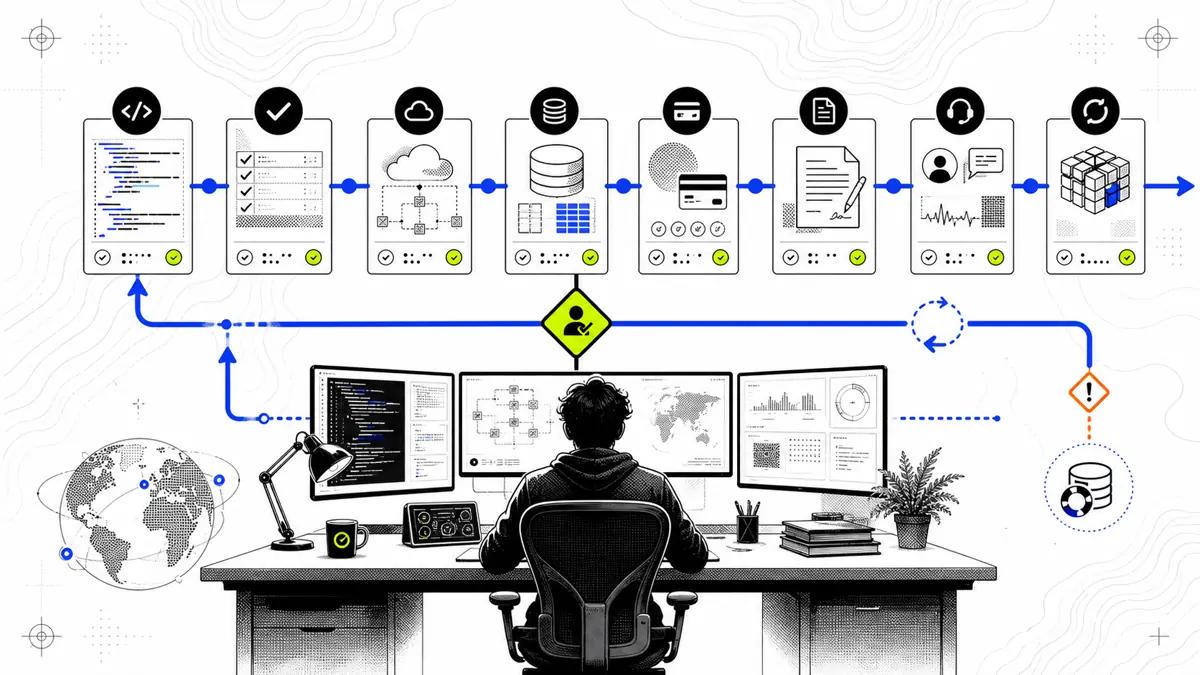
Low budget ¥003,000–¥01,200/month ██
Medium budget ¥01,500 – ¥06,000/month ███████
High budget ¥0.8 million – ¥4.0 million/month ████████████████████Usage charges are more likely to get out of control than seat subscriptions. Watch these four types:1, 11
- Large model contexts, agent calls, and batch tasks;
- Logging, tracing and error events;
- Database computing, egress traffic and object storage;
- Pay refunds, disputes, taxes and transaction fees.
Set a budget alert on every platform. Track monthly bills and the cost of each unit of work:1, 11
Infrastructure cost per customer
= Cloud resources of the month + model call + email SMS + payment of variable fees
  ÷ Number of paying customers in the current month

Contribute gross profit
= actual income
  - Payment fee
  - Variable costs of models and cloud resources
- Direct customer service costsRecommended combination: Extremely low-budget verification stack
Applicable to: one person, payment requirements have not been verified, users are less than a few hundred, short-term manual operation is allowed.1, 11
| Hierarchy | Recommended |
|---|---|
| Editor | VS Code + GitHub Copilot Pro, or just use the free editor and on-demand models |
| warehouse | GitHub Free |
| Collaboration and projects | Feishu Free Edition or Notion Free; Linear Free Tube Issue |
| CI/CD | Minutes within GitHub Actions plan |
| deploy | Railway Hobby or Cloudflare Workers; frontend available with Vercel |
| database | Neon Free + Drizzle, or Supabase Free |
| Certification | Supabase Auth or Clerk Free |
| Monitor | Sentry Free |
| Documentation | Docusaurus or warehouse Markdown |
| support | Crisp Free, shared mailbox |
| Contracts and invoices | China uses compliant electronic signature platform to purchase by portion; international service available Zoho Invoice |
| pay | Choose local payment or Merchant of Record according to the place of registration |
The principle of this stack is "don't prepay the future". The free tier is available for validation, but commercial-ready plans, automated backups and support capabilities should be purchased as soon as the product generates steady revenue.8
Recommended combination: Balanced business stack
Applicable to: One to three people, with existing income, requiring stable publishing, subscription billing and basic auditing.1, 11
| Hierarchy | Recommended |
|---|---|
| Editor | Cursor Pro or VS Code + Copilot |
| warehouse | GitHub Team, enable protected branches |
| collaboration | Chinese team Feishu; international team Slack |
| Project | Linear Basic; operational documents are placed in Notion |
| CI/CD | GitHub Actions |
| Containers and deployment | Docker + Vercel Pro/Railway Pro/Cloudflare |
| database | Supabase Pro + Prisma, enable point-in-time recovery or additional backup |
| Certification | Clerk Pro or Supabase Auth |
| Monitor | Sentry Team + Grafana Cloud Free/Pro |
| pay | Supporting regional use of Stripe; global digital product evaluation Paddle |
| customer service | Crisp Mini or Intercom Essential |
| Documentation | Docusaurus or Notion, use GitBook when customer documentation needs are high |
| contract | eSignBao or PandaDoc; the invoice enters the formal accounting process |
This combination works when each product has a defined place: an issue enters the project system, code passes review, the build reaches preview, errors reach Sentry, customer feedback reaches support, and the next issue is recorded.1, 11
Recommended combination: Extension and compliance stack
Suitable for: three to eight people, B2B customers, multiple environments, higher unit price per customer, or enterprise identity integration is required.1, 11
| Hierarchy | Recommended |
|---|---|
| Editor | Cursor Teams or JetBrains IDE + AI |
| Warehouse and security | GitHub Team/Enterprise or GitLab Premium |
| collaboration | Slack Pro or Teams + Microsoft 365 |
| Project | Linear Business or Jira |
| CI/CD | GitHub Actions/GitLab CI; critical builds use isolated Runner |
| deploy | Docker image, independent staging/production, Cloudflare front-end, managed container platform |
| database | Hosted PostgreSQL, multi-region is only used when the business requires it |
| Certification | Auth0 or Clerk enterprise plan; supports SSO, SCIM and auditing |
| observation | Sentry + Grafana Cloud; available on a budget Datadog |
| customer service | Zendesk or Intercom |
| Documentation | GitBook externally, Notion/Confluence internally |
| Contracts and Finance | Formal contract system, accounting system, double payment approval, tax consultant |
| safe | SAST, dependency scanning, Secret scanning, SBOM, annual penetration testing |
Automation architecture
flowchart LR
    A[Customer interviews and support requests] --> B[Notion/Linear/Jira]
    B --> C[Description of requirements and acceptance criteria]
    C --> D[AI IDE / Coding Agent]
    D --> E[Short-term branch and Pull Request]
    E --> F[Lint/Typecheck/Tests]
    F --> G[Dependency and key scanning]
    G --> H[preview environment]
    H --> I{manual acceptance}
    I -->|PASS| J[PRODUCTION RELEASE]
    I -->|Return| D
    J --> K[Sentry / Grafana / Datadog]
    K --> L[Error, performance, cost alarm]
    L --> B
    J --> M[Payment, customer service and product analysis]
M --> AThe correct boundaries for automation are:1, 11
- Issues can be created automatically;
- Automatically create branches and Pull Requests, yes;
- Automatically deploy the preview environment, yes;
- After passing all checks, you can automatically enter the test environment;
- Automatic modification of production data, refunds, deletion of customer accounts or changes in permissions should not be allowed by default;
- AI automatically merges into the production master branch and is only suitable for low-risk, strong testing and changes that can be rolled back immediately.
GitHub Secret Scanning can check Git history for hard-coded keys, Dependabot can identify dependencies with known vulnerabilities and create pull requests for security updates; the master branch should require status checks to pass before merging.6, 10, 11, 12
Six-week rollout and operating basics
Six-week implementation timeline
The following takes the launch on August 3, 2026 as an example. The time required for company registration is determined by the specific region and materials. Technical work can be done in parallel with registration, but legal subject information should be used for formal signing, invoicing and payment collection.9
gantt
    title Vibe Coding Personal Company Six-Week Implementation Plan
    dateFormat YYYY-MM-DD
    axisFormat %m-%d

    section Company and Operations
    Determine jurisdiction, subjects and responsibility boundaries: a1, 2026-08-03, 7d
    Banking, accounting, contract and invoice process: a2, after a1, 14d
    Privacy Policy, Terms of Service and Vendor List:a3, 2026-08-17, 14d

    section engineering basics
    Warehouse, permissions, branch protection: b1, 2026-08-03, 5d
    CI, test, key scan: b2, after b1, 7d
    Preview, test and production environments: b3, after b2, 7d

    section products
    Customer interviews and scope freeze: c1, 2026-08-03, 7d
    Core MVP:c2, 2026-08-10, 14d
    Authentication, Payment and Customer Support :c3, 2026-08-24, 10d

    section online
    Backup and recovery drill:d1, 2026-08-31, 3d
    Safety and Compliance Inspection:d2, 2026-09-01, 4d
    Small-scale paid release: d3, 2026-09-05, 3d
Review and next stage roadmap: d4, after d3, 3dTurn prompts into project contracts
The quality of Vibe Coding depends on the stability of the context. Instead of temporarily telling AI to "write professionally" every time, it is better to place AGENTS.md, CLAUDE.md or similar rule files in the root directory of the warehouse:1, 11
# Product and engineering contract

## Product boundary
- This is a multi-tenant B2B SaaS.
- Every business row must include `tenant_id`.
- A user must never read or mutate another tenant's data.
- Billing status is authoritative only from verified payment webhooks.

## Change protocol
1. Explain the proposed change before editing.
2. List affected files, migrations, APIs, permissions and rollback steps.
3. Do not add a dependency until checking whether the standard library
   or an existing package already solves the problem.
4. Never read `.env`, production logs or customer exports.
5. Do not weaken tests, TypeScript strictness or authorization checks
   merely to make CI pass.

## Definition of done
- Formatting, lint, typecheck and tests pass.
- New behavior has at least one automated test.
- Database changes are backward compatible during deployment.
- User-facing changes update documentation.
- Security-sensitive changes require human review.An effective task prompt should contain five parts:1, 11
Background:
Customers cannot download historical invoices from the canceled subscription page.

Goal:
Allow accounts that have been canceled but are still within the data retention period to view and download existing invoices.

Constraints:
Subscriptions must not be restored; new invoices must not be created; tenant_id must be verified;
Invoice addresses or tax numbers must not be output in the log.

Acceptance criteria:
Four types of tests are given: normal, ultra vires, expired account and payment provider timeout.

Non-target:
This task does not modify the refund logic, prices, or reconstruct the entire Billing module.Dockerfile example
# syntax=docker/dockerfile:1

FROM node:24-alpine AS dependencies
WORKDIR /app
RUN corepack enable
COPY package.json pnpm-lock.yaml ./
RUN pnpm install --frozen-lockfile

FROM node:24-alpine AS builder
WORKDIR /app
RUN corepack enable
COPY --from=dependencies /app/node_modules ./node_modules
COPY . .
RUN pnpm run lint \
    && pnpm run typecheck \
    && pnpm run test \
    && pnpm run build

FROM node:24-alpine AS runtime
WORKDIR /app
ENV NODE_ENV=production

RUN addgroup -S app && adduser -S app -G app

COPY --from=builder --chown=app:app /app/dist ./dist
COPY --from=builder --chown=app:app /app/package.json ./
COPY --from=builder --chown=app:app /app/node_modules ./node_modules

USER app
EXPOSE 3000
CMD ["node", "dist/server.js"]This example isolates the development process through a multi-stage build and runs as a non-root user. Real projects should also pin base image digests, generate SBOMs, scan images, and remove unnecessary production dependencies. SLSA organizes construction sources, product integrity, and supply chain controls into a framework for step-by-step improvement; NIST SSDF recommends integrating security development practices directly into the software life cycle, rather than doing a single inspection before going online.11, 12
GitHub Actions Example
name: ci

on:
  pull_request:
  push:
    branches: [main]

permissions:
  contents: read

jobs:
  verify:
    runs-on: ubuntu-latest
    timeout-minutes: 15

    steps:
      - name: Checkout
        uses: actions/checkout@v4

      - name: Set up Node
        uses: actions/setup-node@v4
        with:
          node-version: 24
          cache: pnpm

      - name: Enable pnpm
        run: corepack enable

      - name: Install locked dependencies
        run: pnpm install --frozen-lockfile

      - name: Format check
        run: pnpm run format:check

      - name: Lint
        run: pnpm run lint

      - name: Typecheck
        run: pnpm run typecheck

      - name: Test
        run: pnpm run test:ci

      - name: Build
        run: pnpm run build

      - name: Build container
run: docker build --tag app:${{ github.sha }} .The production environment should further:1, 11
- Third-party Actions are pinned to the reviewed commit SHA;
- The build task is read-only by default, and the deployment task uses independent permissions;
- The production Secret is not injected when the Pull Request comes from an external branch;
- Database migration is performed by specialized steps;
- Production deployments require a protected environment and manual approval;
- Deployment artifacts should be built once in CI and promoted between environments, rather than rebuilt for production.
Deployment and operation baseline
| Field | Minimum requirements | Stable business requirements |
|---|---|---|
| environment | Local, preview, production separation | Add shared testing environments and controlled production approvals |
| database | Daily automatic backup | Point-in-time recovery, off-site backup, quarterly recovery drills |
| publish | Can roll back to the previous image | Progressive release, database backward compatibility, release auditing |
| Log | Structured logs and request IDs | Log desensitization, retention policy, cross-service tracking |
| Alarm | Error rate and unavailability | Delays, queue backlogs, payment failures, cost anomalies |
| Permissions | MFA, independent account, minimum permissions | SSO, role separation, regular permission review |
| key | Do not enter the code repository | Hosted Secret Manager, rotation and short-lived credentials |
| Depend on | Lock files, automatic update reminder | SBOM, source review, build signature and artifact certification |
| Disaster recovery | Documented recovery steps | Define RPO/RTO and practice them |
| customer service | Shared mailbox | Event templates, status pages, major customer notification processes |
OWASP Top 10:2025 regards web application security risks as a basic cognitive framework for developers, and lists software supply chain failure as an important risk category. For Vibe Coding, this is especially important because AI tends to quickly add dependencies, copy sample configurations, and call third-party services.11, 12
Migration and expansion strategies
Don’t build Kubernetes at the zero-user stage because “there may be a million users in the future”. A more reasonable expansion path is as follows:1, 11
| Stage | Architecture | Evidence that triggered migration |
|---|---|---|
| Verification period | Single warehouse, modular monolith, single PostgreSQL, managed deployment | No migration necessary yet |
| initial growth | Add queues, caches, object storage, and read-only replicas | Request timeout, background task blocking, database connection saturation |
| Steady growth | Separate Workers, Webhooks, Reports and Search | A certain module has independent expansion or fault isolation requirements |
| Performance optimization | Rewrite explicit hotspots to Go or Rust | Performance analysis proves that compute or memory is the bottleneck |
| multi-region | Regional deployment, data boundaries and traffic routing | Contractual, delayed or regulatory requirements |
| corporatization | SSO, SCIM, audit logs, permissions and data retention policies | Enterprise customers are willing to pay for these capabilities |
Three questions must be answered for every migration:1, 11
- Whether the current bottleneck is proven by data;
- Whether the migration will add a permanent control surface;
- If the migration fails, can we return to the original architecture within one day?
Cases, risks, and next steps
Case: One Person China B2B Reporting Tool
This is a case of reasonable assumptions.1, 11
The founder has a background in data engineering and sells automation industry reports to small and medium-sized enterprises in China. The product requires uploading tables, generating charts and exporting PDFs, and initially had less than fifty monthly customers.13, 14
If the first version adopts Cursor, Next.js, Supabase, Vercel, Stripe and Intercom, it looks technically complete, but there are two problems: Stripe merchant registration location may not necessarily be suitable for mainland Chinese entities, and Vercel and domestic access, filing and data deployment requirements also need to be verified based on actual business. A more reasonable combination is:7, 8, 9, 13
- TypeScript modular monolith;
- GitHub private repositories and protected master branches;
- Cloud and database services available in China, or managed databases that have clearly completed cross-border assessments;
- Feishu hosts customer interviews and internal SOPs;
- Sentry does error tracking;
- Domestic compliance payment and invoicing processes;
- Sign a B2B service contract with eShanbao;
- AI only processes desensitized fields and templates, and does not directly read complete customer data.
Organizationally, the founder is responsible for product, development and sales, accounting and tax reporting are outsourced to local professional institutions, and contract templates are designed once by lawyers and reviewed regularly.1, 11
In the first month, this company should spend on company setup and contracts, database backups, permission isolation, reliable PDF generation, and customer-data protection before buying Jira, Datadog, Zendesk, or Kubernetes.8, 11, 12
If an application provides generative artificial intelligence services to the public in China, it also needs to determine whether the "Interim Measures for the Management of Generative Artificial Intelligence Services", model filing or application registration, and generated synthetic content identification requirements are applicable. This measure is mainly aimed at providing content-generating services to the public in China; situations that are only developed or applied within the organization and not provided to the public do not fall within the same scope of application. The Identification Method for Generating Synthetic Content published in 2025 also specifies explicit and implicit identification requirements for applicable services.13, 14, 15
Case: Four People International Micro SaaS
This is the second reasonable hypothetical case.1, 11
The team consists of a founder, a product engineer, a design and growth person, and a part-time customer success person selling workflow software to North America and Europe.16
- Cursor Teams or VS Code + Copilot;
- GitHub Team;
- Linear Business and Slack;
- Docker, Vercel Pro and Railway;
- Supabase Pro or Neon PostgreSQL;
- Clerk is responsible for organization and logging;
- Paddle as Merchant of Record, or use Stripe when the company's place of registration supports it and the team has tax capabilities;
- Sentry + Grafana Cloud;
- Intercom or Crisp;
- GitBook is external, Notion is internal;
- Sign up with PandaDoc, a formal accounting system to handle bookkeeping and reporting.
The first phase remains a modular monolith. The service will be split only when any of the following conditions are met:1, 11
- Webhook retries affect the main site;
- Reporting tasks need to be expanded independently;
- Enterprise customers require independent data areas;
- Performance analysis proves that a certain computing module requires Go or Rust;
- A service requires an independent SLA.
If processing EU personal data, teams should identify themselves as data controllers or processors and establish appropriate data processing agreements with infrastructure, customer service, analytics and AI vendors. When personal data is transferred out of the European Economic Area, cross-border mechanisms such as adequacy decisions and standard contractual clauses will also be assessed.16
Key risks and controls
| Risk | Typical performance | Control measures |
|---|---|---|
| AI generated errors | Code runs, but permissions, refunds, or boundary conditions are wrong | Acceptance testing, manual review, dual or external review of high-risk modules |
| Context leakage | Paste customer data, logs, and keys into the model | Data classification, desensitization, enterprise data policy, prohibition of reading .env |
| supply chain risk | AI adds spelling-similar packages, obsolete packages, or unnecessary dependencies | Dependency whitelist, lock file, Dependabot, SBOM, source review |
| Out of control permissions | Agent obtains production terminal, database and payment background permissions | Minimum permissions, short-term vouchers, preview environment, production manual approval |
| Single vendor lock-in | Authentication, database, functions and logs all use proprietary interfaces | Standard SQL, adapter, cycle export, migration walkthrough |
| data loss | Console says "Backed up" but never restored | Automatic backup and independent copy, regular recovery drills |
| privacy breach | Excessive collection, indefinite storage, and no basis for cross-border | Data inventory, purpose restrictions, retention periods, deletion and export mechanisms |
| intellectual property | AI output contains unknown license code and outsourcing results are not transferred | Reliance on licensing review, original records, attribution of work in contracts |
| Fiscal and tax errors | Personal account collection of company income, omissions, and income recognition errors | Separate accounts, monthly reconciliation, professional accounting, voucher archiving |
| Founder single point of failure | Domain names, clouds, banks and codes can only be recovered by one person | Emergency contacts, recovery code hosting, business continuity manual |
When personal information is processed in China, the Personal Information Protection Law applies to domestic personal information processing activities, and under certain circumstances has extraterritorial application to overseas activities processing natural person information in China. Businesses need to clarify the purposes of processing, lawful basis, sensitive personal information, individual rights, cross-border provision and processor obligations. The Personal Information Protection Compliance Audit Management Measures, which will take effect in 2025, further stipulate compliance audit requirements.13, 14
Providing Internet information services in China also requires ICP filing or value-added telecommunications business licensing requirements based on server deployment, service nature and business model; the Ministry of Industry and Information Technology provides an official filing and licensing system.7, 13, 14
What to do next
Vibe Coding gives one person much of the implementation capacity of a small engineering team. It does not remove the work of running a company. Faster prototyping can also move bad code, weak contracts, the wrong tax structure, and unsafe data flows into production faster.7, 13, 14
Choose software that creates one continuous, inspectable production chain. Do not maximize ratings in every category; protect the controls the business cannot replace.1, 11
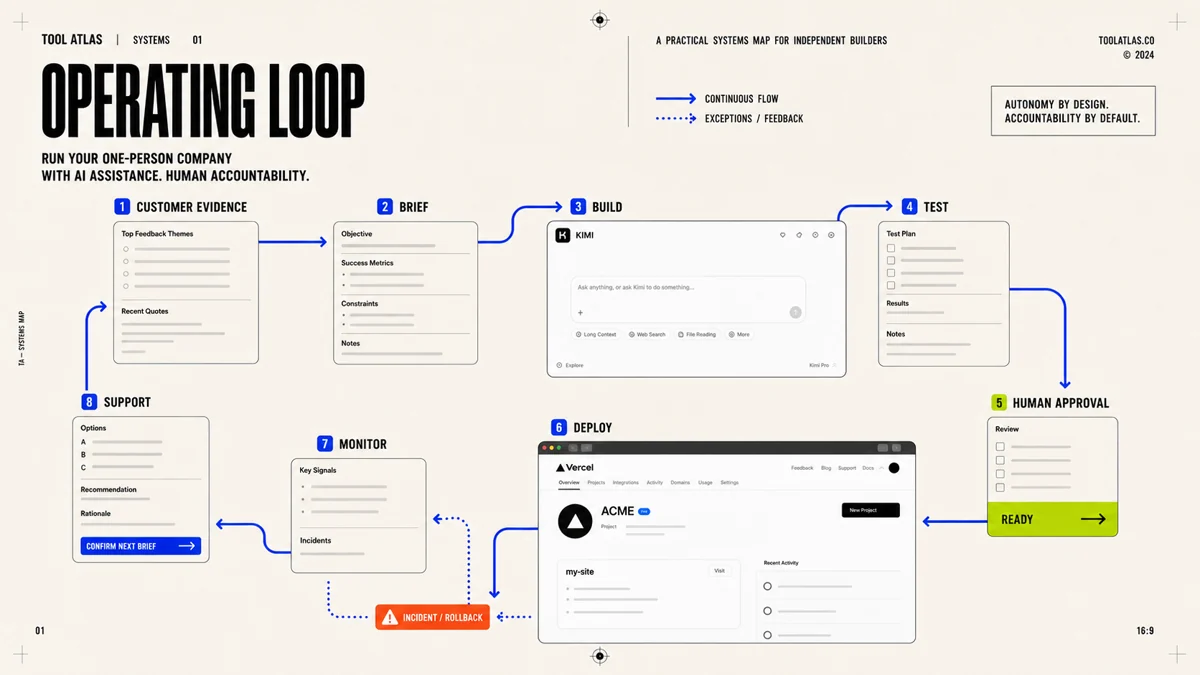
customer evidence
→ Clarify needs
→ AI-assisted implementation
→ Automated testing and safety checks
→ Manual acceptance
→ Release can be rolled back
→ Monitoring and Support
→ Financial, Contractual and Compliance Records
→ Next round of product decisionsA solo company has a short decision chain. That speed also removes the colleague who would normally challenge an assumption. Tests, ledgers, contracts, monitoring, and recovery drills must provide that resistance.1, 11
Five actions to start
- Determine the entity and market before purchasing the instrument. Clearly indicate the company’s registration place, tax residence, main customer location, payment currency and data location; distinguish the responsibilities of sole proprietorships, limited liability companies and overseas entities.
- Select a reversible default stack. For normal SaaS, start with TypeScript, Node.js, PostgreSQL, Docker, GitHub, managed deployment, and managed authentication; don’t microservice ahead of time without data.
- Establish quality gates that cannot be bypassed by AI. Warehouse rules files, protected master branches, formatting, type checking, testing, dependency scanning, key scanning, and manual production approval must precede high-frequency delivery.
- Complete a real recovery and accident drill. Restore the database from backup, revoke a leaked key, roll back a deployment, simulate payment webhook and send it repeatedly, and confirm that the customer notification and log chain are valid.
- Upgrade software with proof of revenue, not architecture with imagination. Upgrade when the free tier limits real business, customers are willing to pay for security or enterprise features, or operations time exceeds the subscription price; remove a duplicate tool, review a vendor lock-in point, and review legal, tax, and data processing chains every quarter.