

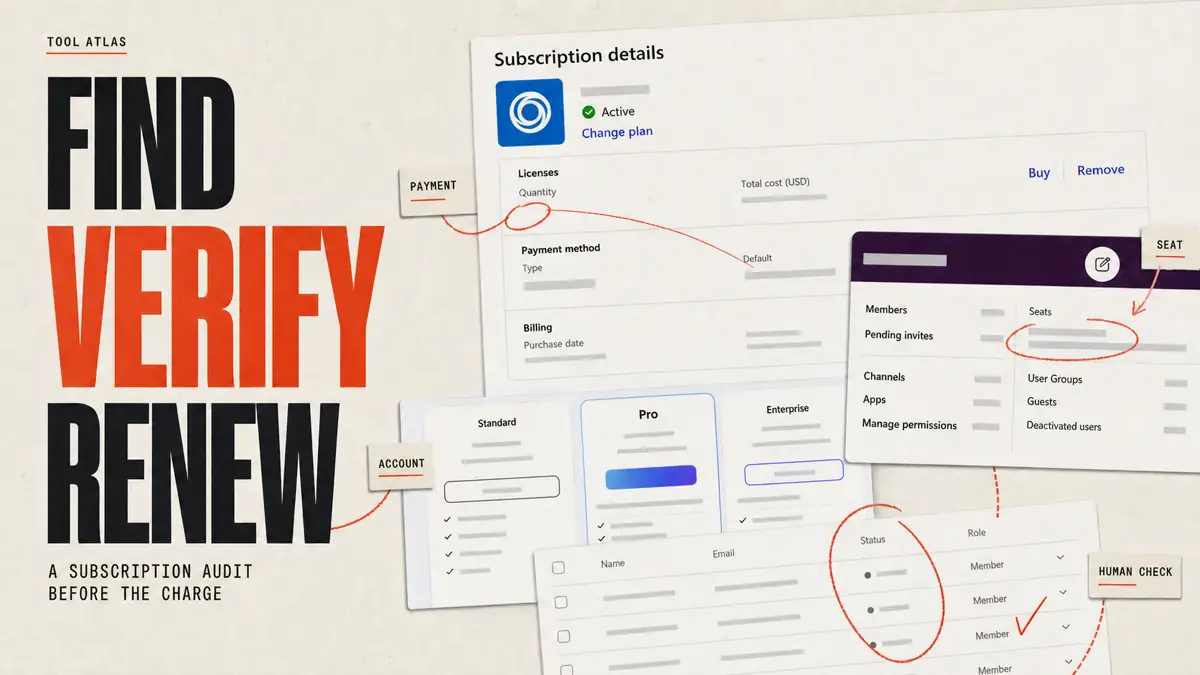
Executive summary
Duplicate SaaS subscriptions are recurring plans that charge for the same account, entitlement, or job through different channels. Start by matching 15 months of bank statements with App Store and Google Play purchases, vendor receipts, payment authorizations, family accounts, and company licenses. Resolve each charge to an owner and real task. Before cancelling anything, export or back up required data, confirm the replacement and contract term, save cancellation proof, and verify that billing stops in the next cycle.1, 2, 4, 5, 8, 9
Start with money, not the apps installed on a device. A useful audit reconciles charges, payment authorizations, app-store records, email receipts, contracts, expense reports, and admin consoles. Each charge must resolve to an account, a set of entitlements, a job, and an owner.7, 8
This guide provides a set of repeatable methods: review at least 15 months of records, unify merchant and product names, distinguish nine types of duplication, check accounts and rights, assess migration risks, close redundant renewals, save confirmation vouchers, and confirm that deductions have stopped in the next accounting period.1, 5, 7, 9
Cancellation comes last. First identify where the data lives, who depends on the service, whether the contract still carries a commitment, and whether the replacement works under normal conditions.1, 5, 7, 9
Nine kinds of subscription overlap
Two transactions with the same name on a bank card are just the easiest type to spot. The really expensive duplication is often hidden between different accounts, different channels, and similar capabilities.1, 5, 7, 9
Nine ways subscriptions overlap
| Repeat type | Surface phenomenon | Common causes | Default processing |
|---|---|---|---|
| Repeat exactly | There are two periodic deductions for the same service or the same benefit. | Order one copy each from the official website and app store; the old subscription is not closed when changing cards or channels. | usually cancel one |
| Duplicate account | Bind personal email, work email or old mobile phone number to the same service | Forget your old account; sign up again after changing devices or companies | Merge accounts or close old accounts |
| family duplication | Multiple family members purchase the same service separately | No unified payer; family sharing scope not checked | Check sharing, device, and privacy restrictions first |
| Overlapping packages | The comprehensive package already includes a certain capability, but still purchase the standalone version | No review of original tools after package upgrade | Compare depth of equity and migration costs |
| Functional overlap | Different products accomplish most of the same tasks | Trials accumulate; teams each choose their own tools | Judged by real tasks from the past 90 days |
| company license seat redundancy | Purchased more seats than active or active users | After leaving the company, I only disabled my account and did not reduce the number of purchases. | Reclaim permissions and reduce paid seats |
| Duplicate reimbursement | After the company pays, the employee reimburses the personal subscription | Missing purchasing catalog and team account | Stop personal renewal and amend the reimbursement process |
| periodicity illusion | Monthly payment and annual payment appear simultaneously in the short term | The old monthly fee still exists when switching annual fees; pre-authorization is confused with formal deductions | First check the coverage period and account period |
| intentionally redundant | Two similar services performing backup, customer isolation, or compliance tasks respectively | The team proactively reserves the second route | It can be retained, but the reason and review date must be stated. |
"Occasionally used" does not justify a subscription being worth renewing. More useful questions are: does it take on tasks that other tools can't reliably do, who will be affected if it's discontinued, how long will it take to replace it, and how much will it cost to keep it for a year.1, 5, 7, 9
Functions with similar names cannot directly trigger cancellation. One of the two cloud disks may be responsible for daily synchronization, and the other may be responsible for off-site backup; the two conferencing tools may serve internal collaboration and customer-specified platforms respectively. Audits are about identifying overpayments and protecting intentional redundancies.16
A six-step audit from statement to cancellation
It is recommended to look back at least 15 months. 12 months cover a complete year, and the additional three months can help you detect cross-year renewals, trial conversions, and deduction date drifts. This is practical advice, not a legal deadline.1, 5, 7, 9
Five evidence sources for a complete audit
| Source | Main purpose | The easiest problem to find |
|---|---|---|
| Bank cards, credit cards and bank statements | Confirm actual expenditures incurred | Official website direct payment, overseas merchants, annual deductions |
| WeChat, Alipay, PayPal and other payment authorizations | Find an automatic debit agreement that is still in effect | Free trials, suspended services, long-forgotten licenses |
| Subscription pages for Apple, Google Play, Microsoft, etc. | Confirm purchase account, renewal date and actual payee | Multiple accounts, in-app purchases, third-party billing |
| Personal and work email | Restore products, plans, accounts and contract terms | Unknown merchant name, price increase notice, annual fee commitment |
| Enterprise invoicing, reimbursement and administrator backend | Reconcile company payments, personal reimbursements and seat counts | Idle seats, shadow IT, duplicate reimbursements |
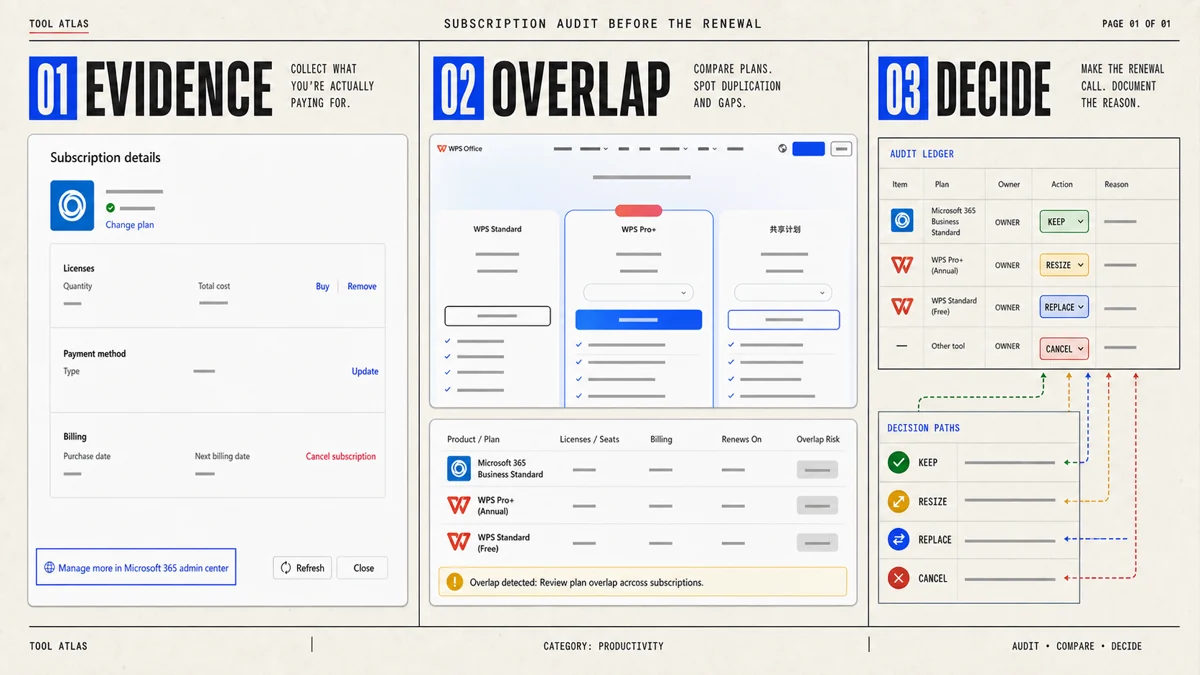
Step 1: Start with charges, not installed apps
Uninstalling the app will not automatically cancel your subscription. The web service may not have a local application, but charges will be deducted every year; the operator or enterprise package may already include a benefit, but will not leave a separate entrance on the mobile desktop. First export the records of all payment accounts, and then look for fixed periods, similar merchant names and close amounts.5
Monthly charges may appear every 28 to 31 days, and annual charges may vary slightly based on weekends, time zones, and taxes. Don't just search for the exact same amount.1, 5, 7, 9
Step 2: Resolve every billing channel to a product
"Apple", "Google", "PayPal" and "WeChat Pay" usually represent billing channels, not necessarily the final service. Add four fields to each transaction: bill display name, actual product, login account, and actual payee. This step is the most likely to expose the problem of charging for the same service through two entrances.1, 2, 9, 10
Apple's purchase history can check items by amount and time range. Google Play clearly states that uninstalling the app will not cancel your subscription. Microsoft's cancellation portal also depends on the actual purchase channel; if purchased through a third party, you usually have to go back to that third party to manage it.1, 2, 5, 7, 8
Step 3: Search every email address and account
Search Chinese and English keywords at the same time: subscription, renewal, automatic renewal, membership, invoice, receipt, trial, subscription, renewal, invoice, receipt, trial, billing. Then add the amount, merchant name, bank card last number or plan name to narrow the range.10
If you have multiple Apple IDs, Google accounts, Microsoft accounts, old mobile phone numbers or work emails, check them one by one. Bad accounts are more common than system glitches when you can't find the "Manage" button.1, 2, 5, 7, 8
Step 4: Compare entitlements, not product labels
For each subscription, write down three real-life tasks you completed in the past 90 days. Then compare file formats, sharing permissions, automation, administrator controls, offline capabilities, customer requirements and recovery methods. The number of features on a promotional page can only generate candidacy and is not a substitute for workflow testing.1, 5, 7, 9
Step 5: Export data and test the replacement before cancellation
Turning off automatic renewal and immediately canceling the contract are not the same thing. Some services can still be used until the end of the current period after renewal; some annual contracts may have early termination fees even if payment is deducted monthly. Before canceling, you need to export data, migrate sharing relationships, record integrations, confirm the capacity of the free plan, and write down the conditions for returning to the old route.10, 15, 16
Step 6: Save proof and check the next billing cycle
At a minimum, save the successful cancellation page, confirmation email, order or contract number, closing date, service expiration date, and refund request number. Clicking the button once does not mean the work is over. In the next accounting period, you still have to go back to the bill to confirm that the deductions have stopped, and the corporate seat has to confirm that the total purchase amount has dropped.1, 2, 3, 7, 8
Copyable subscription audit ledger
| Subscribe | Actual payee | Login account | Cycle and next renewal date | Annual cost | User/Seat | Tasks for the last 90 days | Repeat judgment | Processing and Responsible Person |
|---|---|---|---|---|---|---|---|---|
| Example: PDF Tools | App Store | Personal email | Monthly payment; 18th | ¥816 | 1 person | Edit, sign, deliver | Overlaps with official website annual fee | Close monthly fee;I |
| Example: Collaboration Suite | Manufacturer's official website | Company Administrator | Pay annually; September 30 | ¥12,000 | 10 seats | Email, documents, meetings | 2 free seats | Reduced to 8 seats; Administration |
| Example: cloud storage | PayPal | Work email | Annual payment; December 5 | ¥720 | 1 person | Customer archive | Partially overlaps with the main cloud disk | Keep off-site backups; review quarterly |
The ledger should also record contractual commitments, cancellation notice periods, data export status, migration risks and next review date. The amount is just a field, not the only criterion.1, 5, 7, 9
Platform records and subscription-management tools
Native platforms are best at confirming purchase accounts, renewal dates, and cancellation status, but each platform can only see the fees it charges. No single entry point is sufficient to complete a full audit.1, 5, 7, 9
As of August 2026, the path below serves as a starting point for verification. Depending on the product version, region, and purchase channel, the menu text may change; the actual management entrance displayed in the account shall prevail.1, 5, 7, 9
What native subscription portals reveal
| Platform | Check entrance | What can be confirmed | Main blind spot |
|---|---|---|---|
| Apple | Subscription page and purchase history in settings | Subscriptions purchased from Apple, billing items, and expiration status | Official website, Google Play and other billing channels |
| Google Play | Subscription page in Payments & Subscriptions | Subscriptions purchased with your current Google account | Other Google accounts and official website direct payment |
| Microsoft | Services and Subscriptions for Microsoft Accounts | Personal products billed directly by Microsoft | App Store, Google Play, retailers and partners for purchase |
| WeChat Pay and Alipay | Automatic renewal, password-free payment or automatic deduction in payment settings | Authorized by the corresponding billing channel to sign the contract | Bank card direct debit, app store and prepaid |
| PayPal | Payments and automatic payments in settings | Merchant authorization and backup payment methods | Non-PayPal transactions |
| Microsoft 365 admin center | Billing, Licenses or Your products | Purchased quantities, assigned users and subscription products | Employee personal reimbursement and other SaaS |
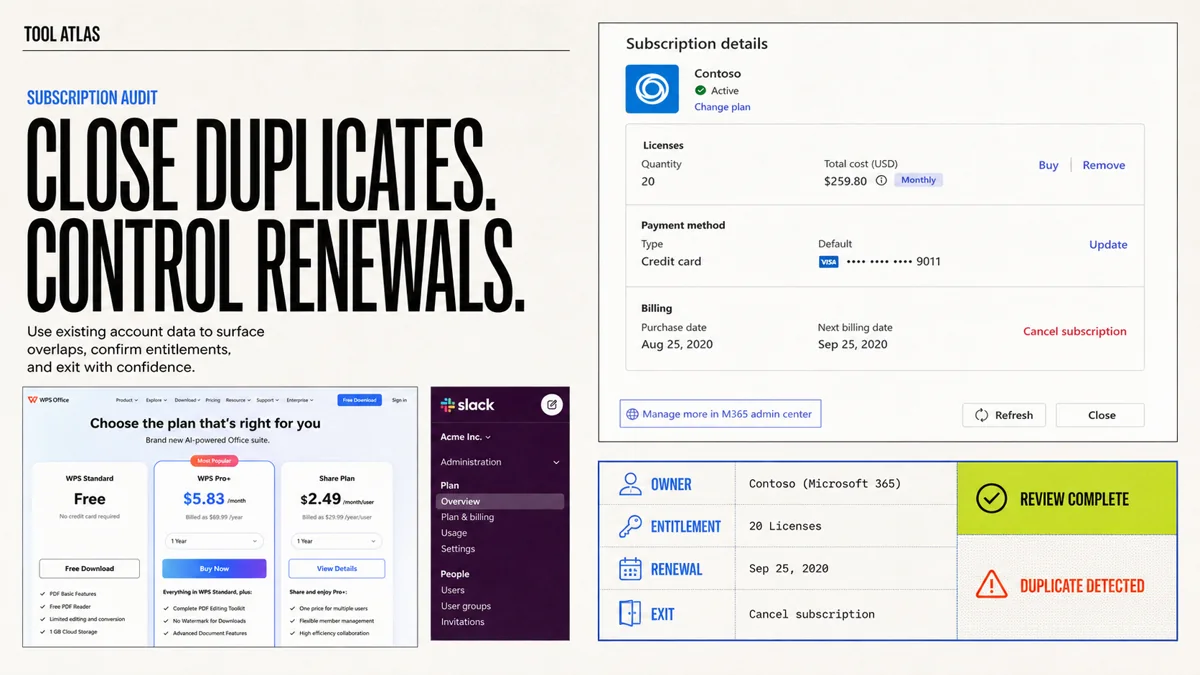
When subscription-management tools are worth the access cost
| Tool or method | Suitable for whom | Advantages | Limitations and new costs |
|---|---|---|---|
| WPS Sheet, Excel or Google Sheets | Individuals, families, small teams | Customizable fields for easy recording of accounts, shares, reimbursements and risks | Requires manual entry and maintenance |
| Bank and credit card billing tools | everyone | Based on actual deductions, it is easy to find annual expenses | The merchant name may be vague and the specific rights and interests cannot be identified. |
| Native pages of Apple, Google, Microsoft, PayPal, etc. | everyone | Account attribution and cancellation status are most accurate | You can only see transactions within their respective ecosystems |
| Rocket Money | Individuals who primarily use U.S. financial accounts | Automatically identify periodic expenses, and some plans provide cancellation assistance | Requires financial account connection; limited regional and institutional support |
| Monarch Money | North American users who want a view of their household finances | Summarize accounts and periodic bills, suitable for joint budgeting | itself a paid subscription |
| YNAB | People who need to proactively arrange annual fee budgets | Annual expenses can be divided into monthly budgets | Not a specialized automatic cancellation tool |
| SaaS management platforms such as Zylo | Medium and large organizations | Centralized discovery of applications, contracts, usage and shadow IT | Too heavy on individuals and micro-teams, often requiring inquiry and implementation |
Don’t rashly add a subscription management tool that you haven’t used for a long time just to manage a dozen subscriptions. If your spending structure is simple, a sheet and quarterly reminders are usually sufficient. Automation tools are only likely to generate net benefits if visibility has been lost on financial accounts, joint household budgets, or enterprise SaaS purchases.1, 5, 7, 9
Three cases: individual, family, and small team
The amounts below are simulated data used to illustrate the audit methodology and do not represent the current prices of any manufacturer.1, 5, 7, 9
Individual: Annual web plan plus monthly App Store plan
| Project | Purchase channels | Period and amount | Scope of interests | Judge | Process |
|---|---|---|---|---|---|
| PDF Tools Mobile Version | Apple App Store | ¥68/month | Use on mobile phone | Overlaps with the annual fee coverage period of the official website | Close App Store renewal |
| PDF Tools Annual Edition | Product official website | ¥598/year | PC and mobile | main plan | Reserve and confirm device scope |
| Same product plug-in | Product official website | ¥99 one-time | Independent extension function | Duplication not yet proven | Check license and usage |
This type of duplication will not appear as two identical amounts on the same day. What you want to compare is the equity coverage period. After checking the Apple purchase history and official website account, choose the retention plan; if you have just renewed, you can submit an application according to the platform's current refund conditions, but do not regard refunds as an inevitable result.1, 2, 3
Family: Three channels paying for the same viewing job
| Member/Device | Purchase channels | Period and amount | Actual use | Question | Process |
|---|---|---|---|---|---|
| father | WeChat automatic renewal | ¥25/month | Use weekly | Overlaps with family head plan | Close continuous monthly subscription |
| mother | Apple Annual Subscription | ¥238/year | main user | Possible home ownership solution | Keep after checking the sharing scope |
| child | Carrier gift | Included in the package | rarely used | Free entitlement not recognized by family | Test whether it is replaceable before expiration |
| home tv | TV upgrade package | ¥12/month | Living room use | Maybe it’s independent large-screen rights | Check to see if it is included |
"Home sharing" does not mean that all third-party services, devices, regions and data can be shared. Apple will also only share eligible subscriptions. Families should determine primary accounts, device needs, child permissions and privacy boundaries before deciding on payers and long-term options.1, 2, 4
Ten-person studio: Idle company seats plus personal reimbursement
| Project | Current status | Duplication or waste | Annual simulation cost | Process |
|---|---|---|---|---|
| Microsoft 365 | Purchased 10 seats, actual 8 people | 2 unused seats | ¥2,160 | Reduce purchase quantity after deallocation |
| Design Tools Team Edition | 10 seats, actual 7 people | 3 empty seats | Already included | Migrate personal account into team |
| Personal design software reimbursement | 3 people each pay monthly | Duplicate with Team Edition | ¥1,440 | Stop personal renewal and reimbursement |
| Video conferencing standalone version | 4 host accounts | 2 people have switched to Collaboration Suite | ¥2,400 | Reserve 2 customer meeting seats |
| AI writing tools | 6 personal accounts | Unclear purpose and overlapping capabilities | ¥4,320 | Record usage for 30 days before making a decision |
In the simulated case, immediately identifiable annual savings were approximately ¥6,000, not counting the AI tool. The most important operational difference here is: canceling a user assignment does not necessarily reduce the paid amount. Administrators should also reduce the actual purchased quantity on the subscription or license page and review it in the new bill.7, 8
Regional differences in rights, payments, and contracts
The following is general information and is not intended to be a substitute for transaction-specific legal advice. Cross-border subscriptions may also be affected by the location of the merchant, purchase channel, payment method and local mandatory rules.1, 5, 7, 9
How rights, payment rails, and contracts differ by region
| Area | Common payment structures | Rights and rules to check | Practical actions |
|---|---|---|---|
| Mainland China | WeChat, Alipay billing; app store; operator package; bank card | The "Regulations on the Implementation of the Consumer Rights Protection Law" requires that automatic extensions and automatic renewals be reminded in a prominent manner before consumers receive services and before the renewal date. | Simultaneously check merchant accounts and payment authorizations, and save renewal reminders, agreements, and closure records |
| USA | Credit card, ACH, PayPal, app store and official website direct payment | The status of federal negative selection rules has changed, and states may have stricter regulations; ACH stopping payments does not mean automatic termination of the contract | Check the FTC’s current rules page and state requirements; notify merchants and banks separately |
| European Union | Bank cards, SEPA direct debit, app stores and cross-border digital services | Most remote contracts typically have a 14-day withdrawal period, exceptions may apply for digital content and services that have already begun performance; paying a refund and canceling the contract are two different things | Notify the merchant to cancel the contract, revoke the deduction authorization, and then apply for a refund according to the applicable conditions. |
In mainland China, just turning off the functions in the merchant app does not necessarily mean that the payment authorization has been lifted; just unbinding the bank card does not mean that the contract has been terminated. A more reliable approach is to confirm the status separately in the service provider account and the actual billing channel.10
In the United States, do not regard rules that have changed or been dealt with by the courts as stable national standards. For automatic deductions from bank accounts, the CFPB recommends that consumers notify the merchant to revoke the authorization and contact the bank or credit union; stopping the flow of funds does not necessarily terminate the original contract obligations.11, 12
In the EU, remote contract withdrawal rights, SEPA direct debit refunds and service contract cancellation each address different issues. After applying for a refund, you should still confirm that the merchant has terminated the contract and authorized subsequent deductions.1, 2, 3, 13, 14
Risk controls and operating rules before cancellation
Cancellation may impact data, file sharing, customer delivery, identity permissions, contractual responsibilities and business continuity. Before saving on license fees, determine who will lose access, what integrations will stop, which files need to be migrated, and whether the free plan has enough capacity.7, 8, 16
Don’t use card expiration as a substitute for cancellation. The bank's card update mechanism may allow new card numbers to continue to accept authorization. Don’t assume that “monthly deductions” must mean monthly payments without commitment. Some annual contracts only require monthly payments.15, 16
Some of Adobe's annual plans may include an early termination fee, with the exact percentage depending on region, time of purchase, and current terms. Capacity, sync, and sharing capabilities may also change when you downgrade a paid Dropbox plan. Before canceling, open the current contract and account page instead of just looking at the search summary.15, 16
Unknown deductions and duplicate subscriptions should also be handled separately. Duplicate subscriptions come from charges you once authorized but may no longer need; fraudulent transactions are payments you never authorized. Transactions that cannot be found in the purchase history should enter the abnormal transaction process of the platform and payment institution.5, 6
Eight rules for keeping subscriptions inside the budget
| Rules | Personal | Family | Small business |
|---|---|---|---|
| unified list | Record all monthly and annual fees | Add payers and users | Add contract owners, departments and seats |
| Set reminder | 30 days and 7 days before annual fee | Use a shared calendar | Graded approval 90, 60 and 30 days before renewal |
| Tighten billing channels | Use dedicated cards or major channels | Fixed household payer | Use a purchasing account or supplier-specific card |
| Record trial | Write down the cancellation date on the day of trial | Check existing family rights first | Do not use your personal card to purchase long-term instruments without approval |
| Set annual payment threshold | Consider after 90 days of continuous use | Identify members’ long-term needs | Have owners, budgets and usage data |
| Reclaim members | Not applicable | Remove members no longer in use | Permissions will be recovered on the day of resignation, and seats will be reduced before the end of the month. |
| Check for plagiarism regularly | Quarterly | Once every six months | Quarterly inspection by department and category |
| Write reasons for reservation | Record irreplaceable tasks | Record sharing, device or privacy restrictions | Document security, customer, compliance or quarantine requirements |
The number of uses only provides one perspective. Low-frequency but high-risk export, audit, or client formatting tasks may be worth paying more for than convenience features you use every day. You can record past 90-day usage, time per replacement, data dependencies, and annual cost for each subscription, but don’t squash these fields into a score that pretends to be precise.1, 5, 7, 9
Pre-renewal action list
| Status | Check action | Completion standards |
|---|---|---|
| To-do | Export the last 15 months of bank card and payment platform transactions | Covers all personal cards, corporate cards and payment accounts |
| To-do | Check Apple, Google Play, Microsoft, WeChat, Alipay and PayPal | Every possible purchase account has been checked |
| To-do | Search personal and work mailboxes for receipts, renewals, and trial emails | Find products, accounts, plans and renewal dates |
| To-do | Map billing merchant names to actual products | No more unexplained periodic deductions |
| To-do | Mark exact duplicates, family duplicates, package overlaps, and feature overlaps | Each suspect item is clearly classified |
| To-do | Check the contract, refund rules and early termination fees | Know the real cost of canceling now |
| To-do | Back up files and migrate data, sharing relationships and integrations | No critical data or permissions will be lost upon cancellation |
| To-do | Close redundant renewals and save confirmation vouchers | There are screenshots, emails, order numbers and expiration dates. |
| To-do | Business accounts reduce actual purchase quantity | The total number of licenses in the new bill has dropped |
| To-do | Review the flow in the next accounting period | No new unusual charges |
| To-do | Write purpose and review date for reserved items | "It may be used in the future" is no longer the only reason |
An audit should not end with one savings number. Give each line item its own decision: renew, resize, replace, cancel, or investigate. Keep the owner, evidence, next review date, and rollback route beside that decision.1, 5, 7, 9
A renewal commits another slice of budget, data, and working habits. Before accepting it, confirm that you are buying a capability you still need rather than preserving a billing route you forgot to close.1, 5, 7, 9