Start with the mistake that would cost the most
An assistant can produce a polished recap from an hour of tangled conversation. That fluency creates a dangerous first impression. A summary may read well while turning “we should explore a September launch” into “the team approved a September launch,” assigning the action to the wrong person, or dropping the condition that made a price acceptable. The expensive errors hide inside decisions, commitments, and sensitive details.11, 6, 7
Treat the product as a record-making system. It receives audio and participant information, creates a transcript, infers speakers, generates interpretations, and may send those outputs into calendars, email, chat, a CRM, or a task tracker. The evaluation has to follow that whole path. Word error rate alone cannot tell you whether the record is safe to use.2, 11, 6
Start with the meeting where a wrong note would have a clear consequence. Sales teams may care about price, scope, and promised follow-up. Product teams care about decisions, dissent, and owners. Researchers care about exact language and consent. Choose one use case, then write down the worst plausible mistake before opening a pricing page.11, 10
A fluent summary can fail the meeting
Imagine a client says, “If legal approves the revised data terms by Friday, we can target September, but the mobile export is not part of this phase.” A recap that says “September launch approved; team to deliver mobile export” contains recognizable words and reverses the decision. Another system might omit the whole exchange and still receive a better transcript score. For the project owner, the first error is worse because it creates two confident commitments that nobody made.11, 6, 7
Use sentences like that in the pilot reference. Mark the proposal, condition, exclusion, owner, and date separately. Then compare the generated transcript, summary, and action list. The assistant should not receive credit for mentioning September if it loses the condition. It should not receive credit for naming mobile export if it turns an exclusion into work.11, 6
This changes the purchase question. A system with excellent search and reliable timestamps may be valuable even when its action extraction needs review. A system that pushes elegant but untraceable actions into other tools is a poor fit for consequential meetings, however impressive the demo. Approve outputs one by one instead of translating general fluency into trust.11, 6, 2
Decide whether another meeting platform is necessary
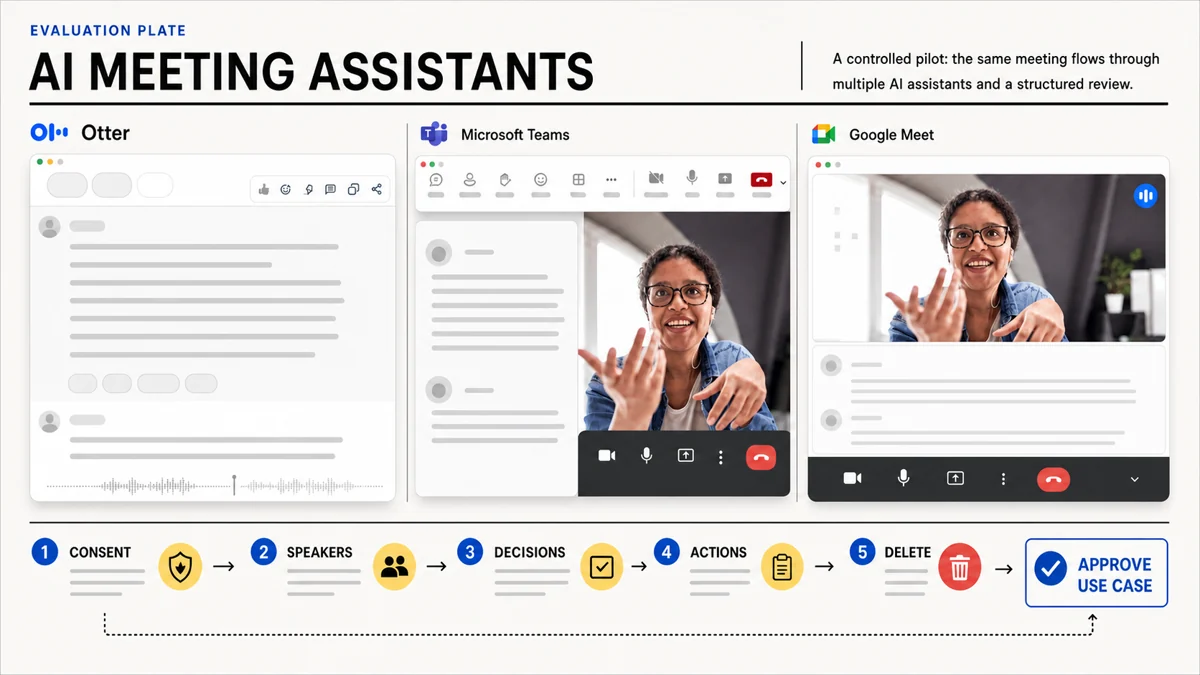
Microsoft Teams and Google Meet already support recording and transcription within their own ecosystems, subject to plan and administrator controls. Teams can assemble recordings, transcripts, shared files, notes, and follow-up tasks in meeting recap. Google Meet can save transcripts to the organizer's Drive and link them to the Calendar event. If your organization already manages identity, retention, and access in one of those systems, its native route deserves the first pilot.5, 6, 7, 9
An external assistant earns a place when it solves a problem the native route does not: meetings spread across platforms, cross-meeting search, a stronger note workflow, coaching, or a shared archive for client calls. It also adds another account, service operator, data store, sharing surface, and deletion process. The feature and the new boundary arrive together.2, 3, 4
Otter, for example, describes collection of audio recordings, screenshots, uploaded material, speaker-identification data, calendar information, usage events, and data from connected services in its privacy policy. That does not make the service unsuitable. It tells a buyer what must enter the review. Compare that route with the data and controls already present in Teams or Google Workspace.2, 5, 7
The shortlist should therefore begin with architecture, not rankings. Pick the native option if it meets the task and keeps the record inside an approved collaboration system. Test an external assistant when you need cross-platform or specialist capability. Reject any route whose contract, consent model, storage, or account controls conflict with the meetings you intend to capture.10, 3, 5, 9
Use a small pilot with difficult meetings
Ten meetings can reveal more than a month of passive use if the sample has range. Include quiet and noisy audio, recurring speakers and guests, a technical discussion, numbers and dates, an accent the team hears in real work, and one meeting where people disagree. Use only meetings that fit the approved pilot boundary, and tell participants what the assistant will create and who will receive it.10, 11, 5, 8
Create a human reference for each meeting. The reviewer does not need to transcribe every word. Record the decisions, open questions, commitments, owners, dates, critical numbers, and moments that require exact quotation. Add timestamps. That reference lets you test the outputs that will affect work instead of arguing about punctuation.11, 6, 7
| Test | Pass condition | Serious failure |
|---|---|---|
| Decision | Status, scope, conditions, and dissent match the reference | A proposal becomes approval or a condition disappears |
| Action | Owner, task, and due date match the reference | The system invents work, changes the owner, or moves the deadline |
| Numbers and names | Material names, amounts, dates, and versions match the source | A price, quantity, person, or date changes |
| Speaker attribution | Commitments and sensitive statements belong to the right person | The record assigns a promise or opinion to someone else |
| Retrieval | A user can reach the source moment from the note | The summary has no usable path back to evidence |
| Sharing | Only intended recipients receive the recording and derived outputs | A link, email, or integration exposes the record outside the approved group |
| Deletion | The team can complete and verify the documented deletion route | The source or derived output remains where the pilot owner cannot control it |
Count missed and invented actions as different errors. An omission sends nobody to work; an invented task can make a team spend money or contact a client without agreement. Track restored qualifications too. Words such as “if,” “subject to,” and “draft” often carry the decision.11, 6
Keep timestamps beside decisions and actions during the pilot. The reviewer should be able to play or read the source moment without searching the full meeting. A product that writes an elegant summary yet makes verification painful pushes hidden labor onto the person who owns the record.6, 7, 11
Read ten meetings as a pattern, not a leaderboard
An illustrative pilot might find that the native assistant retrieved source moments reliably in nine meetings, omitted one owner twice, and kept all records inside the existing workspace. The external assistant might produce clearer prose, make one invented action, and cut review time on cross-platform calls, while also creating a new sharing and deletion route. Those observations do not produce a universal winner. They support different approvals.6, 7, 2, 4, 11
The review meeting should replay every serious failure before discussing convenience. Ask whether a reasonable user could detect it, how far it traveled, and whether correction removed downstream copies. A misattributed joke that stayed in a private draft is not equivalent to a fabricated client promise copied into a CRM. Counting both as one “error” hides the decision you need to make.11, 10, 2
Keep the sample even when the tool changes. Retest a small fixed set after a model update, a new recap feature, an administrator-policy change, or an integration rollout. The point is not to freeze the product. It is to notice when a previously approved use quietly becomes a different system.11, 6, 9, 2
Make consent work during the conversation
Participants need notice before capture starts. Explain the service, what it will capture, which outputs it will produce, who can see them, and how someone can object. Platform recording indicators support that notice, but an external bot or device-level capture can create a different data path. Test the behavior your participants will encounter.10, 5, 8, 2
The organizer also needs a way to stop. A late participant may object. A routine status meeting may move into a personnel issue or an unreleased transaction. Give one person the authority to pause recording, remove the assistant, and restrict or delete the affected material. Consent at minute one cannot authorize every topic that appears at minute forty.10, 8, 5
Harvard's guidance illustrates how strict an institutional boundary can be: it says meeting assistants should not be used in Harvard meetings except for approved tools with contractual protections. Your organization may set another rule, but the principle holds. Individual convenience does not override the meeting owner's policy, participant expectations, or contractual limits.10
Trace the record from capture to deletion
For one pilot meeting, draw every copy: calendar event, bot or platform, audio, transcript, summary, screenshot, email, chat post, integration, export, backup, and retained item. Name who administers each place and who can still read it after the organizer leaves. This map often exposes more risk than the model evaluation.2, 5, 9
Test account behavior with controlled data. Remove a user. Expire or revoke a shared link. Disconnect the calendar. Delete a conversation through the documented route. Check what stays in email, downstream tools, administrator views, and recipient accounts. Otter documents moving deleted conversations to Trash before permanent deletion; Google Vault can retain Meet data under organizational rules. “Delete” can therefore mean different things at different layers.4, 9, 2
Disable automatic downstream actions during the pilot. A corrected summary does not retract a CRM note or task that an integration already created. Let a named reviewer approve decisions and actions before they leave the meeting system. Add automation after the team has tested correction and revocation across the whole route.11, 6, 2

Measure review effort and correction cost
The subscription price covers software access. Your operating cost includes setup, participant notice, correction, access administration, support, and deletion. Record those minutes for each meeting. Then count time saved when someone finds a source moment, writes approved notes, or prepares actions. The net result can differ by output.1, 11
A tool may succeed as searchable memory and fail as an action generator. Another may produce useful personal notes while creating too much risk for external client calls. Approve those uses separately. Product-wide verdicts hide the difference between a low-consequence retrieval aid and an automated system that writes to the CRM.11, 10, 6
| Proposed use | Default review | Sensible boundary | Reason to stop |
|---|---|---|---|
| Personal recall for an internal status meeting | User checks source before relying on a detail | Search and private draft notes only | Capture or access exceeds the agreed workspace |
| Shared internal recap | Meeting owner reviews decisions, owners, dates, and sharing | Publish after named approval | Material conditions or dissent repeatedly disappear |
| External client record | Two-party notice and accountable human review | No automatic downstream action | Wrong commitment, participant objection, or uncontrolled sharing |
| Research, personnel, legal, or unreleased transaction | Policy and contract review before any pilot | Use only where explicitly approved | The meeting falls outside the approved tool or consent route |
| CRM or task automation | Human approves each structured action during the pilot | Enable only for a narrow, reversible field set | Invented or corrected content survives downstream |
This is why review minutes matter more than summary length. A five-minute recap that requires twenty minutes of audio hunting is not five-minute work. A transcript with linked source moments may look less polished and still save the accountable reviewer time. Measure from meeting end to approved record, including corrections and access checks.11, 6, 7
Keep the pilot narrow if reviewers correct the same class of mistake in every meeting. The time can still be worthwhile when recall and search matter, but the team should stop copying that output into decisions. If review takes longer than writing the record, the assistant has not saved work for that use case.11, 1
Approve one use case with explicit boundaries
End the pilot with a sentence a colleague can follow: “Approved for internal project-status meetings, with organizer notice, restricted sharing, human review of decisions and actions, no automatic integrations, and deletion under the workspace retention rule.” That sentence is more useful than “Otter approved” or “Copilot approved.”11, 10, 3
Add the rejected uses beside it. “Not approved for personnel discussions, research interviews, legal advice, or automatic CRM updates” prevents a narrow success from spreading into a high-consequence context. Record the plan and administrator settings used during the test; a product name without configuration is not a reproducible approval.10, 11, 3, 5, 9
Stop the pilot when the assistant captures without required notice, exposes a record to the wrong group, fails the deletion route, or sends a fabricated commitment downstream. Retest after a configuration, plan, policy, or model change that could affect the result. The meeting owner should know who can disable the system that day.10, 11, 4
The best assistant is the one that improves a named meeting job after review work and data handling are counted. For many teams, the right starting point is the feature already inside their managed meeting platform. External tools deserve a pilot when their cross-platform memory or specialist analysis creates enough value to justify another record system.5, 7, 1, 11