


Start with the decision
AI rarely erases an occupation in one clean stroke. It first compresses the tasks that are standardized, fully digital, and easy to check. Organizations then hire fewer entry-level workers, raise output expectations, and redistribute the remaining work across a smaller team.1, 2, 3, 4
The International Labour Organization estimates that roughly one in four workers worldwide has some occupational exposure to generative AI. Transformation is more likely than complete replacement, with clerical and administrative work most exposed and finance, customer service, and some professional services also affected. The World Economic Forum expects structural change by 2030 to touch jobs equal to 22% of current employment, creating about 170 million roles while displacing about 92 million; 39% of today’s skills may change or become obsolete.1, 2, 3, 4
Your real competitor is not “AI” in the abstract. It is a peer with comparable experience who can run a more reliable process:1, 9
They connect research, organization, drafting, analysis, design, revision, and delivery into one stable AI-assisted workflow while remaining responsible for the facts, judgment, and final result.1, 9
Controlled studies show that this gap is more than marketing. In a professional-writing experiment, generative AI cut completion time by about 40% and raised quality by about 18%. In research involving more than 5,000 support agents, assistance lifted average productivity by roughly 14%, with larger gains for newer and lower-skilled staff. In a software-development experiment, GitHub Copilot users completed a specified coding task about 55.8% faster.5, 6, 8, 24
AI does not automatically improve judgment. A Harvard Business School and Boston Consulting Group experiment found that consultants completed more work, faster and at higher quality, when tasks sat inside the model’s capabilities. On a task beyond that jagged boundary, AI users were more likely to be wrong. Separate research with knowledge workers found that greater confidence in AI was associated with less critical thinking.7, 9
The durable advantage is not prompt technique. It is a combination of domain judgment, workflow design, quality control, proprietary context, delivery skill, and responsibility.1, 9
| Core assets | Specific meaning |
|---|---|
| Domain judgment | Know which questions are important, which answers are not trustworthy, and which details will affect the results |
| AI orchestration | Able to break down a fuzzy task into research, generation, verification, processing and delivery steps |
| Quality control | Ability to check facts, sources, figures, logic, formatting, copyright and compliance risks |
| exclusive context | Master customer history, industry information, real cases, internal processes or personal experience |
| Delivery capability | Ability to transform AI output into reports, forms, videos, web pages, automation or decisions |
| trust and responsibility | Be willing to take responsibility for results rather than blaming errors on the model |
With a commitment of 5 to 10 hours per week and a monthly budget of no more than $30, a realistic goal is to:1, 9
- First 30 days: Master a high-frequency workflow, complete at least three demonstrable results, and reduce the time spent on one repetitive task.
- First 90 days: Run the process 10 to 20 times, develop templates, checklists, and portfolios, and try to serve real clients, colleagues, or communities.
- Three to twelve months: Composite barriers will be formed of “domain capabilities + AI processes + verifiable cases + customer channels”.
The key is not to subscribe to the most software, but to have a set of cheap tools that consistently produce measurable results.1, 9
AI compresses task bundles before it removes occupations
Debates about which occupations AI will replace tend to swing between panic and dismissal. Both miss what organizations actually purchase: completed tasks and reliable outcomes, not job titles.1, 2, 3, 4
The company will not retain this position just because the employee is called "Marketing Specialist", nor will it eliminate this position just because the employee is called "Designer". What companies are more concerned about is: how many pieces of content, how many pictures, how many customer responses, how many data reports are needed in a week, and how much money it will cost to complete these tasks.1, 2, 3, 4
A career usually consists of four tasks:1, 2, 3, 4
| Task type | Example | AI impact |
|---|---|---|
| information processing | Search, organize, summarize, classify, enter | Highly compressed |
| content production | Write the first draft, make pictures, cut short videos, and generate code | Significant compression |
| judgment decision making | Choose a plan, identify anomalies, and take responsibility | Partial assistance |
| Relationships and Execution | Negotiation, coordination, on-site handling, building trust | Difficult to replace in the short term |
The first two types of tasks that AI compresses are the first two types of tasks. The problem is that the majority of jobs in many entry-level positions happen to be made up of the first two categories. The China Academy of Information and Communications Technology’s research on artificial intelligence governance and employment changes also pointed out that medium-skilled tasks such as data analysis, process monitoring, file sorting, and administrative affairs are highly replaceable, and the impact on entry-level positions is particularly worthy of attention; at the same time, compound positions such as AI products, deployment, data operations, ethics and security are increasing.1, 2, 3, 4
This explains an apparent contradiction: a company may simultaneously announce “recruiting AI talent” and “reducing headcount.” They usually reduce not everyone but those who can only complete standardized steps, cannot judge the results, and cannot redesign the process. About two-thirds of employers surveyed by the World Economic Forum plan to recruit people with specific AI skills, and about 40% of employers expect to reduce employment in areas where AI can automate tasks.1, 2, 3, 4
To judge your own risks, you don't have to predict the macroeconomics first. You can first do a "substitutable physical examination" of your main tasks. Each item is worth zero to two points:1, 2, 3, 4
| Risk issues | Zero points | One point | Two points |
|---|---|---|---|
| Is the work done entirely on the computer? | Extensive field work | Mix online and offline | Almost completely digital |
| Are input and output standardized? | Every situation is different | There are some templates | Input and output height fixed |
| Are there a lot of repeated steps? | rarely repeated | periodic repetition | Repeat a lot every day |
| Is the result easy and quick to accept? | Requires long-term observation | Partially inspectable | It takes a few minutes to determine |
| Dependence on relationships, responsibilities and implicit experiences | Highly dependent on | medium dependence | almost no dependence |
A total score of seven to ten means that the task is highly exposed; a score of four to six means that the job will be reorganized; a score of zero to three means that the entire job is difficult to be directly replaced by generative AI in the short term, but there may still be automated links.1, 2, 3, 4
This score is not to predict the probability of unemployment, but to help you find out: Which parts must be handed over to AI as soon as possible, and which parts must be upgraded to your own core values.1, 9
For example, a human resources specialist's "writing recruitment copy, screening keywords, and arranging interviews" can be significantly compressed, but "identifying candidates' true motivations, convincing key talents, and handling differences between hiring managers" are still highly dependent on people. A photographer's "photo selection, basic retouching, and copywriting generation" can be accelerated by AI, but "on-site observation, aesthetic decision-making, client communication and style consistency" still constitute the main value.1, 9
In other words, the most dangerous strategy is not to use AI but to insist on completing steps in person that customers are no longer willing to pay for human time.1, 9
Map task risk and the next useful move
The World Economic Forum predicts that cashiers, ticketing clerks, administrative assistants, executive secretaries, postal tellers, bank tellers and data entry personnel are among the fastest declining job categories; at the same time, there is still room for growth in big data, financial technology, artificial intelligence, software development, nursing, social work, education, construction, sales and distribution.1, 2, 3, 4
However, the job list can only be used as a reference. What really helps is converting each high-risk position into an adjacent role that is harder to replace.1, 2, 3, 4
| Position or task | Exposure | Parts that are easily compressed | More realistic steering directions |
|---|---|---|---|
| Data entry, file organization | very high | OCR, classification, format conversion, entry | Data cleaning, anomaly checking, process management, permission management |
| administrative assistant | very high | Schedule organization, meeting minutes, first draft of emails | Cross-department coordination, project operations, supplier management |
| Basic customer service | very high | FAQ, work order classification, response templates | Complaint handling, customer success, knowledge base operation, quality analysis |
| Basic copywriting | very high | Title, product description, social media draft | Content strategy, interviews, fact-checking, brand tone management |
| General translation and transcription | very high | General text initial translation, subtitle transcription | Professional review, localization, terminology management, on-site interpretation |
| Junior graphic production | higher | Size adaptation, background replacement, simple poster | Brand system, creative direction, business transformation design |
| Basic short video editing | higher | Subtitles, depause, slicing, horizontal and vertical conversion | Topic selection, narrative, shot planning, account operation |
| Elementary data analysis | higher | SQL drafts, diagrams, descriptive summaries | Indicator design, causal judgment, business suggestions, data governance |
| Junior program development | higher | Boilerplate code, test drafts, simple pages | Architecture, requirements analysis, debugging, security, product judgment |
| Basic accounting and bookkeeping | higher | Bill identification, classification, reconciliation | Tax judgment, internal control, abnormal investigation, management analysis |
| Recruitment screening | Middle to high | Resume summary, keyword matching, invitation | Talent persuasion, organizational diagnosis, interview design, employer branding |
| teachers and trainers | medium | Exercises, handouts, basic Q&A | Learning diagnosis, feedback, motivation management, course design |
| journalists and researchers | medium | Search, transcription, first draft, background abstract | Original interviews, evidence verification, investigation, opinions and accountability |
| salesperson | medium | Email drafts and customer information sorting | Demand discovery, negotiation, relationship building, complex transactions |
| care, repair, construction, care | lower | Documentation, scheduling, knowledge inquiry | On-site execution, risk judgment, interpersonal care and responsibility |
The International Labor Organization emphasizes that generative AI has the highest exposure to civilian jobs, but exposure does not mean that jobs will inevitably disappear; most occupations are more likely to undergo task restructuring. The International Monetary Fund estimates that about 40% of global employment is affected by AI, with a higher proportion of exposure in developed economies. However, some of these jobs will be enhanced by AI rather than simply damaged.1, 2, 3, 4
Here are three trends that are easily overlooked.1, 9
First, entry-level positions will be squeezed earlier than senior positions.In the past, companies hired new people because a lot of data compilation, preliminary research and basic production had to be completed by people. Now, senior employees can do these tasks themselves with the help of AI. Newcomers can no longer get a position just by being "obedient, hard-working and cheap", but need to demonstrate judgment and deliverables earlier.1, 9
Secondly, average-level prices will fall and excellent-level output will expand.AI can allow a large number of people to quickly generate "acceptable" articles, pictures, tables and codes, so just being qualified is no longer scarce. What is really scarce is knowing how to define problems, how to find errors, how to maintain consistency, and how to connect multiple tools.1, 9
Finally, the shelf life of skills is shortening.The World Economic Forum predicts that by 2030, about 39% of existing skills will have changed or become obsolete; AI and big data, technological literacy, creative thinking, resilience, curiosity and continuous learning are listed as the fastest growing or most important skills. Job research from the Organization for Economic Co-operation and Development also shows that positions with high AI exposure do not necessarily require employees to become machine learning engineers. Instead, management, business, cognitive, communication and digital skills are increasingly important.9, 1, 2, 3
Most people do not need to become AI specialists. They need to understand their field, use AI deliberately, check its work, and turn the result into something another person can act on.1, 9
Build a low-cost tool stack and a real budget
The following prices and free quotas are based on the official public page before and after August 2, 2026. Prices, taxes, payment methods, and feature limits may differ in different countries and regions; the "entry time" in the table is the effective practice time estimated by this article based on ordinary non-technical users, and is not a manufacturer's commitment.10
| Purpose | Tools | Free or low-cost plan | The most suitable scenario | Estimated entry time |
|---|---|---|---|---|
| General writing, research, document analysis | ChatGPT | Free version; Go US public price is $8/month; Plus is $20/month | Writing, document summarization, data analysis, graphics, research and coding assistance | 3-6 hours |
| Long articles, editing, complex data processing | Claude | Free version; Pro about $20/month | Long article revision, analysis, project information, code and structured writing | 3-6 hours |
| Search, Office Suite and Material Learning | Gemini, Gemini Notebook | Basic functions are free; AI Plus is about US$4.99/month, Pro is about US$19.99/month | Google Docs, Sheets, Information Questions and Answers, Source-Driven Learning | 3-6 hours |
| Chinese writing and daily Q&A | DeepSeek | The official website and application provide free access. | Chinese reasoning, writing, code, document reading | 2-4 hours |
| Chinese content, images and videos | bean bag | Free for basic use | Copywriting, translation, pictures, short video assistance | 2-4 hours |
| Chinese search, PPT and data summary | Tongyi Qianwen | Free for basic use | Web page abstract, PPT draft, picture and Chinese search | 2-4 hours |
| Posters, presentations, social media design | Canva | Free version includes limited AI features | Posters, resumes, PPTs, social media images and simple videos | 4-8 hours |
| Image generation and commercial design | Adobe Express, Firefly | Express is free; Premium is about US$9.99/month; Firefly has a free quota | Product images, background processing, design templates, generative images | 4-8 hours |
| Podcasting and video text editing | Descript | The free version has limited media time per month; the paid version is about US$16-24/month | Transcription, de-verbalization, subtitling, podcasting and interview editing | 6-10 hours |
| Dubbing and speech generation | ElevenLabs | Free quota; Starter is about US$6/month, Creator is about US$22/month | Multilingual dubbing, demo narration, audio prototyping | 2-5 hours |
| Tables and Data Analysis | ChatGPT data analysis | The free version has a quota limit, and the paid plan increases the quota. | CSV, Excel, PDF, charts, data cleaning and interpretation | 5-10 hours |
| data visualization | Power BI Desktop | Desktop version is free; Pro is about $14/month | Operating reports, dashboards, sales and financial analysis | 10-20 hours |
| No code automation | Make | The free version costs about 1,000 points per month; Core costs about $12 per month. | Forms, emails, spreadsheets, CRM and content flow | 8-15 hours |
| Quickly connect to frequently used apps | Zapier | Free version has about 100 tasks/month; Professional version starts at about US$19.99/month | Email reminders, form processing, customer leads and schedules | 6-12 hours |
| Self-hosted automation | n8n | Community self-hosted version free | More complex workflows, APIs, internal systems and AI agents | 20-40 hours |
| Code generation and interpretation | GitHub Copilot | Free version has limits; Pro is about $10/month; free for eligible students | Web pages, gadgets, scripts, testing and code learning | 8-20 hours |
| Course tutorials and exercises | Khan Academy, Khanmigo | Khan Academy is free; some areas in Khanmigo are about $4/month | Math, programming, writing exercises, and Socratic tutoring | 2-5 hours |
The most common mistake when choosing a tool is to mistake purchasing a subscription for a capability upgrade. In fact, the average person initially only needs three types of tools:1, 9
| Hierarchy | Recommended configuration | Function |
|---|---|---|
| core model | Choose one among ChatGPT, Claude, Gemini, DeepSeek, Doubao or Qianwen | Thinking, writing, analyzing and breaking down tasks |
| Professional tools | Choose one from Canva, Descript, Power BI, Copilot, etc. | Generate specific deliverables |
| system tools | Choose one from Table, Notion, Make or Zapier | Save data, run processes and automate handovers |
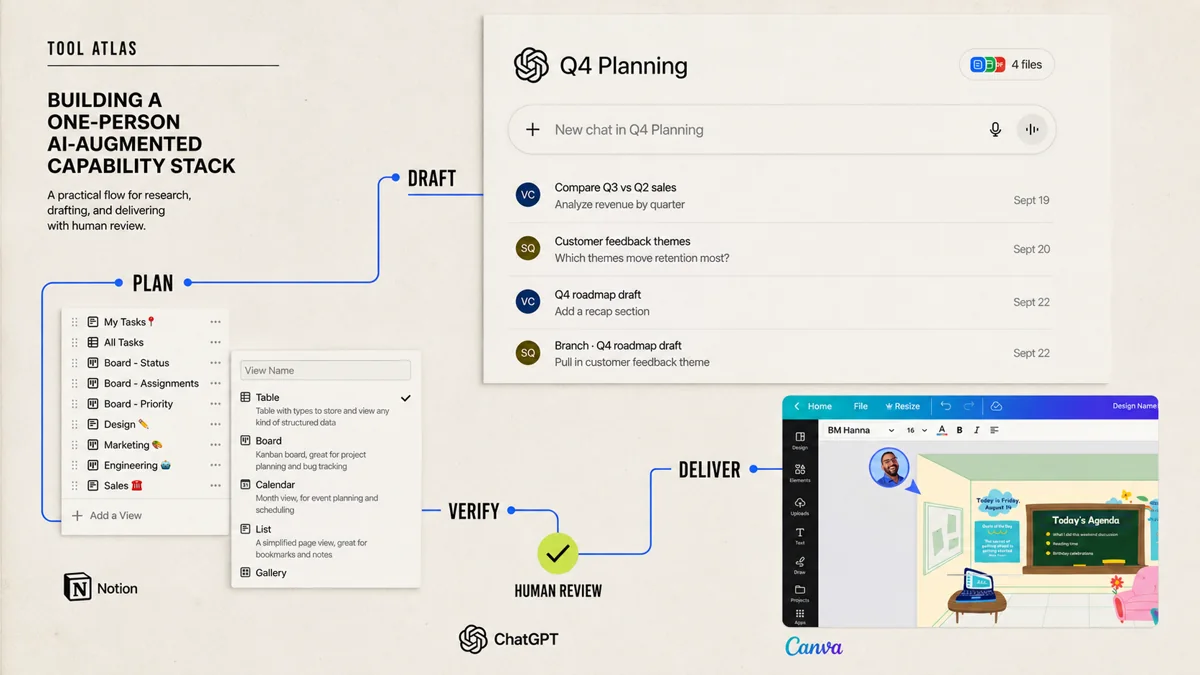
Free phase.There is no charge for the first month. Using a free general model and adding free credits to Canva, Power BI Desktop, Make or Zapier is enough to complete most introductory experiments.16, 20, 21, 22
Single subscription phase.When the free credits start to keep getting in the way and you're already saving more than ten hours per month with AI, choose a universal subscription for $8 to $20. ChatGPT Go, Plus, Claude Pro or Google AI plans all fall within the user-set monthly budget of $30.13, 14, 15
Specialization stage.Add a second subscription only if a specialized tool directly increases revenue, reduces outsourcing expenses, or significantly saves time. For example, video editors add Descript, developers add Copilot, and dubbing creators add ElevenLabs.8, 24, 18, 19
A very simple payment standard can be used:1, 9
Monthly savings value = number of hours saved × your effective hourly value + reduced outsourcing costs + new revenue.1, 9
A $20 monthly tool is not a productivity investment if it merely produces more unused content. Pay when it saves valuable time, replaces real outside cost, or helps create revenue you can verify.1, 9
Combine skills in a workflow you can repeat
It is difficult to form a long-term advantage by mastering an AI software alone. Software prices will drop, models will be updated, and others will learn from it. More lasting capabilities come from skill sets.1, 2, 3, 4
| Skill set | Applicable people | Deliverables | Getting started |
|---|---|---|---|
| AI + Industry Writing + Fact Checking | Professional, editor, marketing, consultant | Reports, white papers, emails, plans, content columns | Transform an industry document into three reader versions |
| AI + table + data narrative | Operations, Sales, Finance, Students | Weekly reports, dashboards, business analysis, research charts | Create a one-page decision brief using public data |
| AI+Design+Channel Operation | Freelancer, store owner, content creator | Posters, short video covers, social media content packages | Seven days of content production for a virtual brand |
| AI + Automation + Business Process | Administration, operations, entrepreneurs | Form circulation, email reminders, customer follow-up | Automatically complete forms to forms and then to email notifications |
| AI + code + product judgment | Students, independent developers, freelancers | Web pages, small programs, internal tools, prototypes | Make a gadget that solves your real problem |
| AI + database + learning design | student, teacher, trainer | Review system, question bank, courses and knowledge base | Convert a textbook chapter into concept maps, quizzes, and error lists |
| AI + interview + content reuse | Self-media, consulting, sales | Long articles, short posts, video scripts, email newsletters | Process an interview into five content assets |
The important shift is from asking for an answer to designing a repeatable process.1, 9
A reliable huhuman-AI collaboration process should at least include the following closed loops:1, 9
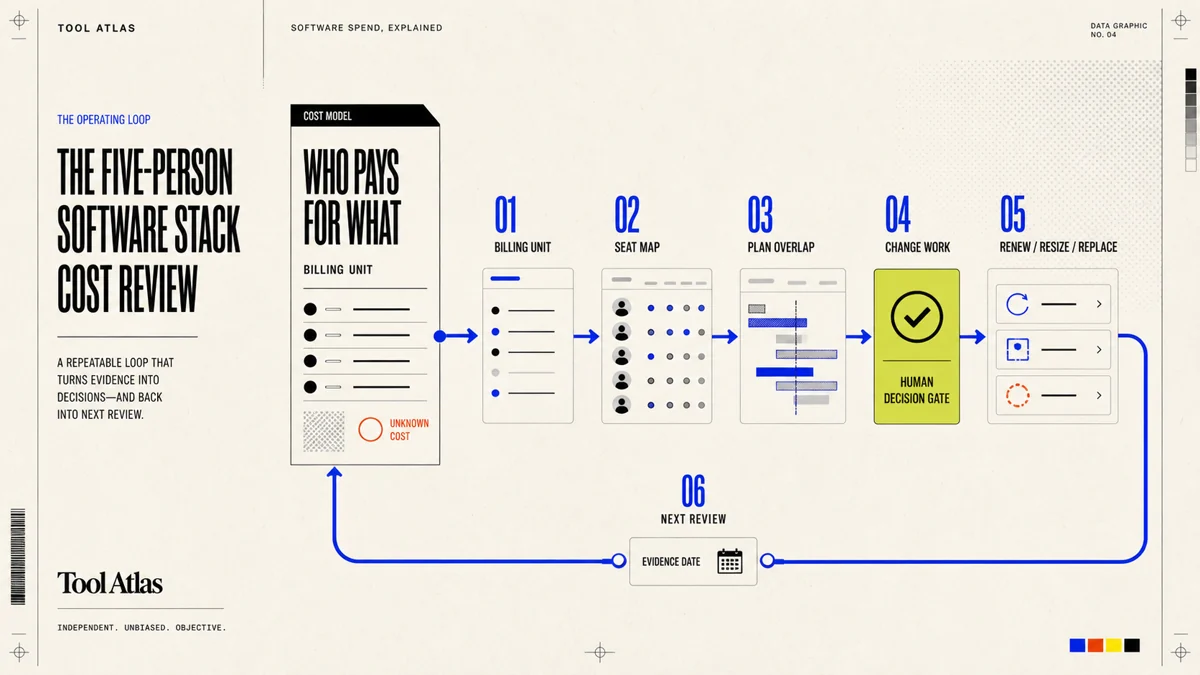
In this picture, AI mainly undertakes four types of work: expanding options, processing large amounts of material, generating first drafts, and performing repetitive operations. Humans primarily perform four other categories of work: defining problems, setting standards, verifying evidence, and taking responsibility.1, 9
Harvard Business School’s “Jagged Technology Boundary” study shows that AI capabilities do not decrease evenly from simplicity to complexity. Some seemingly difficult creative tasks, AI does very well; some seemingly ordinary logical and factual tasks, it may make steady mistakes. Users cannot judge reliability simply by whether the answers are fluent.7, 11
Therefore, people outside specialist AI roles need to create at least four of their own "operating cards".1, 9
Task Card Write down the input, output, target audience, format, deadline and mistakes that cannot be made.1, 9
Source Card specifies which conclusions must have original sources, which data must be cross-verified, and which information cannot be uploaded.1, 9
Review Card Check names, dates, amounts, units, citations, logical jumps, copyright and privacy.10, 12, 11
Review Card records the original time-consuming, the time-consuming after AI assistance, the number of modifications, error types and final results.1, 9
These cards are more valuable than a collection of hundreds of so-called "universal clues." prompts address a conversation, while work standards address repeated delivery.1, 9
Use evidence and start with bounded work
The most obvious value of generative AI is usually not to create new jobs out of thin air, but to reduce the search, drafting and iteration costs of existing jobs.1, 9
In an experiment published by Noy and Zhang in Science, when participants completed professional writing tasks such as press releases, short reports, and analysis plans, the average time spent using ChatGPT dropped by about 40%, and the quality score increased by about 18%. Notably, people with lower abilities experienced greater improvements, suggesting that AI may quickly close the output gap on common tasks.5, 1, 2, 3
In a study of 5,179 customer support workers, generative AI assistants improved the number of issues solved per hour by about 14% on average; novice and low-skilled workers saw improvements closer to 35%, while the best workers saw smaller gains. Researchers believe that AI, to a certain extent, transfers the communication patterns and solutions accumulated by outstanding employees to novices.6, 1, 2, 3
This revelation to people outside specialist AI roles is not that "AI makes experience no longer important." On the contrary: experience is changing from tacit knowledge in the individual's mind to an organizational asset that can be copied by processes, templates, and models.If a new employee only does execution, he will be more likely to be compressed; if he can actively refine experience, maintain a knowledge base, and analyze problem types, he may change from a person being automated to a person managing automation.1, 9
In an experiment at Boston Consulting Group, 758 consultants used generative AI to handle consulting tasks. Within the scope of AI capabilities, the number of tasks they completed increased by approximately 12.2%, the speed increased by approximately 25.1%, and the quality improved by more than 40%. However, on a task that AI is not good at, the possibility of AI users giving correct answers actually decreases.7
This means: The higher the risk of the work, the less likely it is to combine "generation" and "decision-making" into one step.1, 9
Below are three work methods that non-technical users can directly copy.1, 9
| Scene | Original approach | AI collaboration steps | Jobs that humans must keep |
|---|---|---|---|
| Weekly report for professionals | Recalling a week's work and piecing together the text | Collect calendars, tasks and data; let AI organize them according to "results-problems-next week's actions"; generate versions of different lengths | Check numbers, explain reasons, decide which issues need to be reported |
| Content pack for freelancers | Write long articles, short posts, scripts and titles respectively | First do a solid research; complete the core long text; then let AI convert it into short posts, emails, video scripts and image copywriting | Original opinion, case authenticity, brand tone and final release |
| student review system | Read and highlight | Upload permitted course materials; let AI create concept maps, question lists, quizzes and error feedback | Respond independently, check textbooks, and explain your reasoning process |
Taking "meeting minutes into execution plan" as an example, novices can operate as follows.1, 9
Define the output first.Don’t just say “summarize the meeting for me,” but clarify what is needed: decisions, people responsible, deadlines, open issues, and risks.1, 9
Handling of sensitive information.Delete ID numbers, contact information, customer confidentiality, contract amounts, and internal information that should not enter third-party systems.10
Traceability required.Let AI label each action item with the original recording location or timestamp, rather than just generating a smooth summary.1, 9
Generated separately.Extract the facts first, then summarize the dispute, and finally draft the email. Don't ask the AI to "analyze and make all decisions" at once.1, 9
Manual confirmation.Confirm the person in charge, deadlines and commitments item by item, especially do not let AI guess who is responsible based on vague conversations.1, 9
Create template.Keep the input format, output structure and check items that work well and reuse them directly next time.1, 9
Record earnings.Compare the time-consuming, number of omissions and number of modifications between traditional methods and AI processes. Productivity gains can only be translated into raises, offers, or operational improvements if they can be measured.1, 9
For freelancers, there’s another uncomfortable truth to recognize: some platform research has observed employment and income declines in freelance categories that are highly exposed to generative AI. The relevant evidence is still limited by the scope of the platform and the observation period, but it shows that the price of services that only sell "number of words", "number of pictures" or "basic code working hours" will be under significant pressure.1, 2, 3, 4
The solution is not to compete with the AI to see who can generate faster, but to change the units sold:1, 9
| Old way of selling | A more robust way to sell |
|---|---|
| Charge per thousand words | Charged by research depth, conversion goals and content system |
| Charge per image | Charge based on brand specifications, campaign goals, and multi-size content packages |
| Charge per minute of clipping | Charged according to topic selection, narrative, distribution and account growth plan |
| Charge per hour for writing code | Charged by runnable functionality, testing, deployment and maintenance |
| Charge per form | Charge based on data cleansing, insights, dashboards and decision value |
AI compresses production costs. If you still quote according to the production steps, customers will ask for price reductions; if you are responsible for problem solving and results, AI can actually expand your profit margins.1, 9
Plan the first 30 days, 90 days, and year
With an investment of 5 to 10 hours per week, approximately 20 to 40 hours are available in 30 days, and approximately 60 to 120 hours are available in 90 days. This is not enough time for one person to become proficient in all AI tools, but it is enough time to establish a process that can be delivered repeatedly.1, 9
Thirty days action list
| Time | Main actions | Estimated investment | Achievements that must be completed | Metrics |
|---|---|---|---|---|
| Day 1-3 | Record your main tasks during the week and mark the repetitive, time-consuming and error-prone parts. | 2-3 hours | A task list and risk score sheet | Find at least three candidate tasks |
| Day 4-7 | Choose a general model and a specialized tool, don't buy multiple subscriptions | 3-5 hours | Complete basic settings, privacy settings and folder structure | Complete three effective conversations independently |
| Day 8-14 | Select a high-frequency task and create input templates, output templates and checklists | 5-8 hours | Run the same process at least five times | Average time consumption dropped by more than 20% |
| Days 15-21 | Create three demonstrable cases: original problem, AI process, manual modifications, and final result | 5-10 hours | Three before and after comparison works | Can explain what the AI did and what it did |
| Days 22-26 | Automate a handoff, such as form-to-form, email reminder, or file archiving | 3-6 hours | A lightweight automation that runs stably | Run successfully three times in a row |
| Day 27-30 | Statistics on savings in time, errors, costs and output to determine whether to pay for upgrades | 2-4 hours | One page monthly review | Explicit tools to retain, discontinue, and improve |
Don’t pursue “AI full automation” in the first month. A reasonable goal is to reduce the time for a specific task by 20% to 40% without increasing the error rate. Research in professional writing and customer service shows that this magnitude has a basis in reality on partially structured tasks but varies widely across tasks.6
It is recommended to complete the following three categories of works in the first month:1, 9
| Works | Suitable for working people | Suitable for freelancers | Suitable for students |
|---|---|---|---|
| Informational works | Industry weekly reports, competitive product summaries | Customer research, topic selection report | Literature review, concept map |
| production works | PPT, data charts | Content packages, short videos, web pages | Presentations, study materials |
| Systematic works | Weekly report process, meeting process | Lead follow-up automation | Review and wrong question workflow |
Don’t just include the final product in your portfolio. What is more convincing is to show: the original task, constraints, tool selection, manual modifications, verification methods and quantitative results. This proves that you are not simply copying the model output, but can control the process.1, 9
Ninety Day Action List
| Time | Competence goals | Key actions | Deliverables | Outcome indicators |
|---|---|---|---|---|
| Days 31-45 | Shift from tool usage to domain expertise | Collect 20 high-quality industry materials and establish a database of terms, cases and standards | A small professional knowledge base | Common sense errors significantly reduced in AI output |
| Day 46-60 | Improve stability | Break the process into fixed steps and define input, output and failure conditions for each step | Standard Operating Procedures and Quality Checklists | Stable results after ten consecutive runs |
| Day 61-75 | Accept honest feedback | Complete three real-life tasks for a colleague, community, or client | Three real deliveries and feedback | At least one user is willing to adopt it again |
| Days 76-90 | Productization or professionalization | Package the process into a fixed service, internal proposal or open case | Service description, portfolio or job proposal | Receive one-time payment, job transfer, performance improvement recognition or interview opportunity |
Three principles should be adhered to in the first 90 days.1, 9
Only optimize high-frequency tasks.Tasks that are only done twice a year are not worth spending dozens of hours automating. Prioritize tasks that come up every week and take more than half an hour at a time.1, 9
Standardize first, then automate.If you can't write the steps clearly yourself, automation will only create chaos faster. Run the manual plus AI process five to ten times before considering Make, Zapier or n8n.21, 22, 23
Capability baseline retained.Learners especially cannot outsource all thinking to AI. Research shows that AI can improve individual creative performance, but it may also make the works of different people converge; overreliance on AI may also reduce active verification and critical thinking.9
The focus from three to twelve months is no longer on trying more tools, but on establishing four layers of barriers:1, 9
| Barrier | Construction method |
|---|---|
| Domain barriers | Continuously study an industry, customer group or problem rather than learning about AI in general |
| data barriers | Accumulate authorized cases, terms, templates, feedback and historical results |
| process barriers | Precipitate experience into a repeatable, checkable, and handover work system |
| trust barrier | Build reputation through public work, customer feedback, delivery record and accountability |
The most ideal mid-term result is not to write "Proficient in using ten AI tools" on your resume, but to be able to provide a more powerful proof:1, 9
I used a proven AI collaboration process to reduce the production time of the weekly market report from six hours to two hours; it ran continuously for twelve weeks, key data were retained from the source, the error rate did not increase, and the team was able to make decisions one day in advance.1, 9
This is closer to what companies are willing to pay for than "proficient in prompt engineering."1, 9
Set risk controls and legal boundaries
The low cost of AI tools can easily mask its external costs. One wrong customer email, one privacy breach, one wrong quote or one infringing image can cost you far more than the dozens of hours saved.10
Privacy and Trade Confidentiality.When processing natural person information in China, you need to comply with the "Personal Information Protection Law" and other regulations. ID numbers, contact information, medical information, financial information, customer lists, internal contracts, undisclosed code and business plans should not be uploaded to public AI services without authorization, corporate policies or appropriate protection measures.10
Data can be divided into three categories:1, 9
| Classification | Example | Suggestions |
|---|---|---|
| public information | Official website, public papers, public financial reports | Usually can be used for analysis, but the source should still be cited |
| internal information | Meeting minutes, internal processes, operating data | Follow company policies first and anonymize or use enterprise tools when necessary |
| highly sensitive information | Identity, medical, payment, password, client confidentiality | In principle, public AI services are not uploaded |
Facts and Responsibilities.Generative AI service management regulations require service providers to respect intellectual property rights, business secrets, personal information and legitimate rights and interests, and improve the accuracy and reliability of generated content. For high-risk scenarios such as medical, legal, financial, security, and personnel discipline, AI can only be used as a research and sorting tool, and the final judgment must be made by those with qualifications or clear responsibilities.10, 11
Generate content ID.China's "Measures for Labeling of Synthetic Content Generated by Artificial Intelligence" has been implemented on September 1, 2025, and involves setting explicit or implicit labels for generated synthetic content. When publishing AI-generated pictures, audio and video, and other content to the public, you need to pay attention to platform rules, content types, and corresponding labeling obligations. You should not deliberately delete, tamper with, or circumvent labels set in accordance with the law.12, 11
Copyright and style imitation.AI output does not automatically mean that it can be freely commercialized. Training sources, prompt inputs, generated results, platform permissions, and later modifications may all affect rights judgments. In China's judicial practice, some cases have recognized the attributes of AI picture works that reflect the user's original selection and adjustment under specific facts. However, this does not mean that all AI-generated content is automatically protected by copyright, nor does it mean that the generated content will not infringe the prior rights of others.12, 11
prompts, generated versions, manual modification records, material authorization and release date should be retained for commercial use; avoid directly imitating the unique style, well-known characters, trademarks, portraits or protected works of living artists.1, 9
Automation out of control.Do not allow unverified AI workflows to automatically execute payments, delete databases, issue contracts, promise prices, respond to major complaints, or publicly publish sensitive content. The automated system should set up amount limits, authority classification, manual approval, logs and revocation mechanisms.1, 9
Costs are out of control.Free credits and low-priced subscriptions can easily make people overlook the waste of time. The actual usage time, effective tasks completed, labor time saved and revenue generated should be calculated monthly. Paid tools that have not produced verifiable value for two consecutive months should be suspended.1, 9
Ability degradation.People who cannot make independent judgments cannot effectively check AI. Students should try to solve the problem first before asking for prompts; writers should retain interviewing and argumentation skills; programmers should understand the operating logic of generated code; analysts should be able to explain the data caliber. AI is suitable for reducing low-value friction, but is not suitable for replacing basic skills.9
Main research and reporting.For labor force trends, we mainly refer to the World Economic Forum's "Future of Jobs Report 2025", the International Labor Organization's "Generative AI and Jobs", the International Monetary Fund's analysis on AI and employment, the Organization for Economic Cooperation and Development's research on AI skills needs, and the China Academy of Information and Communications Technology's reports on artificial intelligence governance.1, 2, 3, 4
Study on productivity and capability boundaries.Mainly refer to Noy and Zhang’s professional writing experiment, Brynjolfsson et al.’s customer support research, Harvard Business School and Boston Consulting Group’s “Jagged Technology Boundary” experiment, GitHub Copilot controlled experiment, and Microsoft Research’s research on AI and critical thinking.5, 6, 7, 8
Tool information.Prices, free credits and features are mainly from the official product pages of OpenAI, Anthropic, Google, Canva, Adobe, Descript, ElevenLabs, Microsoft, Make, Zapier, n8n and GitHub. Since AI products are updated frequently, you should check the official pricing, data usage terms, commercial license and cancellation policy in your region before paying.13, 14, 16, 17
AI is lowering the price of routine output. It is also lowering the cost of learning professional methods, producing a portfolio, analyzing evidence, and building software.1, 9
The first change pressures people who sell steps. The second rewards people who define the problem, combine tools, verify the result, and deliver consistently.1, 9
The practical response is neither to defend the old workflow nor to chase every new model. It is to change the role you play:1, 9