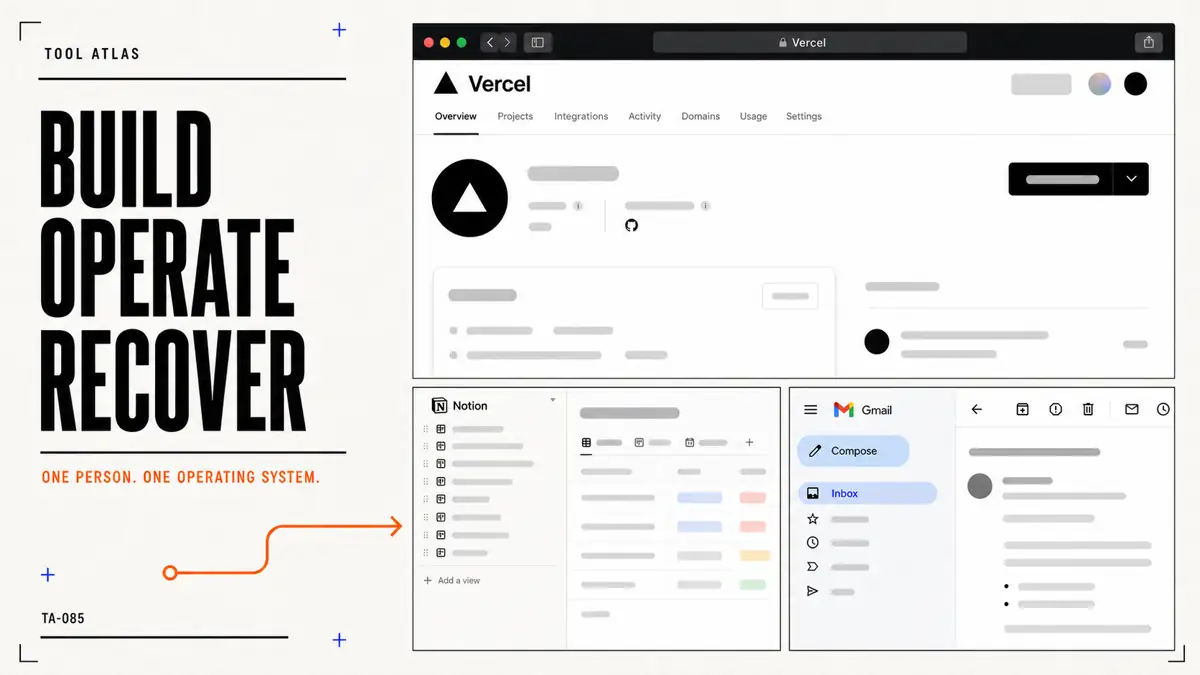
One founder still means seven operating jobs
At 08:10, a payment webhook has failed twice. A customer in Germany wants an account deleted. Last night's release raised the error rate for one browser. A contractor needs access to a repository, and the accountant is waiting for the processor-fee reconciliation. None of these jobs looks like the product demo, but any one of them can stop a one-person company.10, 22, 7
The useful definition of a one-person company is a business with one decision-making core. It does not require the founder to perform every legal, accounting, translation, security, or specialist task personally. The founder keeps judgment and final accountability while software, managed infrastructure, accountants, lawyers, and narrowly scoped contractors perform defined work.20, 21
That distinction changes the software question. A long list of subscriptions creates more accounts to secure, reconcile, and leave. A functioning operating stack gives each domain one authoritative record, routes important events through controls the founder can inspect, and makes failure recoverable without reconstructing the company from memory.7, 8, 9
| Job | System that carries the routine work | Decision the founder keeps |
|---|---|---|
| Product | Linear or another issue system | Which customer problem earns time |
| Engineering and release | GitHub, CI, managed deployment | What may enter production and when to roll back |
| Security and reliability | Identity controls, backups, Sentry, uptime monitoring | Incident severity, customer harm, and recovery priority |
| Customer support | A shared inbox or help desk | Which failures deserve product change or direct intervention |
| Revenue and finance | Payment processor plus accounting ledger | Pricing, cash risk, refund exceptions, and tax advice |
| Privacy and legal | Vendor register, request queue, signed-document repository | Data purpose, retention, contract position, and escalation to counsel |
| Contractors | Contract, identity, access matrix, and offboarding record | Scope, classification advice, acceptance, and access approval |
Give every domain one source of truth
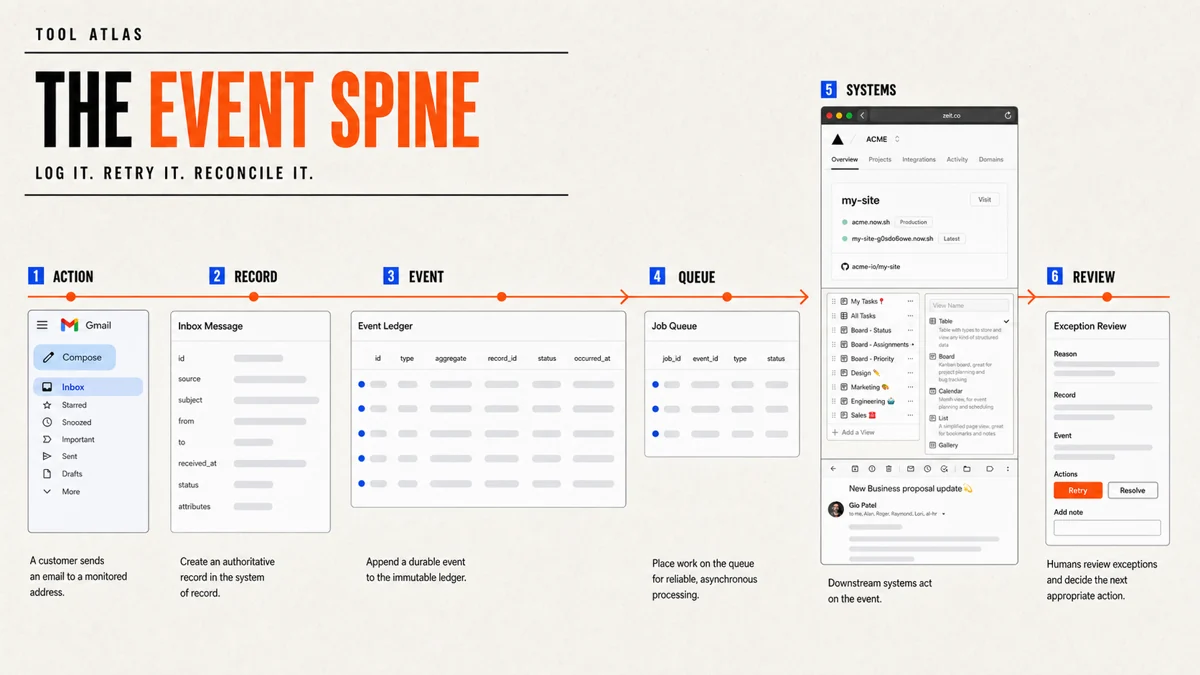
A solo company becomes fragile when twelve products each hold a slightly different version of the customer. Billing status originates in the payment platform. Product entitlements belong in the application database. The CRM may copy lifecycle state for sales convenience, but it must not silently become the authority for access. The accounting ledger must reconcile payouts, fees, refunds, and liabilities instead of treating the processor dashboard as profit.10, 15
The same rule applies to work. GitHub owns source and release history; the issue system owns commitments; a document system owns procedures and decision records. Chat, email flags, AI conversation history, and a founder's memory may help capture an idea. They should not become the only place where a customer promise, recovery step, or access decision exists.3, 1, 18
| Domain | Authoritative record | Useful derived copy | Dangerous substitute |
|---|---|---|---|
| Source and releases | GitHub repository, pull request, and release revision | Deployment notification | A local folder or AI chat |
| Planned work | Issue system with owner and outcome | Support or CRM link | Chat message or starred email |
| Product state | PostgreSQL or equivalent transactional database | Product analytics event | CRM field or spreadsheet |
| Billing | Stripe, Paddle, Lemon Squeezy, or another processor | CRM lifecycle label | Manually edited access list |
| Accounting | Xero, QuickBooks, or another double-entry ledger | Management dashboard | Gross processor revenue |
| Identity and access | Workspace identity and password manager | Contractor checklist | Shared credentials |
| Procedures and decisions | Versioned documents | Daily digest | Founder memory |
Buy managed infrastructure, keep the event spine
One founder should usually buy managed deployment, databases, authentication, email delivery, monitoring, payroll, and tax administration. Vercel, Supabase, and Cloudflare can remove months of undifferentiated infrastructure work. The trade-off is real: usage pricing can rise, vendors can change product boundaries, and provider-specific features can make exit expensive. Budget alerts, exports, a documented rollback, and a tested restore keep convenience from becoming dependence.4, 5, 6, 7
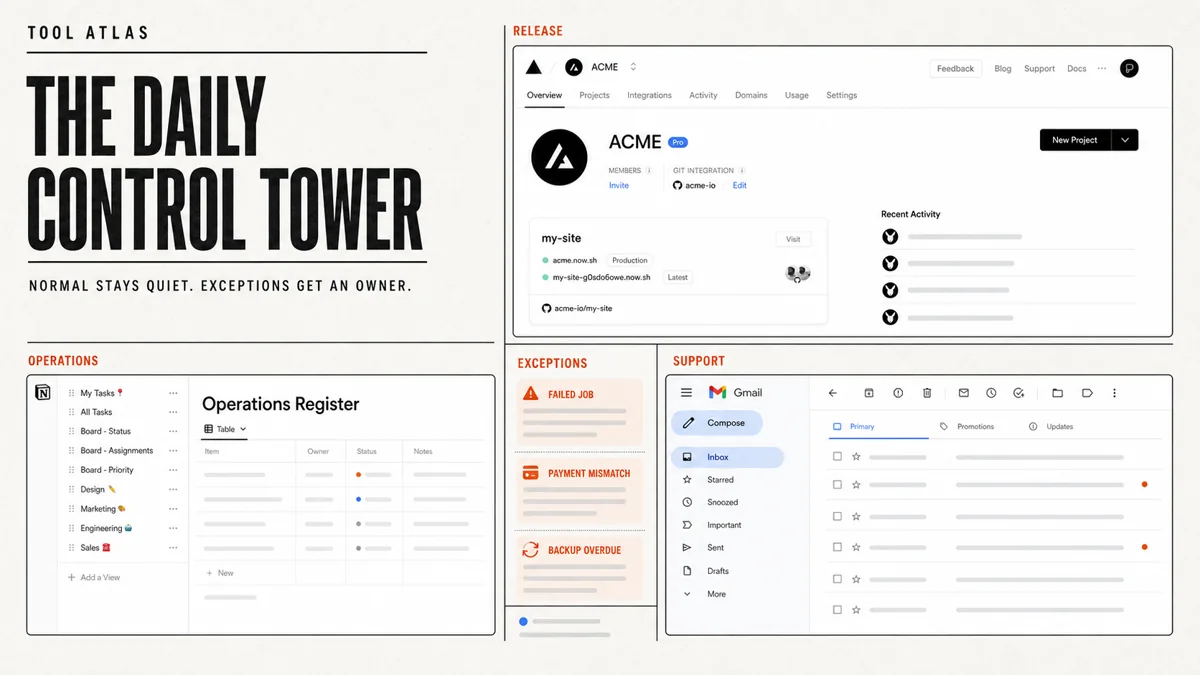
Critical events still need a route the company controls. Payment confirmations, subscription changes, account deletion, access provisioning, and security alerts should enter an owned receiver or queue before they update other SaaS products. Store the external event ID, verify signatures, make processing idempotent, retry safely, and reconcile the result. Stripe documents that live webhook deliveries can be retried for up to three days, so duplicate handling is normal production behavior rather than an edge case.10, 11
Convenience automation can remain in Zapier, Make, or n8n when a temporary failure only delays clerical work. Copying a support tag into Linear is reversible. Granting an entitlement, deleting an account, issuing an invoice, or rotating a production credential requires durable evidence and a manual fallback.19, 10, 7
- Record every consequential event before performing its side effects.
- Separate read, draft, write, publish, delete, and pay authority.
- Give each job a retry policy, dead-letter view, alert threshold, and named owner.
- Keep a manual route for correcting access, notifying customers, restoring data, and reconciling money.
- Test one restore and one rollback before the first paid launch.
Stage the stack by revenue and risk
The research model starts near $130 a month for a technically capable founder running a non-regulated SaaS or digital product. That figure excludes processor fees, AI inference, taxes, insurance, legal and accounting services, advertising, and contractors. A better-instrumented operation at repeatable revenue can reach roughly $330 to $500 a month before those variable and professional costs. Treat both figures as dated planning ranges, not checkout quotes.1, 2, 4, 5, 15
The first stack should make it possible to ship, take payment, restore data, answer a customer, close the books, and secure administrator access. It does not need enterprise sales tooling, a data warehouse, multiple chat products, or a localization platform. Add those systems when revenue, a customer contract, a recurring bottleneck, or a measured market creates the requirement.7, 8, 16
| Stage | Minimum operating stack | Add only when | Planning range |
|---|---|---|---|
| Validation | Workspace identity, password manager, GitHub, one issue queue, managed hosting and database, backups, payments, accounting, basic analytics, support address | A paid customer or material data creates a real operating duty | About $130 per month before variable and professional costs |
| Repeatable revenue | Error tracking, uptime monitoring, help desk, lifecycle email, stronger access controls, signed documents, monthly reconciliation | Support volume, revenue, or incident cost justifies instrumentation | About $330 to $500 per month before variable and professional costs |
| Managed contractor | Contract workflow, identity lifecycle, least-privilege vaults, access review, offboarding evidence | A recurring bottleneck has a bounded outcome | Add roughly $29 to $49 per contractor monthly, excluding compensation |
| EOR employee | Employer-of-record administration, payroll, benefits, local compliance support, manager cadence | The work needs genuine employment and sustained responsibility | Add roughly $599 to $699 monthly before salary and statutory costs |
| Enterprise-facing | Security evidence, stronger logging, vendor reviews, penetration testing, specialist counsel, possible assurance work | Contract value and buyer scrutiny pay for the ongoing control burden | Quote and scope separately; one-time professional costs may dominate |
Choose the global boundary before the global tools
“Global” should first mean that eligible customers can buy the product, not that the company has localized every market. Start English-first, publish the supported jurisdictions and currencies, and restrict places the company cannot serve safely. Local payment methods, translated support, regional contracts, and local entities should follow measurable demand.22, 23
Payments force an early operating choice. A direct processor such as Stripe gives the company more billing control, while the seller remains responsible for understanding registration, tax, filing, invoices, and the commercial record. A merchant of record such as Paddle or Lemon Squeezy can become the seller for covered transactions and take on more payment and tax administration in exchange for a larger transaction charge. The correct answer depends on customer type, geography, invoice requirements, transaction size, and the founder's finance capacity.12, 13, 14, 23
Privacy also follows the customer, not the incorporation trend. European rules can apply when a company offers goods or services to people in the EEA or monitors them. The cheapest control is data minimization: collect fewer fields, retain them for a stated period, keep a vendor register, and rehearse access, export, correction, and deletion across every system that holds a copy.22, 7
Hiring across borders needs its own decision. Contractor-management and employer-of-record platforms organize contracts, invoices, payroll, and country workflows; they do not erase classification, permanent-establishment, management-and-control, or personal tax questions. Pay for jurisdiction-specific advice before the working relationship makes the answer expensive.20, 21, 24
| Question | Lower-complexity route | Trigger for a heavier route |
|---|---|---|
| Payments | Merchant of record for globally distributed low-headcount digital sales | Direct processing when B2B contracts, invoices, or scale justify finance operations |
| Localization | English-first product with supported-market disclosure | One market produces enough revenue or friction to fund translation, support, tax, and legal work |
| Privacy | Minimize collection, document purpose and retention, maintain request workflow | Sensitive data, enterprise contracts, or regulatory scope requires specialist review and stronger controls |
| Hiring | Bounded contractor outcome with reviewed agreement and access matrix | Ongoing managed work, local labor rules, or customer requirements call for employment or an EOR |
| Entity and tax | Form and operate with advice tied to where the founder lives and manages the company | Sustained local presence, staff, inventory, or contracts create a documented reason for another structure |
Run one control tower instead of twenty notifications
The founder needs one daily exception digest: failed jobs, overdue webhooks, error rate, uptime breaches, urgent support, failed payments, available cash, and backup age. Successful backups, normal purchases, every signup, and every deployment should remain searchable without interrupting the day. Page the founder for customer harm, security risk, exhausted retries, money divergence, and loss of recovery.9, 10, 7
The first work block should go to the week's highest-leverage product or engineering outcome before general communication opens. Process support in reliable windows, turn repeated confusion into documentation or product work, and keep a short administrative window for contracts, bookkeeping exceptions, and vendor tasks. A fifteen-minute close records decisions, checks silent automation failures, and chooses tomorrow's first outcome.1, 17, 3
Monthly operations need more than a dashboard review. Reconcile processor balances to bank deposits, inspect refunds and disputes, close the ledger, confirm tax reserves, restore a backup in an isolated environment, review account changes, and sample data export and deletion. Quarterly, ask which vendor has become dangerous, which data no longer has a purpose, and which recurring work needs elimination, automation, a specialist, or a hire.15, 7, 22
- Daily: review exceptions, protect two focused work blocks, process support, and close the capture inbox.
- Weekly: review cash, activation, retention, support load, reliability, and one distribution channel; commit to one product outcome.
- Monthly: close the books, restore data, reconcile payments, review access, and sample privacy workflows.
- Quarterly: review vendor dependence, unused data, jurisdiction cost, founder-only knowledge, and the next operating bottleneck.
| Signal | Daily question | Escalate when |
|---|---|---|
| Jobs and webhooks | Is any consequential event unprocessed beyond its service target? | Retries are exhausted, duplicates diverge, or money and access disagree |
| Reliability | Did error rate, latency, or uptime move outside the accepted range? | Customers are blocked, data may be wrong, or rollback is required |
| Security | Did administrator access, secrets, dependencies, or unusual logins change? | Privilege is unexplained or containment is needed |
| Support | Is a critical ticket open, or is one confusion pattern repeating? | Harm is ongoing or several accounts share the same failure |
| Finance | Do payouts, fees, refunds, liabilities, and bank deposits reconcile? | Cash or tax exposure cannot be explained |
| Recovery | How old is the latest verified backup and restore test? | The recovery point exceeds the written limit |
Stay solo only while the operating model still works
Solo founders often treat headcount as a failure of leverage. The better test is whether one decision-making core can still meet the product's obligations. A recurring function that needs specialist judgment, local presence, continuous coverage, or sustained creative energy may deserve a contractor, employee, or partner even when software could automate part of it.20, 21
Key-person risk arrives before hiring. If only the founder can access production, understand billing, contact the bank, restore the database, or explain a customer contract, the company has an undocumented single point of failure. Independent backups, emergency access, signed ownership records, decision logs, and rehearsed recovery reduce that risk without creating a large organization.7, 3, 10
Before the next annual plan, print one page that answers four questions: What can stop the company from taking orders? What can cause irreversible customer harm? What can create an unpayable legal or tax liability? Which work still depends on information that exists only in the founder's head? The next software purchase should follow one of those answers.7, 22, 24
- Keep the company solo when focus, margins, service quality, and recovery remain healthy.
- Add a specialist when a bounded, high-consequence task exceeds the founder's judgment.
- Hire when a recurring responsibility needs continuity, ownership, and shared context.
- Narrow or sell when the product portfolio consumes attention without earning its operating complexity.